
A packaging line food safety audit checklist fails the moment an auditor walks past the conference room binders and finds an unlabeled grease gun on a maintenance cart, a chipped cutoff blade inside a vertical bagger, or a bypassed reject confirmation photo-eye on the takeaway conveyor. Unverified contact polymers, cross-contaminated industrial lubricants, and sluggish pneumatic reject pushers cause immediate major non-conformities, forced lot quarantines, and costly customer rework.
While our parent food-equipment evidence checklist establishes how to separate dated records, laboratory test reports, and unverified sales claims during pre-purchase document reviews, this operational guide provides the floor-level inspection protocol for internal quality assurance teams and packaging supplier audit leads. It maps Global Food Safety Initiative (GFSI) benchmarked clauses in BRCGS Food Safety Issue 9 (Clauses 4.6 through 4.10) and SQF Food Safety Code: Food Manufacturing Edition 9 (Module 11) directly to physical checkpoints across vertical form-fill-seal (VFFS) baggers, horizontal flow wrappers (HFFS), rotary pre-made pouch machines, thermoform-fill-seal (TFFS) lines, and multihead combination weighers.
| Audit Pillar | GFSI Clause Mapping (BRCGS Issue 9 / SQF Ed. 9) | Required Documentary Evidence (Dated Record) | Physical Line-Side Verification & Threshold | Dominant Failure Mode & Prevention |
|---|---|---|---|---|
| 1. Food-Contact Materials | BRCGS Clauses 4.6.2 & 4.6.6 / SQF Clause 11.2.9 | Part-numbered Declarations of Compliance (DoC) per FDA 21 CFR 174-177 or EU 10/2011 (OML <= 10 mg/dm2); EN 10204 3.1 mill certificates for AISI 304/316L steel |
Cross-check installed wear part lot numbers (belts, suction cups, PTFE tape, silicone seals); verify contact metal finish Ra <= 0.8 um (32 uin) |
Supplier files an EU 10/2011 plastics declaration for stainless chutes or generic unlinked catalog sheets; enforce part-level BoM serialization |
| 2. NSF H1 Lubricant Control | BRCGS Clauses 4.7.4 & 4.9.1 / SQF Clause 11.6.4 | Current NSF White Book H1 / 3H registration letters, SDS files, ISO 21469 certificates, and monthly PM lubricant checkout vs usage ledgers | Verify color-coded H1 grease guns, locked H1 vs H2 cabinets, bearing drip pans, and ISO 8573-1 Class 1.2.1 (<= 0.01 mg/m3 oil) point-of-use air filters |
Night-shift grab error using heavy-metal H2 grease or over-greasing overhead bearings; lock H2 cages and run monthly mass-balance reconciliation |
| 3. Glass, Brittle Plastic & Blades | BRCGS Clauses 4.9.3 & 4.9.4 / SQF Clauses 11.7.4 & 11.7.5 | Plant Brittle Material Register and Serialized Knife Log with shift-start and shift-end signed visual inspection sheets | Confirm guards are ductile polycarbonate (PC), photo-eyes use IP69K PESU/PPSU, HMIs carry shatter film, and VFFS/HFFS blades bear laser-etched IDs |
Acrylic (PMMA) guards shatter into X-ray-invisible shards (1.18 g/cm3) or chipped VFFS knife teeth enter pouches; ban PMMA and snap-off blades |
| 4. Fail-Safe Reject Mechanics | BRCGS Clause 4.10.3 / SQF Clause 11.7.6 | Shift challenge test logs covering leading/center/trailing packs, consecutive reject timing, fault interlocks, and bin count reconciliation | Execute 5-point physical challenge: back-to-back packs (t_cycle < t_gap), reject verify eye (t_reject +/- 50 ms), bin-full sensor, and < 4.5 bar air cutout |
Testing only coil/X-ray alarm LEDs while a jammed pusher or low air pressure lets contaminated packs pass; wire all fault sensors to halt the belt |
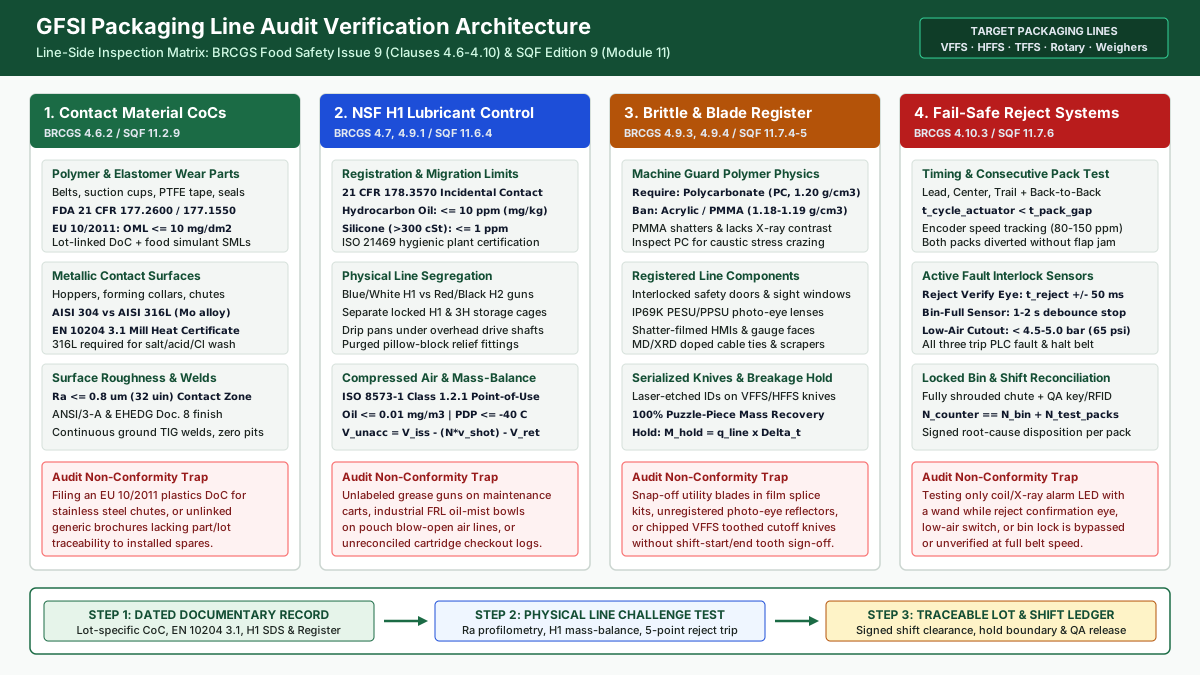
1. GFSI packaging line clause mapping and food-contact material verification
Key takeaway: Every polymer wear component and metallic product-contact surface on a packaging machine must link by part number and purchase lot to a material-specific regulatory compliance declaration; generic vendor statements that “all machine parts are food grade” fail BRCGS Clause 4.6.2 and SQF Clause 11.2.9.
During a packaging supplier audit or pre-commissioning Factory Acceptance Test (FAT), auditors inspect the Bill of Materials (BoM) for every surface that directly contacts unpacked food, primary packaging film interiors, or open headspace zones above filling funnels. Under BRCGS Food Safety Issue 9 Clause 4.6.2 and SQF Edition 9 Clause 11.2.9, equipment must be constructed of materials that prevent chemical migration, flaking, or corrosion under actual operating temperatures and sanitation chemistries.
High-risk contact wear parts across packaging machinery
Unlike static storage tanks, high-speed packaging lines rely on elastomeric and polymeric wear components that abrade, flex, and undergo thermal cycling every shift. Auditors must trace individual Certificates of Compliance (CoC) or Declarations of Compliance (DoC) for five primary equipment groups:
- Vertical Form-Fill-Seal (VFFS) baggers: Forming shoulders and collars (stainless steel or low-friction polymer linings), vacuum or friction film pull-down belts, silicone jaw backings, PTFE-coated fiberglass barrier tapes over horizontal and vertical heat-seal bars, and internal product settling chutes.
- Horizontal Form-Fill-Seal (HFFS) flow wrappers: Infeed flight lugs and pusher attachments, stainless dead-plates, fin-seal guide assemblies, and rotary crimper elastomer inserts.
- Rotary pre-made pouch machines: Elastomeric vacuum suction cups that grip and pull open pouch mouths, internal stainless dosing funnels, and compressed-air blow-open nozzles.
- Thermoform-Fill-Seal (TFFS) lines: Deep-draw forming cavity inserts, silicone vacuum chamber perimeter gaskets, upper web heat-seal membranes, and trim removal guides.
- Multihead combination weighers: Vibratory dispersion cones, radial feeder pans, pool and weigh hopper buckets, silicone or PTFE dust seals, and steep-angle discharge chutes.
Polymer vs metallic compliance documentation (FDA 21 CFR & EU 10/2011 vs EN 10204 3.1)
A recurring non-conformity in packaging equipment files is the submission of mismatched regulatory declarations. Auditors must verify that the compliance standard matches the exact material class of the component:
- Polymers, elastomers, and fluoropolymers: Under U.S. jurisdiction (21 CFR Part 174 through Part 177), declarations must cite the exact substance section and extraction conditions, such as 21 CFR 177.2600 for rubber articles intended for repeated use (silicone gaskets, nitrile/EPDM vacuum suction cups, pull-down belts) or 21 CFR 177.1550 for perfluorocarbon resins (PTFE sealing tapes and Hopper liners). Under European Union rules, plastic contact parts must carry a Declaration of Compliance conforming to Framework Regulation (EC) No 1935/2004 and Commission Regulation (EU) No 10/2011, documenting that the Overall Migration Limit (
OML <= 10 mg/dm2of contact surface, or<= 60 mg/kgin food simulants) and substance-specific migration limits (SML) were verified using representative food simulants (e.g., Simulant A: 10% ethanol; Simulant B: 3% acetic acid; Simulant D2: vegetable oil) at worst-case contact time and temperature. - Category error trap (EU 10/2011 on metals): Suppliers frequently issue a blanket statement claiming “EU 10/2011 compliance” for stainless steel multihead weigher buckets or forming collars. EU 10/2011 applies exclusively to plastics. Accepting a plastics migration declaration for a metallic chute invalidates the supplier evidence file.
- Austenitic stainless steels (AISI 304 vs AISI 316L) and surface finish: Metallic food-contact parts require an EN 10204 Type 3.1 inspection certificate from the steel mill linking the chemical composition and mechanical properties to the specific heat number stamped or recorded on the fabrication drawing, alongside Good Manufacturing Practice (GMP) conformance under Regulation (EC) No 2023/2006. Standard dry-product chutes and VFFS forming tubes typically use AISI 304 (1.4301) austenitic stainless steel. However, lines handling high-salt, pickled, acidic (
pH < 4.5), or chlorinated-foam washdown products require molybdenum-alloyed, low-carbon AISI 316L (1.4404) to prevent chloride pitting corrosion and intergranular weld-zone sensitization. - Surface roughness threshold (
Ra <= 0.8 um): Product-contact stainless surfaces and ground TIG welds must maintain an arithmetic mean roughness ofRa <= 0.8 um(32 uin), free of pinholes, cold laps, or unground weld spatter in accordance with ANSI/3-A Sanitary Standards and EHEDG Doc. 8 principles. Where equipment undergoes wet sanitation or automated flushing, pair this surface finish check with the cleanability of packaging equipment review and clean-in-place validation records.
2. NSF H1 lubricant verification protocol and mass-balance audit
Key takeaway: Effective NSF H1 lubricant verification requires proving both formulation compliance under 21 CFR 178.3570 and physical line segregation from industrial H2 oils, backed by ISO 8573-1 Class 1.2.1 compressed-air filtration and monthly mass-balance reconciliation of maintenance grease logs.
Mechanical packaging systems contain high-load cam followers, linear guide rails, eccentric drive shafts, and pneumatic actuators positioned directly above or adjacent to open packaging film webs and filling hoppers. Under BRCGS Clause 4.7.4 / 4.9.1 and SQF Clause 11.6.4, chemical contamination from machinery lubrication is a primary audit target.
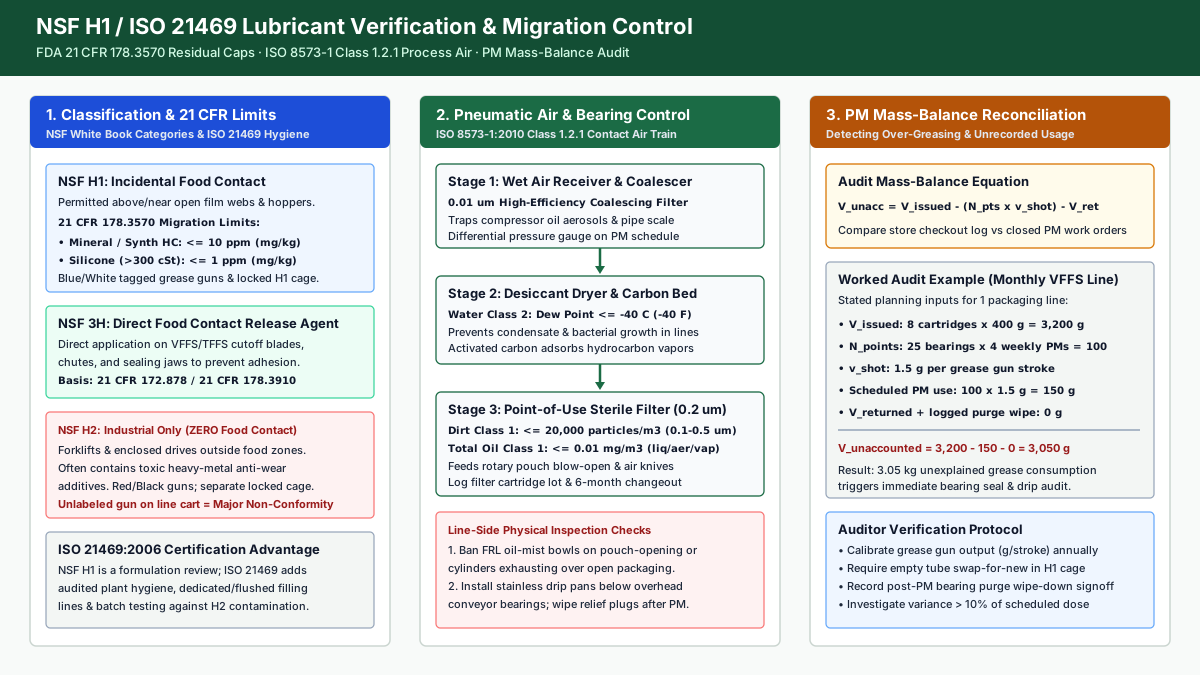
Regulatory limits: FDA 21 CFR 178.3570, NSF H1/H2/3H, and ISO 21469
Auditors must verify that plant maintenance teams and equipment OEMs distinguish between three NSF International nonfood compound registration categories and understand the residual migration caps established in 21 CFR 178.3570:
- NSF H1 (Incidental food contact): Formulated exclusively from approved base stocks, thickeners (such as aluminum complex, calcium sulfonate, or PTFE), and additives listed in 21 CFR 178.3570. H1 lubricants are required on any bearing, chain, or slide where incidental contact with food or open primary packaging is technically unavoidable. The regulation mandates applying the minimum quantity necessary for the technical effect and sets strict maximum residual migration limits in the food product:
- Hydrocarbon base stocks and mineral oils:
<= 10 ppm(10 mg/kg) maximum residual in food. - Dimethylpolysiloxane (silicone fluids with viscosity > 300 cSt):
<= 1 ppm(1 mg/kg) maximum residual in food.
- Hydrocarbon base stocks and mineral oils:
- NSF 3H (Direct food contact release agents): Governed by 21 CFR 172.878 (white mineral oil) or 21 CFR 178.3910 (surface lubricants used in the manufacture of metallic articles), 3H compounds are edible oils or USP-grade mineral oils permitted for continuous direct contact on TFFS cross-cut blades, VFFS knives, or sticky confectionery chutes to prevent product adhesion.
- NSF H2 (No food contact permitted): Industrial lubricants restricted to enclosed gearboxes on palletizers, forklifts, or utility equipment located outside food and primary packaging zones. H2 oils and greases frequently contain toxic heavy-metal anti-wear additives, antimony, or zinc dialkyldithiophosphate (ZDDP). Using an H2 lubricant on a packaging line above open product triggers an immediate critical non-conformity and product recall review.
- ISO 21469:2006 hygienic manufacturing certification: While NSF H1 registration evaluates the chemical formula on paper, ISO 21469:2006 (Safety of machinery: Lubricants with incidental product contact, Hygiene requirements) requires unannounced third-party plant audits of the lubricant manufacturer, verifying dedicated or validated flushed filling lines, filtration, and batch testing so H1 cartridges are never cross-contaminated with H2 residues at the blending plant.
Five floor-level NSF H1 lubricant verification checkpoints
During the line walk, an auditor does not stop at reading the Safety Data Sheet (SDS) binder. Execute these five physical and documentary checks:
- Color-coded and tagged grease guns: Every manual or battery-powered grease gun, oil can, and transfer pump must carry a permanent color band (for example, high-visibility blue or white for NSF H1; red or black for industrial H2) and a durable metal or laminated tag matching the exact lubricant part code and 6-digit NSF registration number printed on the cartridge inside. An unlabeled grease gun or a hand-written squeeze bottle on a technician’s cart is an automatic audit failure.
- Segregated, locked storage cabinets: NSF H1 lubricants and 3H release agents must be stored in a dedicated, locked cabinet physically separated from H2 industrial lubricants, penetrating oils, and sanitation chemicals. Separate keys or badge permissions prevent night-shift mechanics from grabbing an industrial aerosol can during an urgent line breakdown.
- Overhead bearing drip pans and purge plugs: Inspect pillow-block bearings on incline bucket elevators, overhead multihead weigher frames, and rotary turret drives. Pumping excessive grease into a sealed bearing blows out the elastomeric lip seal, causing grease globules to hang from the housing and drip into open forming tubes or pouches. Verify that stainless catch pans are mounted beneath overhead drives and that maintenance SOPs require wiping bearing relief plugs clean before line restart.
- Pneumatic air-line lubricators and ISO 8573-1:2010 Class 1.2.1 filtration: Compressed air that blows open pre-made pouches, actuates air knives, or exhausts from pneumatic cylinders directly over open packaging zones is a direct vector for oil aerosols, condensed water, and pipe rust. Standard industrial FRL (Filter-Regulator-Lubricator) oil-mist bowls must never be installed on air lines feeding packaging zones. Point-of-use process air must be verified against ISO 8573-1:2010 Purity Class 1.2.1:
- Solid particulates (Class 1):
<= 20,000 particles/m3in the0.1 to 0.5 umsize band,<= 400 particles/m3in the0.5 to 1.0 umband, and<= 10 particles/m3in the1.0 to 5.0 umband, achieved via0.01 umcoalescing and0.2 umsterile point-of-use hydrophobic membrane filters. - Humidity and liquid water (Class 2): Pressure dew point
PDP <= -40 C(-40 F) via twin-tower desiccant drying to prevent liquid condensate and microbial biofilm growth inside stainless drop lines. - Total oil (Class 1):
<= 0.01 mg/m3combined liquid, aerosol, and hydrocarbon vapor concentration, requiring activated carbon adsorption towers upstream of the final sterile filter.
- Solid particulates (Class 1):
- Mass-balance reconciliation of lubricant logs: Auditors cross-reference storeroom inventory issue logs against completed Preventive Maintenance (PM) work orders to detect unrecorded over-greasing or blown seals.
Lubricant mass-balance formula:
V_unaccounted = V_issued - (N_points x v_shot) - V_returned
Worked calculation example (stated planning assumptions for a VFFS packaging line):
Suppose the maintenance storeroom log shows 8 cartridges of NSF H1 aluminum-complex grease (400 g per cartridge, so V_issued = 3,200 g) checked out to Packaging Line 2 over a 4-week audit period. The machine PM schedule specifies 25 lubrication points greased weekly (N_points = 25 x 4 = 100 point-events) using a calibrated grease gun delivering v_shot = 1.5 g per stroke (150 g total scheduled application), with V_returned = 0 g and zero purged waste logged.
V_unaccounted = 3,200 g - (100 x 1.5 g) - 0 g = 3,050 g
An unexplained variance of 3,050 g (3.05 kg) proves that technicians are either pumping excessive grease past blown bearing seals into the machine frame or using Line 2’s checkout code for untracked repairs. Threshold rule: if unaccounted lubricant mass exceeds 10% of scheduled PM consumption (V_unaccounted > 0.10 x N_points x v_shot), initiate an immediate physical inspection of overhead bearing seals and require empty-for-full cartridge exchange control.
3. Glass, brittle plastic, and packaging blade register
Key takeaway: Polymethyl methacrylate (PMMA / acrylic) is prohibited on packaging line guards and sight windows because it shatters into transparent shards (1.18 to 1.19 g/cm3) that X-ray detectors cannot distinguish from food; every guard, sensor lens, and laser-serialized cutoff knife must be tracked on a shift-verified register.
Under BRCGS Issue 9 Clauses 4.9.3 and 4.9.4 and SQF Edition 9 Clauses 11.7.4 and 11.7.5, facilities must maintain a risk-based register of all glass, brittle plastic, ceramics, and cutting blades in open product and primary packaging zones. On high-speed packaging lines, transparent machine enclosures, optical sensors, and toothed cutoff knives present acute physical contamination risks that tie directly to our foreign-material control limits.
Engineering distinction: polycarbonate (PC) vs acrylic (PMMA) and detectable polymers
Auditors inspecting OEM or retrofit safety guarding must verify the exact polymer specification on the mechanical engineering drawings rather than accepting generic descriptions like “clear plastic guard” or “Perspex window”:
- Why acrylic (
PMMA) is a critical hazard: Polymethyl methacrylate (acrylic, sold under trade names such as Perspex or Plexiglas) exhibits low impact toughness (Izod impact ~16 to 21 J/m) and fails by catastrophic brittle fracture when struck by a wrench, jammed cylinder, or thermal shock. Worse, PMMA has a bulk density of1.18 to 1.19 g/cm3, which is virtually identical to water (1.00 g/cm3) and typical food products (0.95 to 1.25 g/cm3). Because X-ray inspection relies on differential mass attenuation (mu / rho), shattered acrylic splinters inside a pouch produce zero usable X-ray contrast, are non-conductive in metal detectors, and are optically invisible against moist foods. - Why polycarbonate (
PC) requires crazing checks: Uncoated polycarbonate (PC, density~1.20 g/cm3) provides15 to 20 timesthe notched impact strength of acrylic (~600 to 850 J/m) and yields by ductile deformation (bending or denting) rather than shattering into loose fragments. However, repeated washdown with high-alkaline caustic detergents, quaternary ammonium compounds, or solvent wipe-downs causes environmental stress cracking (chemical crazing), visible as micro-fissures around bolted hinges and latch mounting holes. Crazed polycarbonate loses its ductile impact margin and must be scheduled for replacement on the Brittle Material Register. - Metal-detectable and X-ray-detectable (
MD/XRD) line accessories: Small polymeric components used in or above open packaging paths (cable ties securing pneumatic airlines, hopper scrapers, hand scoops, pen housings, and sensor mounting clips) must be molded from engineered polyamide, acetal (POM), or polypropylene compounded with micro-dispersed iron oxide or stainless/barium sulfate fillers, verified in the plant’s test file at the line detector’s actual aperture sensitivity.
Mandatory items on the packaging line Brittle Material and Blade Register
An audit-ready packaging line register maps every item by line number, zone, material specification, and inspection frequency:
| Register Category | Specific Packaging Line Components | Engineering Material & Marking Requirement | Mandatory Inspection Cadence |
|---|---|---|---|
| Interlocked Safety Guards & Windows | VFFS jaw enclosure doors, HFFS rotary crimper covers, TFFS forming/sealing station hoods, multihead weigher enclosures | Verified Polycarbonate (PC, min 6 to 10 mm thickness); zero acrylic (PMMA); inspect bolted hinges for caustic stress crazing |
Weekly to monthly signed audit (risk-based by vibration and washdown exposure) |
| Hopper Sight Glasses & Level Windows | Product surge hoppers, liquid filler bowls, auger filler agitation vessels | Tempered borosilicate glass with external bonded shatter-containment sleeve, or thick machined PC/PSU |
Daily or shift-start visual check |
| Photo-Eyes, Reflectors & Vision Cameras | Film registration mark sensors, infeed pack-gap photo-eyes, reject chute eyes, prismatic reflectors, barcode vision domes | Shatterproof IP69K-rated PESU (polyethersulfone) or PPSU (polyphenylsulfone) lenses; protective stainless shrouds over reflectors |
Shift-start and post-washdown visual check |
| HMI Screens & Pressure Gauges | Operator touchscreen panels (HMI), vacuum/pressure dial gauges on thermoformers and pneumatic manifolds |
Bonded anti-splinter polymer overlay film on all glass capacitive/resistive HMIs; laminated shatterproof faces on dial gauges | Weekly register inspection |
| Packaging Cutoff & Slitter Knives | VFFS toothed zigzag cutoff knives, HFFS rotary anvil blades, TFFS cross-cut/longitudinal circular slitters, film-splicing cutters | Unique laser-etched serial number on every blade; strict prohibition of multi-segment snap-off utility knives in packaging zones | Shift-start, shift-end, and post-jam signed visual check for chipped teeth |
Breakage quarantine and 100% puzzle-piece reconstruction protocol
When a registered VFFS serrated cutoff knife loses a tooth or a photo-eye reflector cracks during production, BRCGS Clause 4.9.3.4 and SQF Clause 11.7.4 mandate an immediate, documented emergency response before the line can restart:
- Immediate line stop and physical quarantine radius: Halt the packaging machine and takeaway conveyors immediately. Establish a physical quarantine zone (minimum
3 to 5 metersradius around floor-level stations, or the entire machine cell plus downstream conveyors if the breakage occurred on an elevated multihead weigher platform). - 100% puzzle-piece mass recovery test: Retrieve the damaged blade or plastic housing and place all recovered fragments on a high-contrast gridded inspection mat. For a chipped VFFS knife or fractured guard, QA and maintenance must physically reassemble the pieces (puzzle-piece reconstruction) or weigh the fragments against the baseline part mass to determine whether
100%of the missing material has been recovered outside the product stream. - Mandatory product hold calculation back to last intact check: If any fragment or single serrated blade tooth (
typically 1.5 to 3.0 mmtriangular tool steel) is unaccounted for, every package produced since the last signed intact blade/brittle inspection must be placed on formal quality hold via the plant’s coding and lot records and lot number tracking and 4-hour mock recall protocol:M_hold = q_line x Delta_t- Worked planning example: If a VFFS bagger runs
85 packs/minat0.50 kg/pack(q_line = 42.5 kg/min) and a missing knife tooth is discovered at the 4-hour (240 min) shift-end check with no mid-shift check recorded, the mandatory hold volume is42.5 kg/min x 240 min = 10,200 kg(20,400 pouches). Increasing signed visual blade checks (or installing automated jaw-torque/cut-verify monitoring) from every 8 hours to every 2 hours cuts maximum exposure by75%.
- Line clearance and QA release sign-off: Strip and discard any open film roll, vacuum and wipe down the forming tube and sealing jaws (never use compressed air to blow fragments across the room), install a newly serialized blade from the locked tool crib, and record a signed QA release before resuming production.
4. Fail-safe reject system challenge testing (beyond the test wand)
Key takeaway: Passing ferrous, non-ferrous, and stainless steel test wands through a detector aperture proves only sensor signal generation; GFSI audits require 5-point mechanical challenge testing of the reject actuator, confirmation photo-eye, bin-full sensor, low-air-pressure cutout switch, and locked bin reconciliation at maximum line speed.
Our companion guide on food metal detector vs X-ray sensitivity details how product conductivity, temperature, and JIMA test-piece geometry govern sensor detection thresholds. However, during a BRCGS Issue 9 (Clause 4.10.3) or SQF Edition 9 (Clause 11.7.6) audit, the most frequent major non-conformities occur after the sensor detects the contaminant: the detector flashes red, the solenoid clicks, and the contaminated package continues straight down the conveyor into finished-goods palletizing.
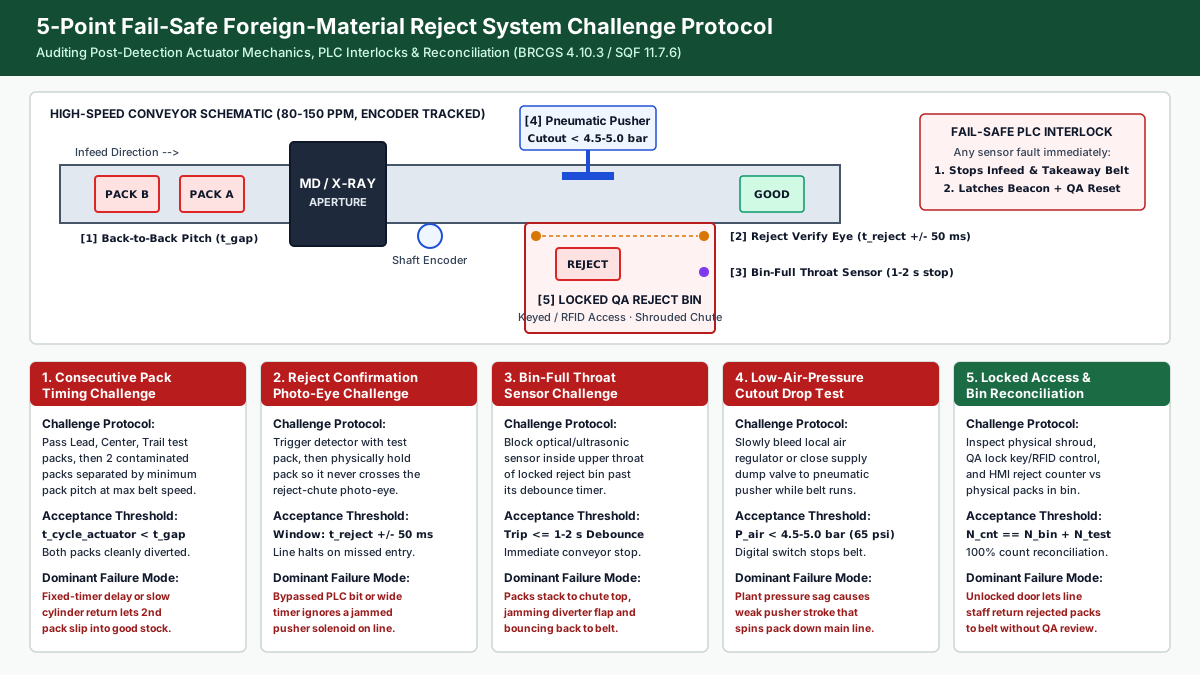
The 5-point fail-safe reject challenge protocol
To satisfy GFSI fail-safe requirements, operators and auditors must challenge the complete closed-loop rejection sequence using certified test pieces inserted into actual production packages:
- Reject Timing and Back-to-Back Consecutive Pack Challenge:
- Protocol: Pass representative packs carrying certified Ferrous (
Fe), Non-Ferrous (Non-Fe), and Stainless Steel (AISI 316) or glass/ceramic test spheres positioned at the Leading Edge, Center, and Trailing Edge of the pack. Immediately follow with a Consecutive Pack Challenge: feed two contaminated test packs separated by the minimum normal production pitch at maximum rated conveyor speed (for example,80 to 150 packs/min). - Engineering threshold: The pneumatic pusher, air-blast manifold, drop-flap, or retracting band must divert both contaminated packs cleanly into the locked reject bin without clipping the trailing corner of the first pack or failing to retract in time for the second pack (
t_cycle_actuator < t_pack_gap). Variable-speed lines require shaft-encoder pulse tracking rather than fixed millisecond delay timers.
- Protocol: Pass representative packs carrying certified Ferrous (
- Reject Confirmation Photo-Eye (Reject Verify) Challenge:
- Protocol: Pass a contaminated test pack through the aperture so the detector triggers the reject cycle, then physically intercept and hold the pack on the belt (or disable the actuator solenoid in test mode) so the package fails to cross the optical photo-eye mounted across the reject chute throat.
- Engineering threshold: The PLC must monitor a strict confirmation window (
t_reject +/- 50 msbased on encoder pulses). When the reject chute photo-eye is not broken within that window, the system must immediately latch a Reject Confirmation Fault, trigger an audible/visual beacon, and interlock-stop the main packaging conveyor.
- Bin-Full Throat Sensor Challenge:
- Protocol: Obstruct the optical, ultrasonic, or capacitive Bin-Full sensor mounted inside the upper throat of the locked reject container for longer than its programmed debounce delay (
1.0 to 2.0 seconds). - Engineering threshold: The PLC must register a Reject Bin Full Fault and halt the infeed and detector belts before rejected packages can pile up to the top of the chute, physically block the diverter paddle, or bounce back onto the good takeaway conveyor.
- Protocol: Obstruct the optical, ultrasonic, or capacitive Bin-Full sensor mounted inside the upper throat of the locked reject container for longer than its programmed debounce delay (
- Low-Air-Pressure Cutout Switch Challenge (Air Drop Test):
- Protocol: On pneumatic pusher, sweep-arm, or air-blast reject systems, slowly dial down the local air regulator (or close the lockable air supply dump valve) while the conveyor is running.
- Engineering threshold: Before local manifold pressure drops below the minimum pressure required for full-speed cylinder actuation (
typically 4.5 to 5.0 bar/65 to 72 psi), the digital solid-state pressure switch must trip a Low Air Pressure Fault and stop the conveyor belt. Without a low-air cutout switch, a plant-wide compressor pressure drop causes sluggish pusher strokes that spin contaminated packs sideways down the main line.
- Controlled Access and Shift Reject Reconciliation:
- Protocol: Inspect the physical chute guarding, lock custody, and the shift-end reject reconciliation log.
- Engineering threshold: The path from the detector aperture to the reject bin must be fully shrouded in stainless steel or polycarbonate so operators cannot reach in and grab moving packs. The bin door must be secured with a physical key or RFID lock restricted to designated QA or supervisory personnel, and every shift log must reconcile the digital HMI counter against physical packs in the bin:
N_HMI_reject_counter = N_physical_packs_in_bin + N_documented_challenge_packs
5. Pre-audit line-walk verification checklist and scoring ledger
Key takeaway: A packaging line audit is complete only when every check produces a traceable, dated record linking the physical machine state to the lot code printed on the package; unverified items must be logged as open corrective actions with assigned owners before the audit window opens.
Use the following consolidated line-walk table during internal monthly self-audits and OEM supplier pre-shipment inspections. Where seal integrity is part of the same line qualification, combine this sheet with our seal integrity questions and ASTM seal testing methods.
| Station / System | Line-Side Inspection Question | Evidence Required to Score Compliant | Immediate Corrective Action if Deficient |
|---|---|---|---|
| VFFS / HFFS Contact Parts | Do all installed pull-down belts, suction cups, PTFE tapes, and silicone gaskets link by part and lot number to a 21 CFR 177 or EU 10/2011 DoC? | Dated DoC folder indexed to current spare-parts BoM + EN 10204 3.1 mill certs for AISI 304/316L contact metal (Ra <= 0.8 um) |
Quarantine unverified spare parts; obtain lot-specific DoC from OEM or swap with certified stock |
| Temporary Repairs (BRCGS 4.7.3) | Is the packaging line completely free of string, tape, cardboard shims, wire ties, or unrecorded temporary modifications? | Clean visual line walk + zero overdue temporary repair tags in the maintenance CMMS log | Remove tape/cardboard immediately; execute permanent stainless/polymer repair and sanitize zone |
| NSF H1 Grease Guns & Cages | Are all grease guns on carts and in cabinets color-coded, labeled with the NSF H1 registration number, and locked separately from H2 oils? | Visual inspection of maintenance carts, locked H1 vs H2 cabinets, and current NSF White Book listing letters | Confiscate unlabeled grease guns; purge suspect bearings with verified H1 grease and re-lock H2 cabinet |
| Compressed Air Point-of-Use | Does air blowing open pouches or exhausting over open product pass through a 0.01 um coalescer, dryer (<= -40 C), and 0.2 um sterile filter without FRL oil bowls? |
Filter housing serial tag, differential pressure log, 6-month element replacement record, and ISO 8573-1 Class 1.2.1 test report | Remove any FRL oil-mist bowl immediately; replace saturated filter lines and install 0.01 um + 0.2 um point-of-use filtration |
| Brittle Plastic & Guarding | Are all machine doors, sight glasses, HMI screens, and IP69K photo-eyes listed on the Brittle Material Register and free of acrylic (PMMA) or crazed PC? |
Current Brittle Material Register + signed shift/weekly inspection sheets showing zero unrecorded cracks | Replace cracked or crazed guards; apply shatter-containment film to unprotected HMIs and gauges |
| Packaging Knives & Blades | Does every VFFS toothed knife, rotary blade, and film cutter carry a laser-etched ID with signed shift-start and shift-end intact-tooth verification? | Serialized Knife Log matching etched blade IDs on the machine + zero snap-off blades in operator toolkits | Halt line if any knife tooth is chipped; execute 3-5 m quarantine, 100% puzzle-piece check, and lot hold back to last signed check |
| Fail-Safe Reject System | Did the detector pass consecutive back-to-back pack rejection plus photo-eye block, bin-full block, and low-air bleed-down challenges today? | Signed shift challenge log + verified PLC line-stop on all 4 fault conditions + reconciled locked QA bin count | Place line on hold until fault interlock stops the belt reliably; re-screen production back to last passed challenge test |