A clean-in-place claim on a packaging line fails when the drawing never says which surfaces the solution reaches and which surfaces still come apart. 3-A’s cleanability resource paper draws that boundary between documented pipeline circuits and components that require manual disassembly.
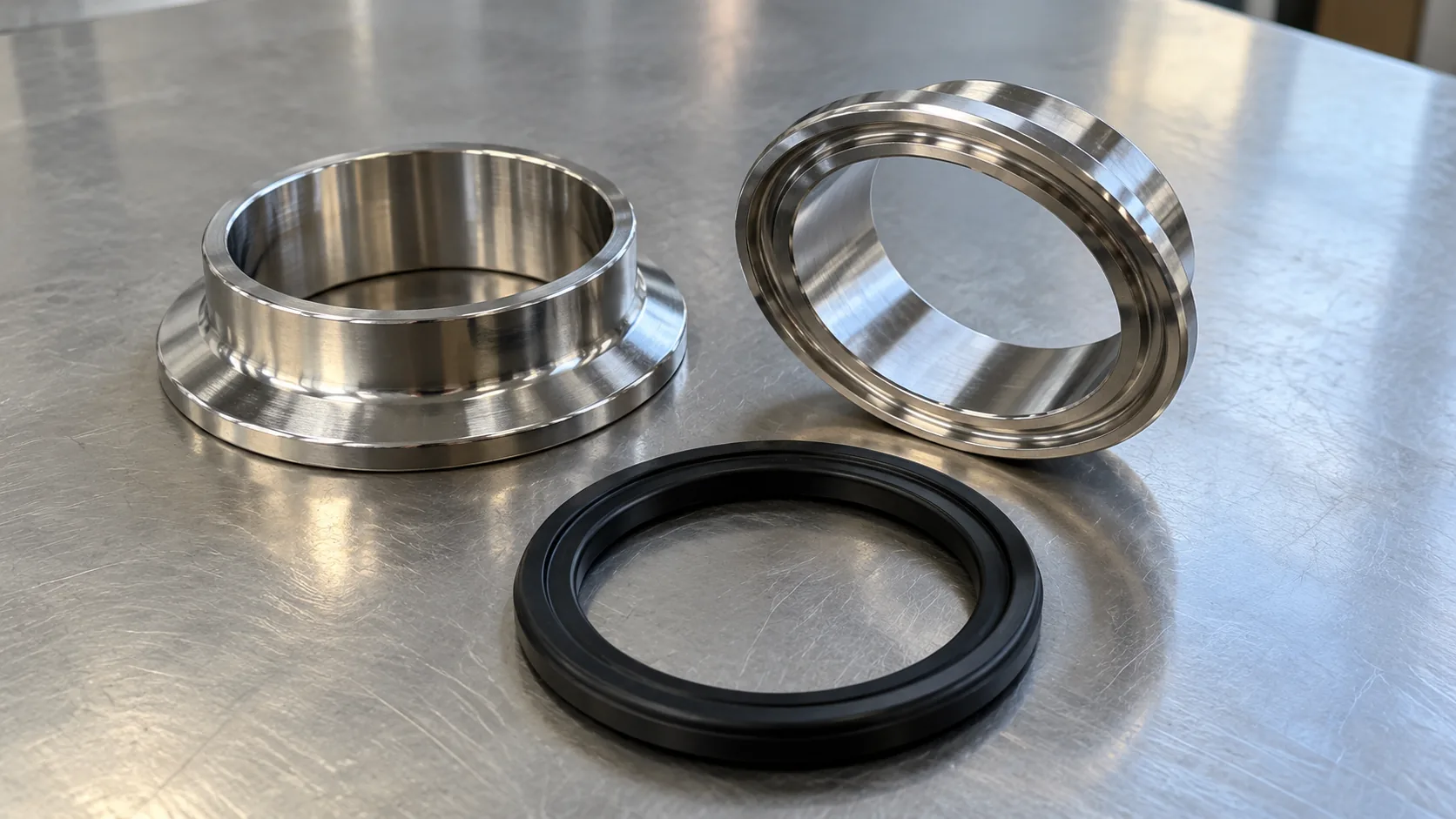
A gasket face pulled into the light. The photograph shows a joint that can be opened. It does not show a validated cycle.
Start from the cleaning definition, not the spray device
3-A defines clean-in-place cleaning as the removal of soil from product-contact surfaces in their process position by circulating, spraying, or flowing chemical solutions and water rinses onto and over those surfaces. Components that are not designed to be cleaned in place are removed for clean-out-of-place or manual cleaning.
The same paper defines the other methods so they are not collapsed into CIP. Clean-out-of-place is soil removal after partial or total disassembly, with solutions circulated in a wash tank. Manual cleaning uses brushes, nonmetallic pads, scrapers, and hoses, with the tools in someone’s hands. Dry cleaning uses a vacuum or dry brushes.
3-A says the standards cover that whole range, from bucket and brush to full CIP. It also says it is a misconception to treat every piece of equipment that meets a 3-A standard as suitable for CIP.
| What you were told | What 3-A actually requires | Dominant failure mode and prevention |
|---|---|---|
| “It is 3-A, so it is CIP.” | Standards cover manual cleaning through CIP. CIP is not implied by the symbol. | A machine sold as CIP that still hides soil. Prevent it by asking which surfaces stay assembled and which come off. |
| “We added a spray ball.” | A spray device or a circulating loop is not, by itself, CIP design. | Soil in a crevice the spray misses. Prevent it by designing the joint out, or by naming the disassembly. |
| “We never open it.” | Full CIP without routine inspection is the documented, accepted case, such as welded pipelines. | Skipping inspection on equipment whose cleanability was never documented. Prevent it with an inspection schedule and access. |
| “The valve is CIP.” | 3-A’s plug-valve example: the crevice between plug and body is cleaned only by removing the plug. | Solution pumped past a crevice. Prevent it by taking that joint off the CIP list. |
Rule of thumb: if a product-contact crevice cannot be reached by flowing solution, it is not a CIP surface. 3-A uses the plug valve as the example. The prevention is disassembly, not a longer wash.
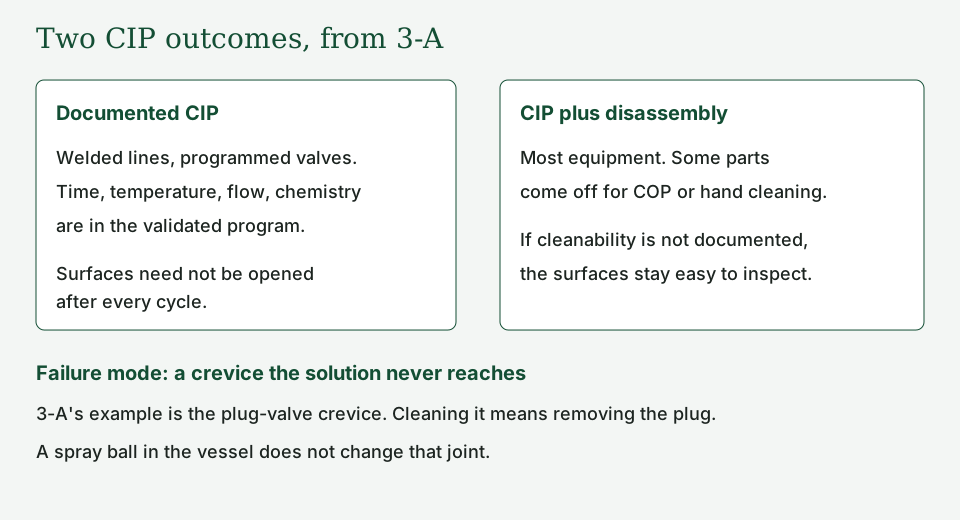
The left path is the documented pipeline. The right path is the rest of the plant, where parts still come off.
Write the pipeline program as four fields
3-A describes the dairy case in which welded pipelines are engineered with a programmed cleaner that controls solution additions, temperatures, flow rate, and cleaning times. Automatic valves, if they are in that system, are programmed to cycle so every seal face is cleaned. That is the subset 3-A puts in the “run, clean, run” category, and the paper says very few equipment types qualify. For those accepted systems, product-contact surfaces do not all have to be readily accessible for inspection. The exception is noted in the specific standard.
Everything else that is sold as CIP still has parts removed for manual or COP cleaning. Because the regimen is not documented and validated, those surfaces have to be easy to take apart and inspect. 3-A says some equipment advertised as CIP-compatible is not.
The record for a packaging filler, a filler bowl, or a valve cluster therefore has two lists:
- Surfaces cleaned in place, with the solution, temperature, flow, and time for each step.
- Surfaces removed, with the tool, the person, and the inspection that follows.
“Readily removable,” in the paper, means designed to be separated quickly with or without simple hand tools. Simple hand tools are a screwdriver, wrench, mallet, or a dedicated tool the cleaning crew already has. A cover on wing nuts tells a cleaner that it comes off. A ring of cap nuts does not.
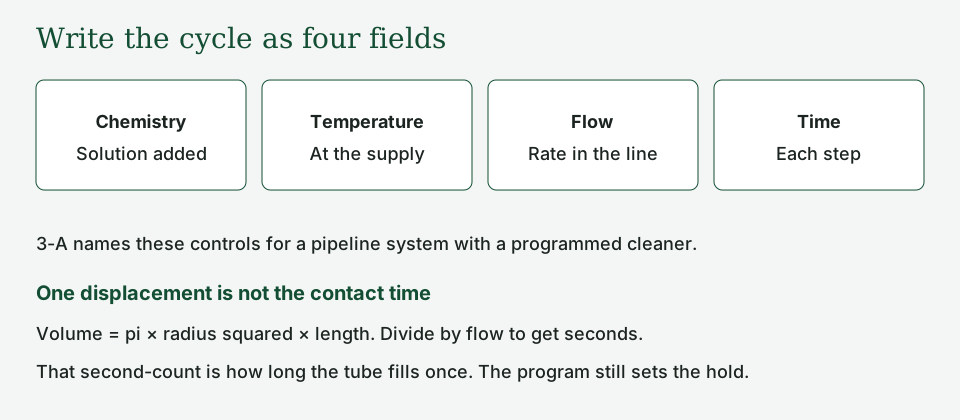
Solution, temperature, flow, and time are the fields 3-A names for a programmed line. The hold is still the program’s, not one displacement of the pipe.
Worked example: displacement time is not contact time
Seconds = pipe volume / flow
Pipe volume is π × radius² × length. Worked example: a tube of 38 mm inside diameter has a radius of 19 mm. Over a 2,000 mm run, volume is 3.1416 × 19 × 19 × 2000 = 2,268,000 mm³, about 2.27 liters. At 20 liters per minute, one displacement takes 2.27 / 20 × 60 = 6.8 seconds.
That 6.8 seconds is how long the new solution takes to fill the tube once. It is not the chemical contact time. If the program calls for 10 minutes of alkaline wash, the displacement is the start of the step, and the 10 minutes are still written down. Using the displacement as the whole wash is the failure mode: the soil sees a rinse, and the chart looks complete.
The cleanability questions ask where a rinse stops. Bring that list to the CIP review so a dead leg is named before the cycle time is. If the hazard is a fragment in the pack rather than a film on the steel, the foreign-material page is the other record.
What this page will not assign
No ATP number, no universal caustic strength, and no valve model. 3-A’s paper does not give them. An inspection schedule is still required where cleanability by CIP has not been documented and accepted. The cost of skipping it is a soil hold-up that the chart never shows, then a teardown after the product is already packed.
Method and sources
All cleaning definitions and the plug-valve example are from 3-A Sanitary Standards, Inc., “Cleanability of Equipment and The Role of The 3-A Sanitary Standards,” retrieved 20 October 2026. The displacement arithmetic uses stated dimensions. Reviewed 20 October 2026.