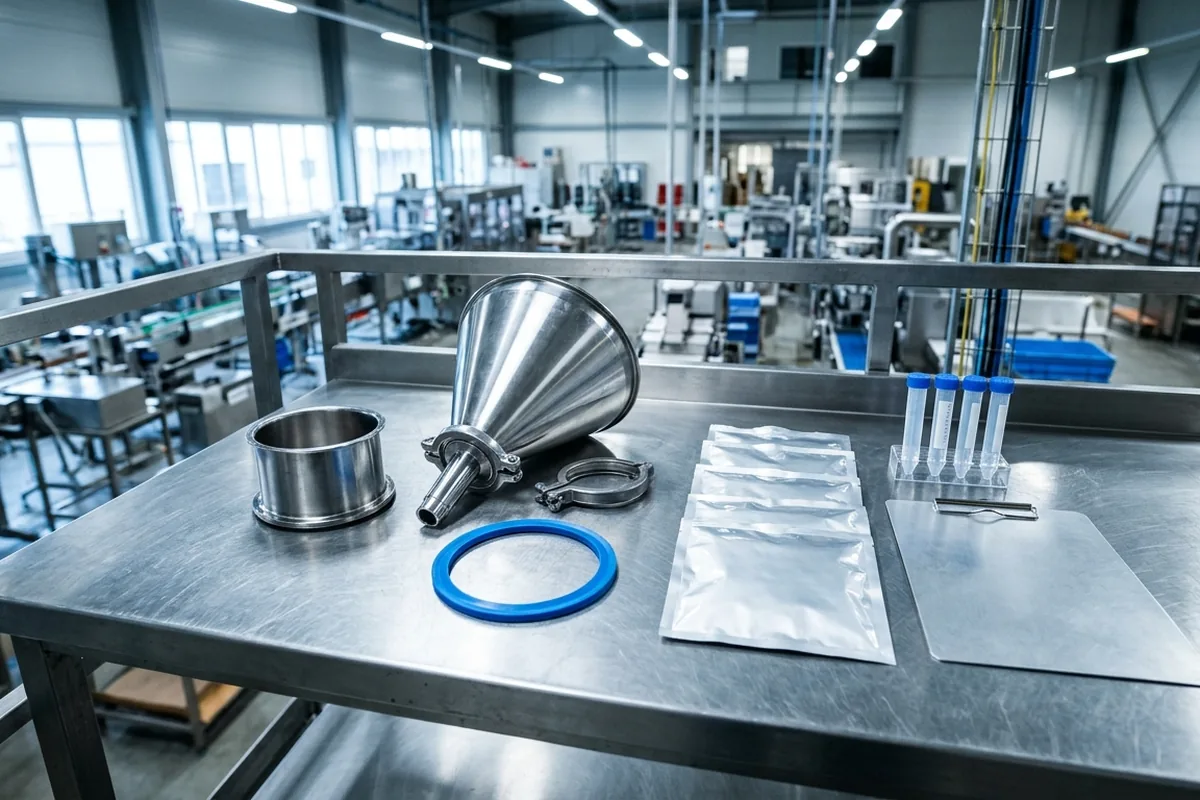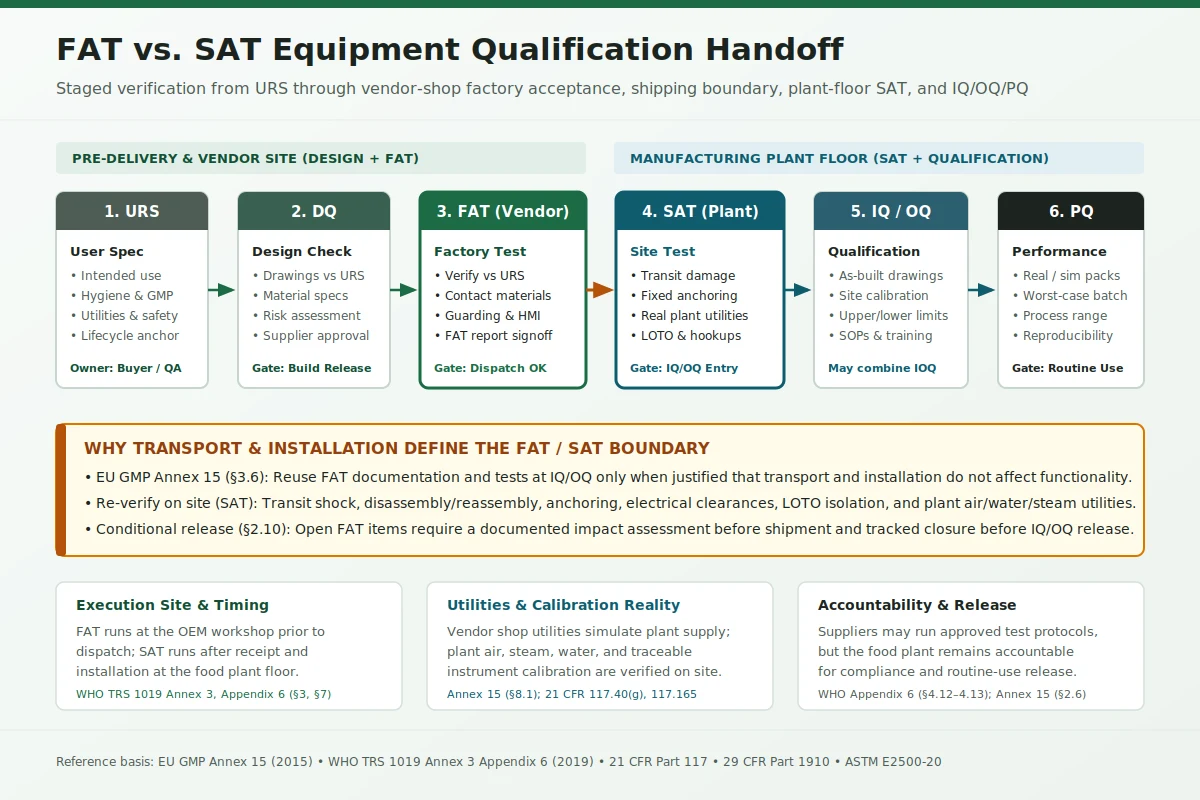
A Factory Acceptance Test (FAT) verifies assembled or partially assembled food packaging equipment at the vendor’s premises against approved User Requirements Specification (URS) and functional criteria before shipment. A Site Acceptance Test (SAT) repeats risk-based checks after delivery and installation on the plant floor, confirming transit integrity, local utilities, safety isolation, and readiness for qualification.
Before conducting either test, organize the supplier’s pre-delivery dossier using the food equipment evidence checklist so dated test protocols and engineering drawings stay separated from unverified sales literature across your supplier audit workflow.
What is a Factory Acceptance Test in equipment manufacturing?
In equipment manufacturing, a Factory Acceptance Test (FAT) is a documented pre-delivery inspection and functional trial performed at the supplier’s premises before dispatch. Under international GMP qualification guidance, FAT confirms that an assembled or partially assembled machine complies with the approved URS and functional specification, recording acceptability and status prior to shipment.
Both the World Health Organization (WHO) Technical Report Series No. 1019, Annex 3, Appendix 6 and the European Commission EudraLex Volume 4, EU GMP Annex 15 anchor FAT directly to pre-shipment verification at the equipment builder’s facility. Under EU GMP Annex 15 Sections 3.4 and 3.5, equipment—particularly machinery incorporating novel or complex technology—may be evaluated at the vendor before delivery to confirm compliance with the URS or functional specification prior to installation.
WHO qualification guidance (Appendix 6, Sections 3 and 7.1 to 7.3) defines FAT as a test conducted, usually at the vendor’s premises, to verify that an assembled or partially assembled system, equipment, or utility meets approved specifications and is ready for dispatch. Every check and test executed during FAT must be formally recorded, and the assembly acceptability and overall equipment status must be documented in the FAT report conclusion prior to shipment.
For food packaging lines, running FAT before crating catches fabrication defects while the vendor’s machinists, welders, electrical builders, and controls engineers remain directly beside the frame. Resolving rough welds, wrong contact materials, missing guard brackets, or PLC alarm logic faults at the supplier workshop avoids tearing down an installed line inside an active sanitary packaging room.
What does SAT stand for and verify after equipment delivery?
SAT stands for Site Acceptance Test, a risk-based verification conducted at the manufacturer’s site of use after packaging equipment is received and installed. SAT supplements FAT by confirming that shipping and rigging caused no functional damage, verifying local utility and safety hookups, and documenting site acceptability in an approved report before formal qualification.
Under EU GMP Annex 15 Section 3.7, a Factory Acceptance Test may be supplemented by executing a Site Acceptance Test following receipt of equipment at the manufacturing site. WHO Appendix 6 (Sections 3, 7.4, and 7.5) similarly defines SAT as a test conducted at the manufacturer’s site of use to verify that an assembled or partially assembled system, equipment, or utility meets approved specifications, requiring risk-based tests upon receipt and a formal acceptability conclusion in the SAT report.
In a food plant pre-evaluation and commissioning sequence, SAT bridges the physical gap between a vendor’s test floor and real packaging-hall operating conditions. Even a machine that ran flawlessly at the vendor must be uncrated, reassembled if shipped in modules, leveled and anchored on the plant floor, tied into facility power, compressed air, water, or steam drops, and checked alongside adjacent conveyors before formal Installation Qualification (IQ) and Operational Qualification (OQ) begin.
| Evaluation Dimension | Factory Acceptance Test (FAT) | Site Acceptance Test (SAT) |
|---|---|---|
| Execution location | Vendor or equipment builder’s premises before dispatch | Food manufacturer’s plant floor at the site of use |
| Timing in delivery lifecycle | Completed prior to crating, shipping, and plant installation | Executed after receipt, rigging, reassembly, and utility hookup |
| Core verification objective | Confirm built hardware, controls, and documents meet URS and functional specification | Confirm transit integrity, site installation, plant utilities, and operational suitability |
| Utility and environmental supply | Vendor workshop power, shop air, and simulated conditions | Actual facility power feeders, compressed air, water, steam, and room conditions |
| Evidence carried downstream | Static build, material, and document checks unaffected by transit or installation | Site-specific safety, utility, calibration, and integrated-line evidence feeding IQ/OQ |
| Formal release milestone | FAT report conclusion authorizing shipment or conditional release | SAT report conclusion authorizing entry into formal IQ and OQ |
How do FAT and SAT work together during line commissioning?
During line commissioning, FAT and SAT operate as connected gates between Design Qualification (DQ) and formal Installation and Operational Qualification (IQ/OQ). Plant personnel review vendor protocols against internal procedures before testing, carry forward FAT checks unaffected by transport and installation, investigate failed criteria as deviations, and close conditional shipment items during SAT.
Protocol ownership, accountability, and leveraging FAT evidence
Eliminating redundant testing without creating compliance blind spots starts before the first test sheet is signed. Under EU GMP Annex 15 Section 2.6, when third-party or vendor validation protocols and documentation are supplied, appropriate personnel at the manufacturing site must confirm suitability and compliance with internal procedures before approval, and vendor protocols may be supplemented with additional test protocols before use.
Once approved protocols are executed cleanly, EU GMP Annex 15 Section 3.6 establishes the exact engineering boundary for reusing vendor-site results: documentation review and selected tests may be performed at FAT without repeating them on site at IQ/OQ if it can be shown that functionality is not affected by transport and installation. Static attributes—such as verified component lists, construction material dossiers, or baseline document completeness—can carry forward, whereas mechanical alignment, electrical continuity after field reconnection, and utility-driven performance must be re-verified at SAT.
Delegating test execution never transfers regulatory responsibility to the equipment vendor. WHO Appendix 6 Sections 4.12 and 4.13 state that suppliers or third parties may perform certain stages under written conditions and responsibilities, but the contract giver remains responsible for ensuring compliance with GMP principles, and equipment may be released for routine use only after documented evidence confirms successful qualification.
Deviation control, punch-list tracking, and conditional release
Packaging equipment rarely clears a complex FAT with zero adjustments. What separates an audit-ready commissioning file from an undocumented verbal promise is formal deviation handling. Under EU GMP Annex 15 Sections 2.7 and 2.8, any significant change to an approved protocol during execution—including changes to acceptance criteria or operating parameters—and any result failing pre-defined acceptance criteria must be recorded as a deviation, scientifically justified or fully investigated under local procedures, and discussed in the final report.
WHO Appendix 6 Section 4.9 requires each stage report to include or reference test results with supporting calculations and raw or original data, test failures, protocol departures, recommendations and justifications for issue resolution, and conclusions. When open items remain at the end of FAT, EU GMP Annex 15 Section 2.10 permits formal conditional approval to proceed to the next stage only when responsible personnel authorize release backed by a documented assessment confirming no significant impact on the next activity.
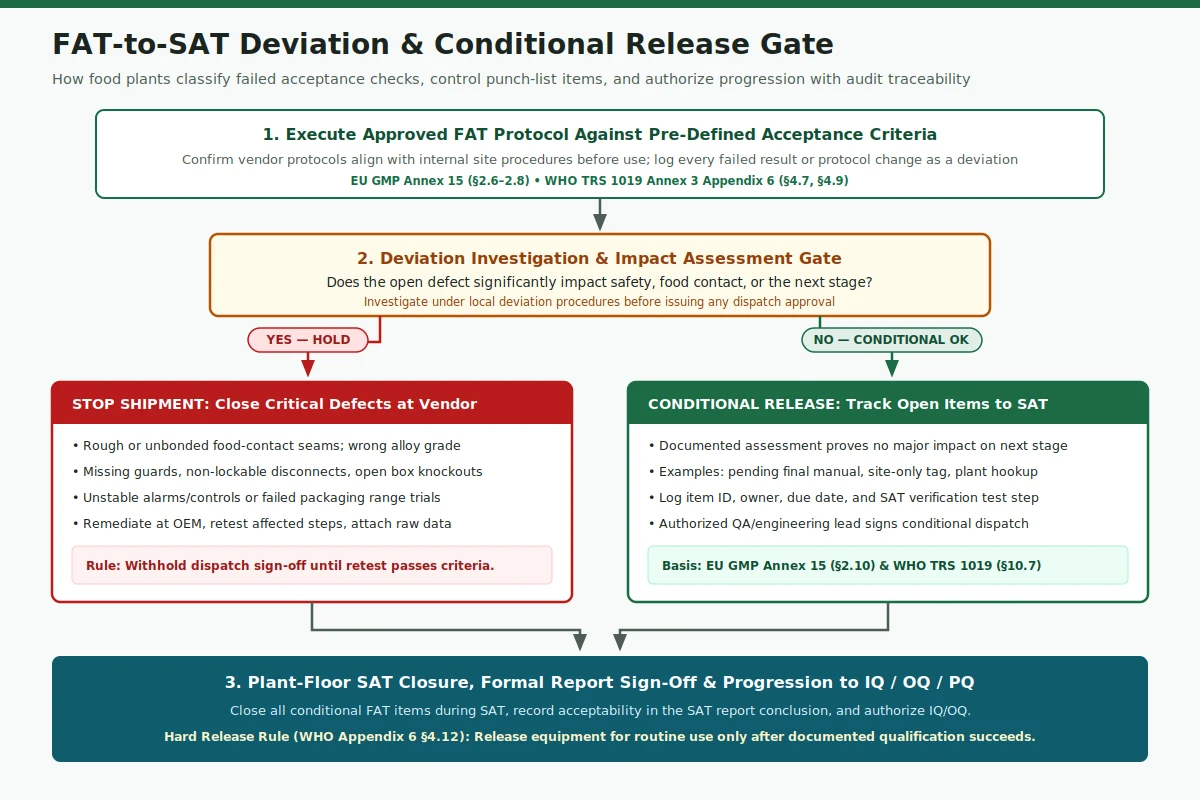
Apply that gate strictly before releasing freight: defects affecting food-contact welds, guarding integrity, or basic control stability block shipment until remediated and retested at the vendor shop, whereas minor site-dependent items (such as final plant-specific disconnect labeling or site-only hookup verification) can move forward under documented conditional approval with tracked closure during SAT.
What items belong on a Factory Acceptance Test checklist before shipment?
A pre-shipment Factory Acceptance Test checklist covers URS and functional compliance, food-contact construction and cleanability, engineering documentation and component traceability, affixed machine guarding and electrical nameplate ratings, and baseline trials of alarms, controls, and packaging parameters across temperature, machine speed, and sealing pressure ranges with raw data captured before release.
Hygienic construction, food-contact surfaces, and documentation
For U.S. human food facilities, 21 CFR 117.40 establishes binding baseline equipment construction rules that should be inspected directly on the assembled machine during FAT before shipping crates close. Under 21 CFR 117.40(a)(1) through (a)(5), food manufacturing and packing equipment must be adequately cleanable, designed and constructed to avoid adulterating food with lubricants, fuel, metal fragments, or contaminated water, and built with corrosion-resistant, nontoxic food-contact surfaces able to withstand food contact and cleaning or sanitizing agents.
Under 21 CFR 117.40(b) through (d), seams on food-contact surfaces must be smoothly bonded or maintained to minimize particle and organic buildup, non-contact equipment in food areas must be constructed to stay clean and sanitary, and holding, conveying, and manufacturing systems—including gravimetric, pneumatic, closed, and automated systems—must be built to remain clean and sanitary. Pair these physical FAT inspections with our packaging equipment cleanability review so inaccessible dead spaces or rough welds are corrected while the machine is still in the vendor’s fabrication bay.
Alongside physical construction checks, WHO TRS 1019 Annex 3 Sections 10.16 and 10.17 highlight documentary verification items that can be audited early during FAT and carried cleanly into IQ: purchase specifications, engineering drawings, operating and maintenance manuals, spare parts lists, vendor details, and traceable construction-material records for installed components.
Machine guarding, electrical hardware, and baseline packaging trials
Safety and electrical construction requirements under 29 CFR 1910.212 and 29 CFR 1910.303 also have hardware elements that belong on every pre-shipment FAT checklist:
- Affixed machine guarding and interlocks: Under 29 CFR 1910.212(a)(1), (a)(2), (a)(4), and (a)(5), barrier guards, two-hand tripping devices, or electronic safety devices must protect against point-of-operation, ingoing nip points, rotating parts, flying chips, and sparks and be affixed to the machine where possible without introducing a new hazard; revolving drums, barrels, and containers require drive-interlocked enclosures, and fan blades under 7 feet above floor or working level require guards with openings no larger than 1/2 inch.
- Electrical enclosures, ratings, and lockable disconnects: Under 29 CFR 1910.303(b)(7), (e), and (f)(4), unused openings in boxes, cabinets, and housings must be effectively closed, durable markings must state manufacturer identity and voltage, current, or wattage ratings, and required disconnecting means must be capable of being locked in the open position.
- Controls, alarms, and packaging operating ranges: Under WHO TRS 1019 Annex 3 Section 10.21, operation controls, alarms, switches, displays, and operational components should be tested. Under EU GMP Annex 15 Sections 7.1 and 7.2, primary and secondary packaging equipment should be qualified across minimum and maximum operating ranges for critical process parameters such as temperature, machine speed, and sealing pressure—establishing a clear pre-shipment baseline that is later re-confirmed with actual plant utilities and production film.
| Checklist Domain | Pre-Shipment FAT Verification Check | Required Evidence Before Dispatch | Regulatory Basis |
|---|---|---|---|
| URS and build compliance | Verify assembled or partially assembled machine against URS and functional specification | Approved FAT protocol, completed test steps, signed FAT report conclusion | EU GMP Annex 15 (§3.4–3.5); WHO Appendix 6 (§7.1–7.3) |
| Food-contact surfaces and cleanability | Inspect corrosion-resistant nontoxic contact materials, smoothly bonded seams, and lubricant containment | Visual inspection sign-off, material traceability records, cleanable-design verification | 21 CFR 117.40(a)–(d); WHO Annex 3 (§10.17) |
| Engineering and maintenance dossier | Audit drawings, purchase specs, operating and maintenance manuals, spare parts lists, and vendor details | Indexed document receipt register approved by site personnel | EU GMP Annex 15 (§2.6, §3.6); WHO Annex 3 (§10.16) |
| Guarding and electrical enclosure build | Confirm affixed point-of-operation guards, drum interlocks, fan guard openings ≤ 1/2 in., closed knockouts, durable ratings, and lockable disconnects | Mechanical guarding checklist, electrical panel inspection sheet, photo log | 29 CFR 1910.212(a); 29 CFR 1910.303(b)(7), (e), (f)(4) |
| Controls and baseline packaging trials | Exercise alarms, switches, displays, and trial runs over temperature, speed, and sealing pressure ranges | Raw/original trial data, deviation log, and documented issue resolution | EU GMP Annex 15 (§2.8, §7.1–7.2); WHO Annex 3 (§10.21, §4.9) |
Which electrical, safety, and utility checks shift from FAT to SAT?
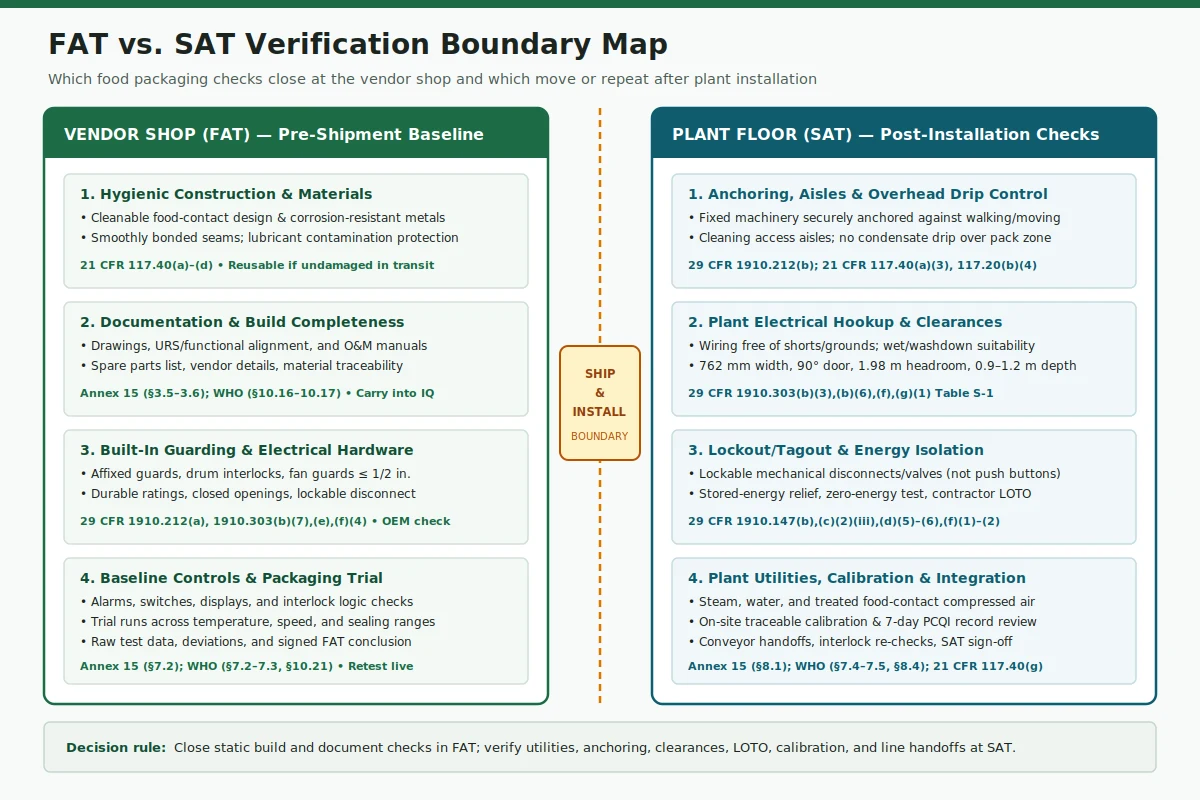
Checks dependent on the physical building, permanent power feeders, and plant services shift from FAT to SAT. After placement on the food plant floor, teams must verify fixed anchoring, cleaning aisles, condensate protection, short-free field wiring, electrical working clearances, machine-specific lockout/tagout isolation, treated food-contact compressed air, plant utilities, and on-site traceable calibration.
Physical installation, sanitary layout, and electrical clearances
No vendor workshop can verify how a packaging machine sits inside the buyer’s physical room envelope. Once rigged into place, four site-bound checks become mandatory during SAT:
- Fixed machinery anchoring: Under 29 CFR 1910.212(b), machines designed for a fixed location must be securely anchored to prevent walking or moving during high-speed cyclic operation.
- Sanitary access and overhead condensate protection: Under 21 CFR 117.40(a)(3), equipment must be installed to facilitate cleaning and maintenance of both the equipment and adjacent spaces. Under 21 CFR 117.20(b)(4), plant aisles and working spaces between equipment and walls must remain unobstructed and wide enough to prevent clothing or personal contact contamination, and fixtures, ducts, and overhead pipes must not drip condensate onto food, contact surfaces, or packaging materials.
- Field wiring integrity, environment rating, and disconnect labeling: Under 29 CFR 1910.303(b)(3), (b)(6), and (f)(1)–(2), completed plant wiring installations must be free from short circuits and unauthorized grounds, conductors and enclosures must be identified for damp, wet, or corrosive washdown environments, and disconnecting means for motors, appliances, feeders, and branch circuits must be legibly marked to indicate their purpose.
- Electrical working space and live-part guarding: Under 29 CFR 1910.303(g)(1) for equipment operating at 600 volts nominal or less, working space in front of electrical panels must be at least 762 mm (30 in.) wide—or the equipment width, whichever is greater—and permit at least a 90-degree opening of cabinet doors or hinged panels. Minimum headroom for installations built on or after August 13, 2007 must be at least 1.98 m (6.5 ft). Under 29 CFR 1910.303 Table S-1, minimum clear working depth is 0.9 m (3.0 ft) for 0–150 V to ground across Conditions A, B, and C, and 0.9 m (3.0 ft) for Condition A, 1.0 m (3.5 ft) for Condition B, and 1.2 m (4.0 ft) for Condition C for higher voltages up to 600 V. Under 29 CFR 1910.303(g)(2)(i), live parts operating at 50 volts or more must be guarded against accidental contact using approved enclosures, restricted rooms, partitions, or elevation of 2.44 m (8.0 ft) or more above the floor.
Lockout/tagout isolation and contractor handoff
Hazardous energy control under 29 CFR 1910.147 can be designed in at FAT, while its isolation effectiveness is verified on the installed plant energy feeds during SAT. Under 29 CFR 1910.147(b), an energy isolating device is a mechanical device—such as a manually operated electrical circuit breaker, disconnect switch, or line valve—that physically prevents energy transmission across electrical, mechanical, hydraulic, pneumatic, chemical, or thermal sources; push buttons and selector switches are control-circuit devices and do not count as energy isolating devices.
Under 29 CFR 1910.147(c)(2)(iii), whenever new machines or equipment are installed after January 2, 1990, energy isolating devices must be designed to accept a lockout device. During SAT commissioning and servicing, 29 CFR 1910.147(d)(5) and (d)(6) require relieving, disconnecting, or restraining all stored or residual energy after locking out and verifying isolation and deenergization before work begins. When equipment must be temporarily energized for testing or positioning, 29 CFR 1910.147(f)(1) mandates clearing tools, removing employees, removing locks, energizing for the test, and re-deenergizing afterward. When OEM technicians perform installation or SAT on site, 29 CFR 1910.147(f)(2) requires the host food plant and the outside employer to inform each other of their respective lockout/tagout procedures.
Plant utilities and on-site traceable calibration
Utility hookups and instrumentation accuracy also cross into plant-floor verification. Under EU GMP Annex 15 Sections 8.1 through 8.3, utility quality for steam, water, air, and other gases must be confirmed following installation—accounting for seasonal variations and intended use—with risk assessments covering direct or indirect product contact such as HVAC systems and heat exchangers. Under 21 CFR 117.40(g), compressed air or other gases mechanically introduced into food or used to clean food-contact surfaces must be treated so food is not contaminated with unlawful indirect food additives; verify point-of-use drops using our compressed air filtration checklist for packaging lines.
For sensors and process controls, 21 CFR 117.40(f) requires instruments measuring, regulating, or recording temperatures, pH, acidity, water activity, or related controls to be accurate, precise, and adequately maintained. Shipping vibration and field installation can shift factory adjustments, so WHO Appendix 6 Section 8.4 specifies that identified measuring, control, and indicating devices should be calibrated on site—unless otherwise appropriately justified—with calibration traceable to national or international standards and traceable certificates on file. Under 21 CFR 117.165(a)(1) and (a)(4)(i), preventive controls verification includes calibrating or checking the accuracy of monitoring and verification instruments and establishing preventive controls qualified individual (PCQI) review of monitoring and corrective action records within 7 working days of creation unless a written justification supports a longer period.
| Plant-Floor Check | Installed Site Requirement | Why It Cannot Close at FAT | Governing Clause |
|---|---|---|---|
| Fixed anchoring and cleaning clearance | Anchor fixed equipment against walking/moving; maintain unobstructed cleaning aisles and zero overhead condensate drip | Depends on plant floor slab, room walls, overhead piping, and adjacent conveyors | 29 CFR 1910.212(b); 21 CFR 117.40(a)(3), 117.20(b)(4) |
| Field wiring and washdown rating | Completed wiring free of shorts and unauthorized grounds; equipment rated for damp, wet, or corrosive room zones | Plant feeders, conduits, and washdown exposure exist only after site wiring | 29 CFR 1910.303(b)(3), (b)(6) |
| Electrical clearances and live-part guards | 762 mm (30 in.) width, 90° door swing, 1.98 m (6.5 ft) headroom, 0.9–1.2 m Table S-1 depth (≤ 600 V), live parts ≥ 50 V guarded or elevated ≥ 2.44 m (8.0 ft) | Governed by final panel placement relative to walls, mezzanines, and neighboring equipment | 29 CFR 1910.303(g)(1)–(2), Table S-1 |
| Lockout/tagout and contractor control | Legibly marked lockable mechanical disconnects/valves, stored-energy relief, zero-energy test, and host-OEM LOTO exchange | Ties into plant main breakers, compressed air headers, steam valves, and local LOTO program | 29 CFR 1910.147(b), (c)(2)(iii), (d)(5)–(6), (f)(1)–(2); 29 CFR 1910.303(f) |
| Plant utilities and food-contact air | Confirm steam, water, HVAC, and treated compressed air at installed drops without unlawful indirect additives | Vendor shop utilities do not replicate plant headers, dryers, or point-of-use filters | EU GMP Annex 15 (§8.1–8.3); 21 CFR 117.40(g) |
| On-site calibration and verification records | Calibrate monitoring/control instruments on site with traceable certificates; establish 7-working-day PCQI record review | Transit vibration and site sensor wiring can shift factory calibration before production | WHO Appendix 6 (§8.4); 21 CFR 117.40(f), 117.165(a) |
How do FAT and SAT relate to downstream installation and operational qualification?
FAT and SAT precede formal Installation Qualification (IQ), Operational Qualification (OQ), and Performance Qualification (PQ) in the equipment lifecycle. They verify vendor build quality and site readiness before formal IQ confirms as-installed drawings and calibration, OQ tests upper and lower operating limits to finalize procedures, and PQ confirms reproducible performance with production materials.
From FAT and SAT into IQ, OQ, and PQ
Both EU GMP Annex 15 (Sections 3.1 to 3.14) and WHO TRS 1019 Annex 3 (Sections 10.5 to 10.6 and 10.14) place FAT and SAT inside a structured qualification progression that flows logically from premises to utilities, equipment, procedures, and processes:
- URS and Design Qualification (DQ): Equipment requirements are defined in the URS or functional specification—the reference anchor across the entire lifecycle—and verified against GMP design expectations during DQ (EU GMP Annex 15 Sections 3.2–3.3).
- FAT and SAT: Vendor-site FAT and post-delivery SAT confirm specification compliance and site suitability prior to subsequent qualification stages (WHO Annex 3 Section 10.14).
- Installation Qualification (IQ): Formal IQ verifies installed components, instrumentation, equipment, pipework, and services against engineering drawings and pre-defined criteria, collates supplier operating and maintenance instructions, verifies materials of construction, and confirms instrument calibration (EU GMP Annex 15 Sections 3.8–3.9).
- Operational Qualification (OQ or IOQ): OQ normally follows IQ—or combines into Installation/Operation Qualification (IOQ) depending on equipment complexity—and tests system behavior across normal ranges, upper and lower operating limits, and worst-case conditions. Completing OQ allows the plant to finalize standard operating and cleaning procedures, operator training, and preventative maintenance schedules (EU GMP Annex 15 Sections 3.10–3.12).
- Performance Qualification (PQ): PQ normally follows IQ and OQ, executing tests with actual production materials, qualified substitutes, or simulated products under normal operating conditions with worst-case batch sizes across the intended process range (EU GMP Annex 15 Sections 3.13–3.14).
Once the line completes qualification and enters routine production, transition your floor verification program to the ongoing food safety audit checklist for packaging lines covering wear-part traceability, lubricant segregation, brittle material registers, and fail-safe reject challenges.
Where ASTM E2500 ends and workplace safety begins
Many food, beverage, and life-science engineering teams also reference ASTM E2500-20 when structuring risk-based equipment verification from concept to retirement. ASTM E2500-20 covers GMP process equipment, supporting utilities, process monitoring and control systems, and automation systems to satisfy FDA, EU, and international expectations for design, installation, operation, and performance.
However, ASTM E2500-20 Section 1.6 draws a clear boundary for commissioning teams: the guide explicitly does not address employee health and safety, environmental, or other non-GxP regulations. Passing a GxP-oriented FAT, SAT, or ASTM E2500 verification package therefore proves fitness for product quality and hygiene—not compliance with OSHA guarding, electrical clearance, or lockout/tagout rules. Pair quality qualification sign-offs with dedicated EHS and electrical inspections before authorizing routine packaging production.