A lot number tracking program fails in a live audit when the quality team can trace a raw meat or dairy batch to finished cases in twenty minutes, but cannot tell the auditor which three pallets received a delaminating roll of top lidding film spliced onto the thermoformer at 07:28, which batches were flushed from a specific modified atmosphere packaging (MAP) nitrogen-carbon dioxide manifold bundle, or where 360 unshipped pouches went between the machine counter and the warehouse rack. In Global Food Safety Initiative (GFSI) audits and regulatory investigations, unlinked packaging roll changes and unreconciled line scrap turn a targeted three-pallet withdrawal into a multi-week plant recall.
While our parent guide on coding and lot records defines the four foundational roles that connect a physical mark on a pack (Mark), the batch file that defines it (Meaning), the cross-check between the two (Match), and the two-row split required when a coder stops mid-run (Break), this operational protocol governs full-line food traceability system execution. It details how quality assurance leads, packaging engineers, and warehouse teams execute a bidirectional (forward and backward) mock recall and 100% mass-balance reconciliation within the mandatory 4-hour GFSI ceiling across raw ingredients, multi-roll packaging film splices, food-grade MAP gas cylinders, inline ISO/IEC 15415 and 15416 barcode verification, and outbound SSCC-18 Bills of Lading (BOL).
| Traceability Dimension | GFSI & Regulatory Standard Mapping | Upstream / Line-Side Data Anchor (KDEs) | Mandatory Verification & Audit Target | Dominant Plant Failure Mode & Prevention |
|---|---|---|---|---|
| 1. Bidirectional Scope (1-Up, 1-Down) | BRCGS Issue 9 Clauses 3.9.1-3.9.3 / SQF Ed. 9 Clauses 2.6.1-2.6.3 / ISO 22005:2007 | Supplier Lot + CoA (Receiving) -> Internal Batch TLC (Transformation) -> Customer SSCC-18 + BOL (Shipping) |
Complete both forward and backward trace plus mass balance in <= 4 hours (<= 2 hours retail best practice) |
Tracing only food ingredients while omitting primary packaging rolls or carryover rework bins; bind all inputs to the TLC |
| 2. Primary Film Roll Splice Genealogy | BRCGS Clause 3.9.2 / SQF Clause 2.6.2 / FDA 21 CFR 177 & EU 10/2011 | Splice timestamp (HH:MM:SS), expiring & new core roll serial IDs, PLC pack counter (N_pack), active pallet SSCC-18 |
Log 100% of top/bottom web roll splices; purge and count 2 to 5 metal-detectable splice-tape transition packs |
Recording only generic film part numbers on work orders; require barcode scans of every master roll core at the splice table |
| 3. MAP Food-Grade Gas Lot Linkage | Commission Reg. (EU) 231/2012 & (EC) 1333/2008 (E290, E941, E948) / US FDA GRAS |
Cylinder bundle or bulk liquid tank CoA lot number, inline mixer flow ratio, ASTM F2714 needle headspace test log | Verify headspace residual oxygen O2 <= 0.5% at startup, after every film splice, and every 30 to 60 min |
Treating packaging gas as an unlogged plant utility; log cylinder/tank CoA lots and all destructive headspace test packs |
| 4. Inline Coder & Barcode Grading | GS1 General Specifications (AI 01, 10, 15/17, 00) / ISO/IEC 15415 (2D) & 15416 (1D) |
MES recipe lock to TIJ/TTO/Laser coder; inline Optical Character Verification (OCV) and ISO verifier grade log |
Minimum barcode print quality ANSI/ISO Grade C (>= 1.5 / 4.0); PLC line-stop after 3 consecutive Grade D/F prints |
Manual keypad date entry errors or ribbon wrinkles producing unscannable codes; interlock vision camera to lockable reject bin |
| 5. Mass-Balance & FSMA 204 Export | BRCGS Clause 3.9.3 / SQF Clause 2.6.3 / FDA FSMA 204 (21 CFR 1.1300-1.1465) | Shipped BOL cases + WMS hold stock + rework + QA library retains + destructive gas/seal tests + splice/reject scrap |
100.0% discrete pack accounting (98.0% to 102.0% bulk/film meter tolerance); FSMA 204 sortable CSV within <= 24 hours |
Destructive QA test packs and startup/splice purges thrown into floor bins uncounted; log every non-shipped unit by bucket |
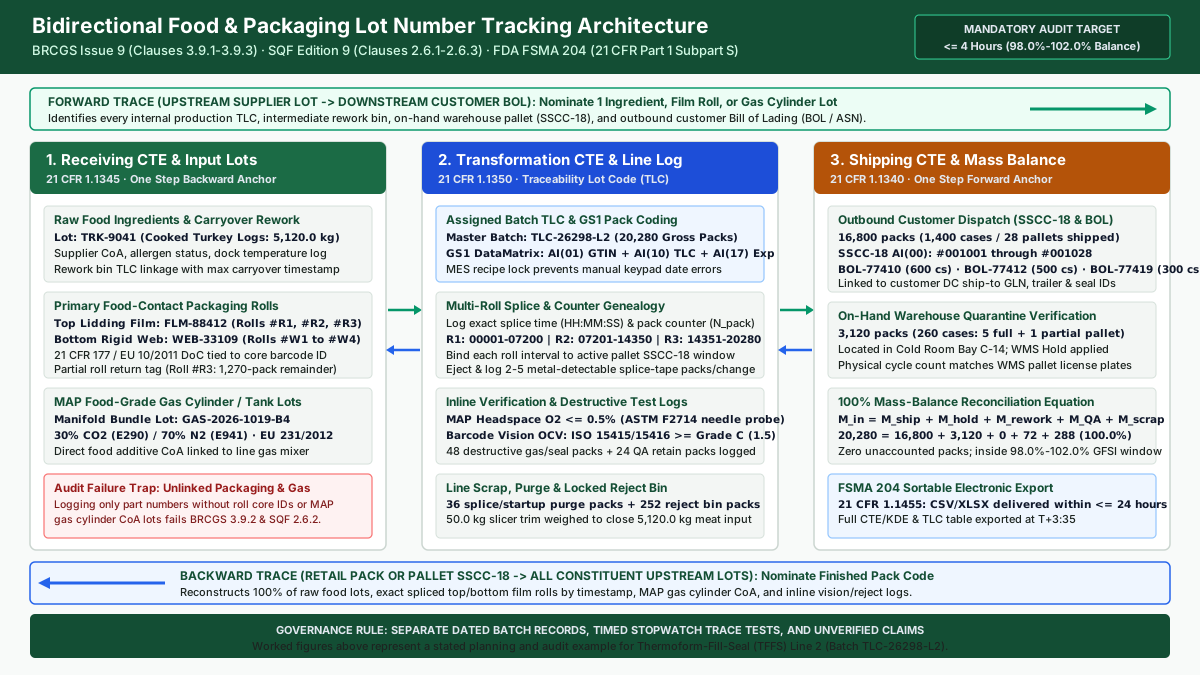
1. GFSI 4-hour traceability rules, FSMA 204 KDEs, and the mass-balance equation
Key takeaway: An audit-compliant food traceability system must execute both a forward trace (upstream supplier lot to customer BOL) and a backward trace (retail package code to every raw ingredient, primary packaging film roll, and MAP gas lot) within 4 hours, closing the mass-balance equation within 98.0% to 102.0% (100.0% for discrete counted packs).
Global food safety standards and federal traceability regulations evaluate a plant’s lot number tracking system not by policy statements, but by stopwatch performance and mathematical closure. Facilities operating high-speed packaging lines must align their batch records with four overlapping compliance frameworks:
- BRCGS Global Standard for Food Safety (Issue 9), Clauses 3.9.1, 3.9.2, and 3.9.3: Mandates that the site trace all raw material lots, primary food-contact packaging (flexible lidding films, thermoforming bottom webs, pre-made pouches, rigid containers, closures, and printed labels bearing legal or allergen declarations), work-in-progress (
WIP), rework, and finished products one step backward to the supplier receiving lot and one step forward to the customer dispatch manifest. Under BRCGS Issue 9 Clause 3.9.3, the facility must test the traceability system across product groups at least annually, incorporating both a forward and backward trace and a quantity check / mass-balance reconciliation, completed within<= 4 hours(with tier-one retail specifications enforcing a<= 2 hoursinternal target). - SQF Food Safety Code: Food Manufacturing (Edition 9), Clauses 2.6.1, 2.6.2, and 2.6.3: Requires documented lot identification across raw materials, food-contact packaging and materials, rework,
WIP, and finished goods. Under SQF Edition 9, annual product trace and mock recall challenges must verify100%disposition accounting across shipped cases, on-hand warehouse inventory, rework, quality assurance samples, and line scrap within the 2-to-4-hour audit window. - FSSC 22000 (Version 6) and ISO 22005:2007: Governed by
ISO 22000:2018Clause 8.3 and ISO 22005:2007 (Traceability in the feed and food chain: General principles and basic requirements for system design and implementation), which define the lot genealogy architecture connecting incoming material transformation nodes to outbound logistics units and require verifiable mass balance between input and output lots. - FDA FSMA Section 204 Final Rule (21 CFR Part 1, Subpart S): Under 21 CFR 1.1300 through 1.1465, facilities manufacturing, processing, packing, or holding foods on the FDA Food Traceability List (FTL) (including soft and semi-soft cheeses, deli salads, fresh-cut produce, nut butters, and finfish/crustaceans) must assign a Traceability Lot Code (
TLC) and record Key Data Elements (KDEs) across three Critical Tracking Events (CTEs):- Receiving CTE (
21 CFR 1.1345): Upstream supplierTLC, immediate previous source Global Location Number (GLN), product description, quantity and unit of measure, receiving date/time, and reference document number (Purchase Order /BOL/ SupplierCoA). - Transformation CTE (
21 CFR 1.1350): The exact point where food ingredients, rework, and primary packaging materials are assembled and sealed into a finished product assigned a new internalTLC, linking every input lot quantity to the outputTLCquantity. - Shipping CTE (
21 CFR 1.1340): Outbound finished productTLC, quantity shipped, pallet Serial Shipping Container Code (SSCC-18), immediate subsequent recipient location (GLN), shipping date/time, and outboundBOL/ Advance Ship Notice (ASN). - 24-Hour Electronic Sortable Spreadsheet Mandate (
21 CFR 1.1455): Covered facilities must generate and deliver an electronic sortable spreadsheet (.csvor.xlsx) containing all requestedCTE/KDErecords andTLClinkages to the FDA within24 hoursof an official request.
- Receiving CTE (
Forward trace vs backward trace operational definitions
Auditors test both directions of the genealogy graph during a certification audit:
- Forward Trace (Upstream Supplier Lot -> Downstream Customer
BOL): Starts with a single supplier lot number received at the plant dock: either a raw food ingredient batch, a primary food-contact packaging film/tray roll lot, or a modified atmosphere packaging (MAP) gas cylinder bundle lot. The trace moves forward through every internal production batch (TLC), intermediate rework bin, finished palletSSCC-18license plate, cold-storage rack location, and outbound customerBOLto identify every distribution center that received a single package built with that input lot. - Backward Trace (Downstream Retail Pack or Pallet
SSCC-18-> Upstream Constituent Lots): Starts with a single finished retail package code (or customer complaint unit / palletSSCC-18) and traces backward through the packaging line batch log to reconstruct100%of the constituent inputs consumed during that run: every raw ingredient batch, rework addition, every master roll of top lidding film and bottom forming web spliced onto the machine, every MAP food-grade gas cylinder or cryogenic tank batch, and the inline date-coder vision verification log.
The strict mass-balance reconciliation equation and the two primary audit traps
To prove that no contaminated units escaped into unrecorded distribution channels, the recall team must close the mass-balance equation across all six disposition buckets:
M_input = M_shipped + M_on_hand + M_hold + M_rework + M_QA_test + M_scrap
When reconciliation is performed by discrete package count on a packaging machine equipped with a PLC impression counter, total accounted packs must equal 100.0% of the gross packs formed. When reconciliation is performed by bulk ingredient mass or by converting linear meters of roll-stock film into theoretical pouch impressions (N_calc = L_film / l_pitch), moisture evaporation, trim waste, and web tension stretch introduce minor physical variance. GFSI auditors evaluate whether bulk and linear-meter mass balances close within 98.0% to 102.0% (+/- 2.0% maximum process yield tolerance). Any unexplained deficit below 98.0% or over-accounting above 102.0% triggers a major non-conformity.
Across packaging plants, two systemic blind spots cause immediate mock recall failures:
- Tracing food ingredients while ignoring primary food-contact packaging (BRCGS Clause 3.9.2 / SQF Clause 2.6.2): BRCGS and SQF auditors routinely select a roll of printed barrier film or a pallet of rigid thermoforming web in the warehouse and ask for a forward trace, or pick a finished retail pouch and demand the supplier Certificates of Analysis (
CoA) and Declarations of Compliance (DoC) for every film roll used during that run. If the plant records only"Film Part #PF-402"on the production work order without logging the vendor’s individual master roll core serial numbers and splice timestamps, a packaging defect such as residual printing solvent odour, non-compliant monomer migration (verified during packaging line food-contact audits), or a delaminating heat-seal layer forces the plant to recall weeks of finished goods rather than isolating the exact three pallets packed during that roll’s 88-minute run window. - Omitting Modified Atmosphere Packaging (
MAP) gases as a direct food additive: Under Commission Regulation (EU) No 231/2012 and Regulation(EC) No 1333/2008(as well as US FDA21 CFR Part 184GRAS andUSP-NFfood-grade gas specifications), protective gases flushed into primary food packages are legally classified as direct food additives and food-contact inputs: Carbon Dioxide (E290,CO2), Nitrogen (E941,N2), and Oxygen (E948,O2). When a gas supplier issues a safety recall for trace benzene, oil hydrocarbon mist, carbon monoxide, or moisture contamination in a high-pressure cylinder bundle or bulk liquid delivery, a plant that fails to link the gas manifold or evaporatorCoAlot number to the packaging batch record cannot isolate which finished productTLCswere flushed with the affected gas.
2. Primary packaging roll-splice genealogy, MAP gas linkage, and inline barcode grading
Key takeaway: Because a single 8-hour production batch consumes 3 to 10 master rolls of packaging film, operators must log five mandatory data points at every splice changeover, pair modified atmosphere packaging gas lot numbers with periodic O2 <= 0.5% headspace checks, and enforce inline ISO/IEC 15415 and 15416 barcode verification at Grade C (>= 1.5) or higher.
A single production batch (TLC) running for 8 hours at 85 to 100 packs/min (40,000+ pouches or trays) never runs on a single roll of film. A vertical form-fill-seal (VFFS) bagger or horizontal flow wrapper (HFFS) typically consumes 3 to 6 master rolls of printed film (8,000 to 12,000 impressions/roll), while a thermoform-fill-seal (TFFS) line consumes 3 to 5 rolls of printed top lidding film alongside 6 to 10 rolls of thicker rigid bottom forming web (APET/PE or PA/PE). Furthermore, six rolls delivered on a single converter pallet frequently originate from two or three different extruder or laminator parent jumbo reels bearing distinct supplier lot codes.
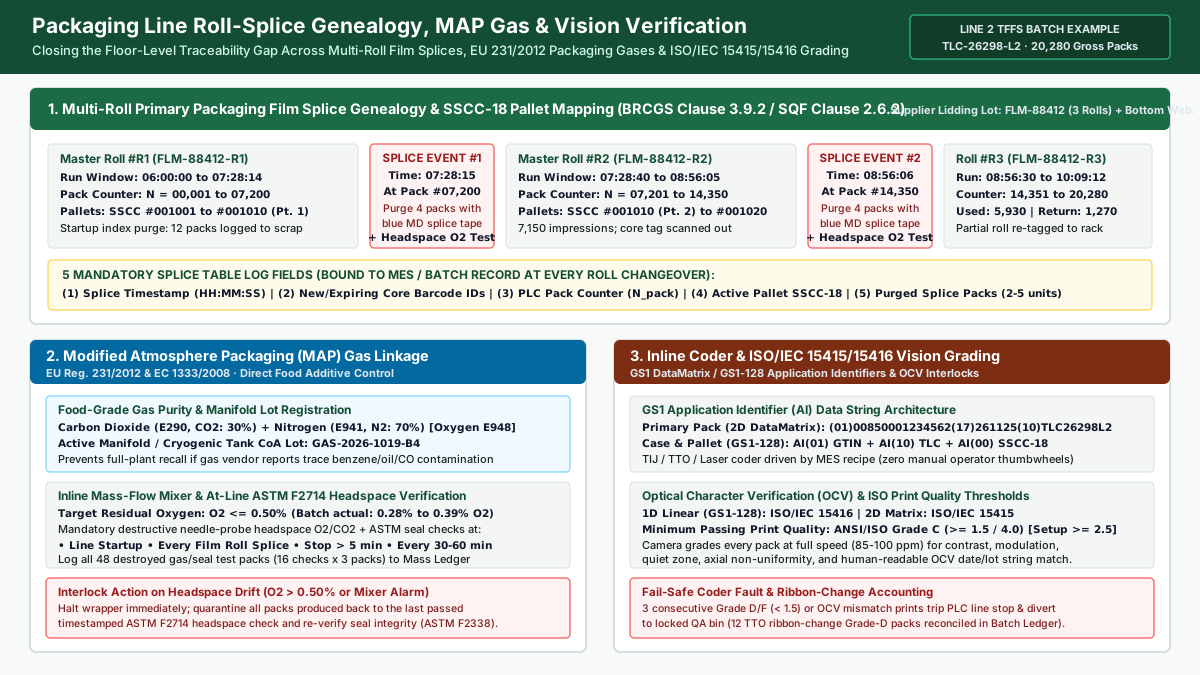
Five mandatory data points at the packaging film splice table
Every time an operator joins the trailing edge of an expiring film roll to the leading edge of a new roll at the unwind splice table, the food traceability system (whether an MES/ERP line terminal or a controlled paper batch traveler) must capture five mandatory data points:
- Exact Splice Activation Timestamp (
HH:MM:SS): Synchronized to the packaging machine PLC and inline date-coder clock so the roll changeover maps to the exact minute within the shift. - Expiring and New Supplier Film Lot & Core Serial IDs: Scanned via handheld barcode scanner from the inner cardboard/plastic core label of the new master roll being mounted, paired with scan-out confirmation of the depleted core removed from the spindle. When a partial roll remains at the end of a batch run, the operator must print and attach a return tag inside the core recording the remaining impression/meter count and the last
TLCon which it ran. - Machine PLC Pack Counter Reading (
N_pack): The cumulative gross impression or pack count displayed on the wrapper HMI at the moment the splice passes the forming shoulder or sealing die (for example, Roll#R1= Packs00,001 to 07,200; Roll#R2= Packs07,201 to 14,350). - Active Pallet
SSCC-18License Plate & Case Number: The exact pallet Serial Shipping Container Code (SSCC-18) and case sequence number being loaded at the end of the line when the splice occurs. Binding the roll change to the activeSSCC-18narrows any future packaging defect quarantine to the exact transition pallet. - Physical Splice-Tape Purge & Quarantine Count (
2 to 5 packs): When a double-thickness film splice taped with high-visibility blue or red metal-detectable (MD) splicing tape travels throughVFFSforming collars orTFFSheat-seal dies, it alters web tension, shifts eye-mark registration, and prevents complete jaw closure. Operators must physically eject and log the2 to 5transition packs containing the splice tape into the line scrap ledger, then pass any metal-detectable splice tape check through the foreign-material control protocol.
Modified atmosphere packaging (MAP) gas traceability and headspace verification
On lines running modified atmosphere packaging (MAP) to extend shelf life and inhibit aerobic spoilage organisms or oxidation in sliced meats, shredded cheeses, fresh pasta, coffee, and bakery goods, the protective gas mixture is a direct ingredient entering the primary package. Audit-ready traceability requires two linked layers of evidence:
- Gas cylinder bundle and cryogenic tank CoA lot linkage: Whether the packaging machine draws premixed gas (such as
30% CO2 / 70% N2) from high-pressure manifolded cylinder pallets (MCPs) or blends bulk liquid Nitrogen (E941) and Carbon Dioxide (E290) via an inline mass-flow dynamic gas mixer, the batch record must log the active cylinder bundle lot number or bulk tank delivery Certificate of Analysis (CoA) lot number. Verify that the supplierCoAcertifies food-additive purity under Commission Regulation (EU) No 231/2012 (andUSP-NF/FCCmonographs), confirming limits on moisture, carbon monoxide, nitrogen oxides, total hydrocarbons/methane, and volatile oil particulates. - Inline mixer alarms and periodic destructive headspace verification (
O2 <= 0.5%): Continuous inline mass-flow gas mixers must be interlocked to halt the wrapper if supply pressure drops or blend ratios drift outside recipe tolerances (typically +/- 1.5% absolute). Because gas flushing works only if the package seal holds gas tight, operators must perform destructive needle-probe headspace gas analysis (using calibrated zirconia or electrochemicalO2and non-dispersive infraredNDIR CO2analyzers per ASTM F2714 or validated plant SOP) paired with destructive ASTM seal integrity testing methods (ASTM D3078bubble emission,ASTM F2338vacuum decay, orASTM F3039dye penetration) at four mandatory intervals:- Line startup before releasing the first case to palletizing.
- Immediately after every top or bottom film roll splice.
- After any machine stoppage exceeding
5 minutes(where residual air can diffuse back into the flushing tunnel or forming chamber). - Every
30 to 60 minutesduring continuous production.
- Headspace threshold and mass-balance logging: For low-oxygen chilled or ambient
MAPpacks, verify that residual headspace oxygen meetsO2 <= 0.50%(or< 1.00%critical reject threshold) alongside the targetCO2 / N2ratio. If any headspace check exceeds0.50% O2, halt the line, hold all packs back to the last passed timestamped check, and inspect the gas lance and sealing dies. Every pack punctured by the headspace needle analyzer or consumed in seal integrity checks must be counted and recorded in the batch Destructive QA Test Bucket so the final mass balance reconciles to zero gap.
Inline date-coder recipe locks, GS1 syntax, and ISO/IEC 15415/15416 barcode grading
To prevent the unlinked or misprinted code failures outlined in our parent coding and lot records guide, high-speed packaging lines integrate Continuous Inkjet (CIJ), Thermal Inkjet (TIJ), Thermal Transfer Overprinting (TTO on flexible film webs), or CO2/Fiber Laser coders directly with the plant’s Manufacturing Execution System (MES).
- Standardized GS1 Application Identifier (
AI) syntax: Machine-readable codes printed on primary packs (GS1 DataMatrixorQR) and outer case/pallet labels (GS1-128linear barcodes) encode unambiguous traceability fields using parenthesized human-readable and FNC1-delimited machine strings:AI (01): 14-digit Global Trade Item Number (GTIN-14).AI (10): Variable-length alphanumeric Batch or Traceability Lot Code (TLC).AI (15)orAI (17): Best-Before Date (AI 15) or Use-By / Expiration Date (AI 17) inYYMMDDformat.AI (00): 18-digit Serial Shipping Container Code (SSCC-18) uniquely identifying each finished pallet for Warehouse Management System (WMS) andBOLtracking.- Example primary pack GS1 string:
(01) 00850001234562 (17) 261125 (10) TLC26298L2
- Inline Optical Character Verification (
OCV) and ISO barcode grading: Eliminating manual keypad entry by pushing coder recipes from theMESprevents wrong-date typing, but thermal transfer ribbon creases, blocked inkjet nozzles, or dirty laser lenses can still render a valid lot string unreadable in distribution. An inline vision system mounted downstream of the coder inspects100%of packs at full line speed, performing Optical Character Verification (OCV) on human-readable characters and grading barcode print quality against ISO/IEC 15416:2016 (for 1D linear barcodes) and ISO/IEC 15415:2024 (for 2D matrix symbols). - Minimum print quality threshold (
>= Grade C / 1.5) and fail-safe reject interlock: Require a minimum passing barcode grade of ANSI/ISO Grade C (>= 1.5on the0.0 to 4.0numeric scale) across symbol contrast, modulation, axial non-uniformity, unused error correction, and quiet zone clearance, targeting Grade B (>= 2.5) at shift start. Wire the vision controller to the machine PLC so3 consecutive no-reads, OCV string mismatches, or Grade D/F (< 1.5) printsimmediately divert the affected packs into the lockable QA reject bin (using the same closed-loop verification principles detailed in food metal detector vs X-ray sensitivity) and stop the packaging machine.
3. Step-by-step 4-hour mock recall execution protocol and mass-balance ledger
Key takeaway: Dividing the 4-hour GFSI mock recall window into five timed phases (T+0:00 to T+3:35) allows cross-functional teams to pull supplier CoAs, reconcile floor splice and destructive test logs, physically cycle-count warehouse quarantine stock, and generate the FSMA 204 sortable spreadsheet with 25 minutes of buffer to spare.
When an external BRCGS or SQF auditor (or the internal QA Recall Coordinator) announces a mock recall challenge, ad-hoc searching across disconnected spreadsheets wastes the first two hours. Execute the following five-phase stopwatch protocol to complete bidirectional traceability and 100% mass-balance reconciliation inside 3 hours 35 minutes.
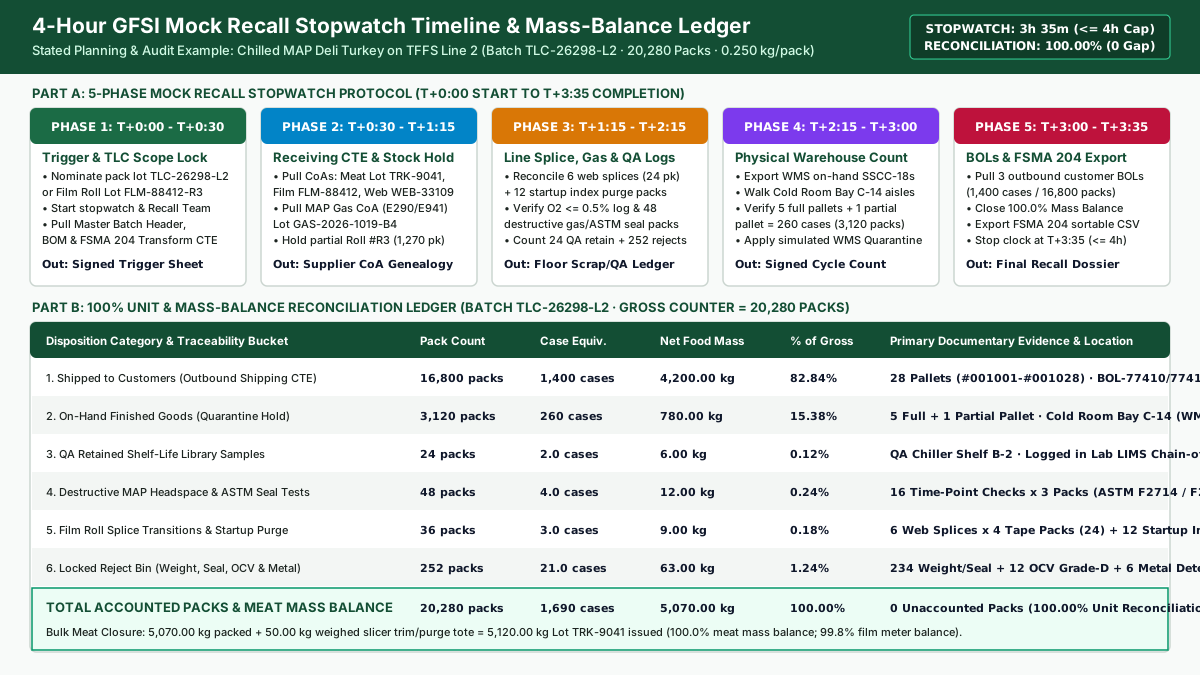
The 5-phase stopwatch execution timeline (T+0:00 to T+3:35)
- Phase 1 (
T+0:00 to T+0:30| 30 min duration): Mock Recall Trigger, Scope Lock &TLCIdentification- Action: The auditor or coordinator nominates the target item: either a Backward Trace from a finished retail package bearing
TLC-26298-L2, or a Forward Trace from an incoming supplier roll of printed barrier lidding film (Lot FLM-88412-R3). Convene the cross-functional recall team (QA Lead, Packaging Line Supervisor, Warehouse/WMS Lead, Purchasing), start the audit stopwatch atT+0:00, lock the challenge scope, and pull the Master Production Batch Header (TLC), formulation Bill of Materials (BOM), andFSMA 204TransformationCTErecord. - Deliverable dated record: Signed Mock Recall Initiation Sheet logging the exact start time (
HH:MM), nominated code, and cross-referenced internalTLCwork orders.
- Action: The auditor or coordinator nominates the target item: either a Backward Trace from a finished retail package bearing
- Phase 2 (
T+0:30 to T+1:15| 45 min duration; 1h 15m elapsed): ReceivingCTE, SupplierCoA& Warehouse Raw/Packaging Stock Hold- Action: Query
ERP/WMSReceivingCTErecords (21 CFR 1.1345) for every input linked to the batch: raw food ingredient lots, carryover rework bins, primary top lidding film rolls, bottom forming web rolls, andMAPfood-grade gas cylinder/tank lots (E290 CO2/E941 N2). Retrieve supplier Certificates of Analysis (CoA) and food-contact Declarations of Compliance (DoC) per the food-equipment evidence checklist. Simultaneously inspect raw and packaging warehouse racks to verify whether any unconsumed ingredient pallets or partial film rolls from the implicated supplier lot remain on site, placing a simulatedWMS Quarantine Holdon residual stock. - Deliverable dated record: Supplier Receiving &
CoAGenealogy Table + Residual Raw/Packaging Stock Hold Report (confirming, for example, that the1,270-packremainder of Film Roll#R3is tagged and held on Warehouse RackP-08).
- Action: Query
- Phase 3 (
T+1:15 to T+2:15| 60 min duration; 2h 15m elapsed): Packaging Line Splice,MAPGas, VisionOCV& Destructive QA Sample Reconciliation- Action: Retrieve the floor-level Packaging Line Batch Folder and
MESlog for the production line:- Reconcile the Film Roll Splice Log showing exact splice timestamps, PLC pack counter intervals, active pallet
SSCC-18numbers, and the2 to 5purged splice-tape transition packs per changeover. - Audit the MAP Gas Mixer & Headspace
O2/CO2Log (O2 <= 0.50%) and count every pack punctured for needle headspace analysis and destructive ASTM seal integrity testing. - Extract the Metal Detector / X-Ray Fail-Safe Reject Bin Log and Inline Vision
OCV/ISO 15415-15416Barcode Reject Log. - Verify retained shelf-life library samples stored in the QA lab chiller.
- Reconcile the Film Roll Splice Log showing exact splice timestamps, PLC pack counter intervals, active pallet
- Deliverable dated record: Reconciled Packaging Line Production, Splice & Destructive/Reject Scrap Ledger accounting for every non-shipped unit formed on the machine.
- Action: Retrieve the floor-level Packaging Line Batch Folder and
- Phase 4 (
T+2:15 to T+3:00| 45 min duration; 3h 00m elapsed): Physical Finished-Goods Warehouse Cycle Count & Quarantine Verification- Action: Export the
WMSon-hand finished-goods inventory list filtered byTLCandSSCC-18pallet license plate. Dispatch warehouse auditors to physically walk the cold-storage or ambient racking aisles and count the cases on every on-hand full pallet, partial pick-slot pallet, and QA hold-cage pallet bearing the implicatedTLC. Verify that physicalGS1-128pallet labels matchWMSbin coordinates and place a simulatedWMS Quarantine Holdon all on-hand units. - Deliverable dated record: Signed Physical Cycle Count & Warehouse Quarantine Verification Sheet.
- Action: Export the
- Phase 5 (
T+3:00 to T+3:35| 35 min duration; 3h 35m total elapsed): Outbound CustomerBOLManifest, Mass-Balance Sign-Off &FSMA 204Sortable Export- Action: Pull all outbound Shipping
CTErecords (21 CFR 1.1340): Customer Purchase Orders, Bills of Lading (BOL), carrier trailer numbers, security seal numbers, andSSCC-18pallet manifests for every shipped case. Compute the final Mass-Balance Reconciliation (100.00%unit accounting;99.8%film linear-meter-to-pack mass balance). Export the FSMA 204 Electronic Sortable Spreadsheet (.xlsx/.csv) and prepare draft customer/regulatory recall notification templates (marked"MOCK RECALL DRILL ONLY - DO NOT TRANSMIT"). Record the stopwatch completion timestamp atT+3:35(25 minutesinside the<= 4-hourGFSI ceiling). - Deliverable dated record: Completed 4-Hour Mock Recall Dossier, Mass-Balance Sign-Off Table, and
FSMA 204Electronic Sortable Spreadsheet.
- Action: Pull all outbound Shipping
4. Worked mass-balance audit ledger (stated planning and audit example)
Key takeaway: Accounting for every pack across six disposition buckets (shipped BOLs, on-hand quarantine, QA library retains, destructive MAP/seal test samples, splice/startup purges, and locked reject bins) eliminates unexplained inventory gaps and proves 100.00% unit closure during an audit.
To illustrate how backward input genealogy, multi-roll splice intervals, and forward customer BOL reconciliation meet in a single audit file, the following worked calculation uses stated planning and audit assumptions for a chilled modified atmosphere packaging (MAP) sliced deli turkey line running on Thermoform-Fill-Seal (TFFS) Line 2:
- Batch Traceability Lot Code (
TLC):TLC-26298-L2(0.250 kgnet food weight per pack;12 packs/case;50 cases/pallet=600 packs/full pallet). - Gross Packs Formed on TFFS PLC Counter:
20,280 packs(5,070.00 kgpacked net meat weight).
Table 1: Backward trace input genealogy linked to Batch TLC-26298-L2
| Input Category (Receiving CTE) | Supplier Lot & CoA / DoC Reference | Quantity Issued & Line 2 Pack Interval | Residual Input Disposition & Hold Status |
|---|---|---|---|
| Raw Ingredient 1: Cooked Turkey Breast Logs | Supplier Lot TRK-9041 (Receiving CoA #8841, core temp 1.4 C) |
5,120.00 kg (20,280 packs @ 0.250 kg = 5,070.00 kg + 50.00 kg weighed slicer trim tote); Packs 00,001 to 20,280 |
0.00 kg remaining in meat prep room; 100.0% meat mass balance reconciled |
Primary Top Printed Barrier Lidding Film (PET / PVdC / PE) |
Supplier Lot FLM-88412 (EU 10/2011 & 21 CFR 177 DoC verified; 7,200 impressions per master roll) |
3 Master Rolls mounted sequentially:• Roll #R1: 00,001 to 07,200 (06:00 to 07:28)• Roll #R2: 07,201 to 14,350 (07:28 to 08:56)• Roll #R3: 14,351 to 20,280 (08:56 to 10:09, 5,930 packs used) |
Roll #R1 & #R2: Depleted cores scanned out.Roll #R3: 1,270-pack partial roll re-tagged and placed on WMS Hold in Rack P-08 |
Primary Bottom Rigid Forming Web (APET / PE, 420 um) |
Supplier Lot WEB-33109 (4 Rolls #W1 to #W4, 5,200 impressions per roll) |
4 Master Rolls (20,800 theoretical impressions; 20,280 formed = 99.8% yield); spliced at Packs 05,190, 10,380, 15,570 |
520-pack partial tail on Roll #W4 tagged and held in packaging cage |
MAP Food-Grade Gas Mixture (30% CO2 E290 / 70% N2 E941) |
Manifold Cylinder Bundle Lot GAS-2026-1019-B4 (EU 231/2012 & USP-NF purity CoA verified) |
1 Active 12-Cylinder MCP Bundle (180 bar start to 42 bar end); 16 ASTM F2714 checks (O2 = 0.28% to 0.39%, all <= 0.50%) |
Active manifold bundle tagged at mixer station; 0 headspace oxygen exceedances |
Table 2: Forward trace and 100% unit/mass-balance reconciliation ledger (20,280 gross packs)
| Disposition Bucket | Pack & Case Count (12 pk/cs) |
Net Mass & Share (kg / %) |
Traceable Documentary Record & Physical Location |
|---|---|---|---|
| 1. Shipped to Customers (Outbound Shipping CTE) | 16,800 packs (1,400.0 cases) |
4,200.00 kg (82.84%) |
28 Full Pallets (SSCC-18 #001001 to #001028) dispatched across 3 Customer DC BOLs:• BOL-77410 (600 cases / 7,200 packs, Pallets #001001 to #001012)• BOL-77412 (500 cases / 6,000 packs, Pallets #001013 to #001022)• BOL-77419 (300 cases / 3,600 packs, Pallets #001023 to #001028) |
| 2. On-Hand Warehouse Inventory (Quarantine Hold) | 3,120 packs (260.0 cases) |
780.00 kg (15.38%) |
5 Full Pallets (250 cases) + 1 Partial Pallet (10 cases), SSCC-18 #001029 to #001034, physically verified in Cold Room Bay C-14 and locked on WMS Hold |
| 3. QA Retained Shelf-Life Library Samples | 24 packs (2.0 cases) |
6.00 kg (0.12%) |
Stored in QA Microbiological/Sensory Chiller Shelf B-2; logged by TLC in Lab LIMS chain-of-custody log |
| 4. Destructive MAP Headspace & ASTM Seal Tests | 48 packs (4.0 cases) |
12.00 kg (0.24%) |
16 scheduled/post-splice time-point checks x 3 packs/check punctured for needle O2/CO2 headspace testing (ASTM F2714) and ASTM F2338 / D3078 seal verification |
| 5. Film Roll Splice Transitions & Startup Purge | 36 packs (3.0 cases) |
9.00 kg (0.18%) |
2 top-film splices + 4 bottom-web splices (6 splices x 4 blue-tape transition packs = 24 packs) + 12 startup thermoformer web-index purge packs |
| 6. Locked QA Reject Bin (Weight, OCV & Detector) | 252 packs (21.0 cases) |
63.00 kg (1.24%) |
Reconciled inside locked QA reject bin at shift end: 234 checkweigher/seal-vision rejects + 12 inline OCV Grade-D barcode rejects during TTO ribbon change + 6 metal detector challenge/reject packs |
| TOTAL RECONCILED OUTPUT | 20,280 packs (1,690.0 cases) |
5,070.00 kg (100.00%) |
0 Unaccounted Packs (100.00% discrete unit balance; 5,070.00 kg packed + 50.00 kg weighed slicer trim = 5,120.00 kg input meat) |
Targeted isolation benefit of roll-splice tracking: Suppose the packaging film converter notifies the plant that Lidding Film Master Roll #R3 (FLM-88412-R3) had a curing defect in its adhesive lamination layer. Because the operator logged Splice Event #2 at 08:56:06 (Pack Counter N = 14,350, active Pallet SSCC-18 #001024), the recall team immediately isolates the exposure to Pallets #001024 through #001034 (5,930 gross packs = 5 full pallets on BOL-77419 plus the 5 full and 1 partial pallet still sitting on hold in Cold Room Bay C-14). Pallets #001001 through #001023 (14,350 packs shipped on BOL-77410 and BOL-77412) are proven unaffected by dated splice records and remain clear of recall.
5. FSMA Section 204 electronic sortable spreadsheet structure (21 CFR 1.1455)
Key takeaway: Under 21 CFR 1.1455, facilities handling Food Traceability List products must be able to export a flat, electronic sortable spreadsheet linking Receiving, Transformation, and Shipping KDEs by TLC within 24 hours; generating this file at Phase 5 of every mock recall validates the export query before an FDA inspection occurs.
A stack of paper batch sheets or unsearchable PDF scans does not satisfy the FSMA Section 204 electronic delivery requirement when the FDA requests records for a broad time window. Ensure your ERP/MES report writer can export a single denormalized CSV or XLSX table containing these mandatory columns:
| FSMA 204 CTE Stage | Mandatory Column Field Name (KDE) |
Example Value from Batch TLC-26298-L2 |
Regulatory Reference (21 CFR Part 1 Subpart S) |
|---|---|---|---|
| Receiving CTE | Upstream Supplier GLN or FFRN |
0085 0009 8765 43 |
21 CFR 1.1345(a) (Immediate Previous Source) |
| Receiving CTE | Input Material Type & Description | Top Printed Barrier Lidding Film (PET / PVdC / PE) |
21 CFR 1.1345 & BRCGS Clause 3.9.2 |
| Receiving CTE | Supplier Input Lot & Roll ID | FLM-88412-R3 (CoA / DoC #DOC-2026-441) |
21 CFR 1.1345 & SQF Clause 2.6.2 |
| Transformation CTE | Assigned Internal TLC |
TLC-26298-L2 |
21 CFR 1.1350(a)(1) (New Traceability Lot Code) |
| Transformation CTE | Transformation Location GLN |
0085 0001 2340 05 (Plant 1, TFFS Line 2) |
21 CFR 1.1350(a)(2) |
| Transformation CTE | Splice Window & Pack Counter Range | 2026-10-26 08:56:06Z to 10:09:12Z (Packs 14,351 to 20,280) |
Line-level MES Splice & Counter KDE |
| Transformation CTE | MAP Gas Additive Lot & O2 Verify |
GAS-2026-1019-B4 (30% CO2 E290 / 70% N2 E941; O2 <= 0.39%) |
EU Reg. 231/2012 & Headspace Verification KDE |
| Shipping CTE | Outbound Pallet SSCC-18 |
(00) 0008 5000 1234 5001 024 |
GS1 Logistics Unit License Plate |
| Shipping CTE | Outbound Shipped Qty & UOM | 50 Cases (600 Packs / 150.00 kg Net) |
21 CFR 1.1340(a)(2) |
| Shipping CTE | Immediate Subsequent Recipient GLN |
0085 0005 5512 12 (Retailer DC #19, Cold Dock) |
21 CFR 1.1340(a)(3) |
| Shipping CTE | Outbound BOL & Dispatch Timestamp |
BOL-77419 (2026-10-26 14:20:00Z; Seal #SL-99481) |
21 CFR 1.1340(a)(4) & Reference Document KDE |
6. Pre-audit lot tracking and mock recall readiness checklist
Key takeaway: Verify all six traceability controls on the packaging floor before the audit window opens; any unlinked packaging roll, unrecorded gas cylinder swap, or uncounted scrap bin must be corrected in the line SOP and re-tested with a timed mini-trace.
Use this floor-level audit readiness table alongside our packaging line food safety audit checklist during monthly internal self-inspections:
| Verification Point | Floor & System Audit Question | Evidence Required to Score Compliant | Immediate Corrective Action if Deficient |
|---|---|---|---|
| 1. Primary Film Roll Splice Log | Does the line batch record capture timestamp, core roll barcode ID, pack counter (N_pack), active SSCC-18, and 2 to 5 purged splice packs for every top and bottom film change? |
Completed Splice Log matching physical core tags on the machine spindle and partial-roll return tags in the warehouse rack | Add mandatory core barcode scan and pack counter fields to the line traveler/MES; re-train operators on splice-tape pack purging |
| 2. MAP Gas Cylinder / Tank Linkage | Are active CO2 (E290), N2 (E941), and O2 (E948) cylinder bundles or bulk tanks linked by supplier CoA lot number to the batch TLC, with O2 <= 0.5% headspace checks after every splice? |
Gas Manifold Lot Changeover Log + supplier EU 231/2012 / USP-NF CoA file + timestamped ASTM F2714 headspace needle log |
Tag active gas manifold bundles with CoA lot numbers; enforce headspace O2 verification at startup, post-splice, and every 30 to 60 min |
| 3. Date-Coder MES Lock & ISO Grading | Is the date coder driven by an MES recipe (no manual keypad entry) and verified by an inline vision camera enforcing ISO/IEC 15415/15416 >= Grade C (1.5)? |
Vision camera verification log + passed 3-consecutive bad print line-stop challenge + zero ungraded manual overprints |
Lock out operator keypad date editing; set inline vision threshold to >= 1.5 (Grade C) and wire fault relay to halt the wrapper |
| 4. Destructive Sample & Scrap Accounting | Are all packs punctured for MAP headspace gas checks, destroyed in ASTM seal tests, held in the QA library, or diverted to the reject bin counted by TLC? |
Shift Mass-Balance Sheet showing explicit counts for QA retains, destructive gas/seal tests, splice purges, and locked reject bin units | Install dedicated tally counters or scan sheets at the at-line gas/seal test bench and locked reject bin to eliminate unaccounted pack gaps |
| 5. Carryover Rework & WIP Bin Control | Does every rework bin or intermediate WIP tote carry a durable tag recording its source TLC, creation timestamp, allergen profile, and target batch consumption timestamp? |
Rework Traceability Ledger showing 100% of rework inputs mapped to parent and child TLCs without infinite circular loops |
Quarantine any unlabeled rework container immediately; enforce strict cut-off rules prohibiting multi-day untagged rework carryover |
| 6. Annual 4-Hour Bidirectional Drill | Has the plant completed at least one forward trace (including a packaging roll or gas lot challenge) and one backward trace with 98% to 102% mass balance in <= 4 hours within the past 12 months? |
Dated Mock Recall Dossier with start/stop timestamps (< 4h), physical warehouse cycle count sheets, BOL copies, and FSMA 204 CSV export |
Schedule and run a timed 4-hour mock recall drill immediately, nominating a multi-roll packaging lot to test splice isolation |