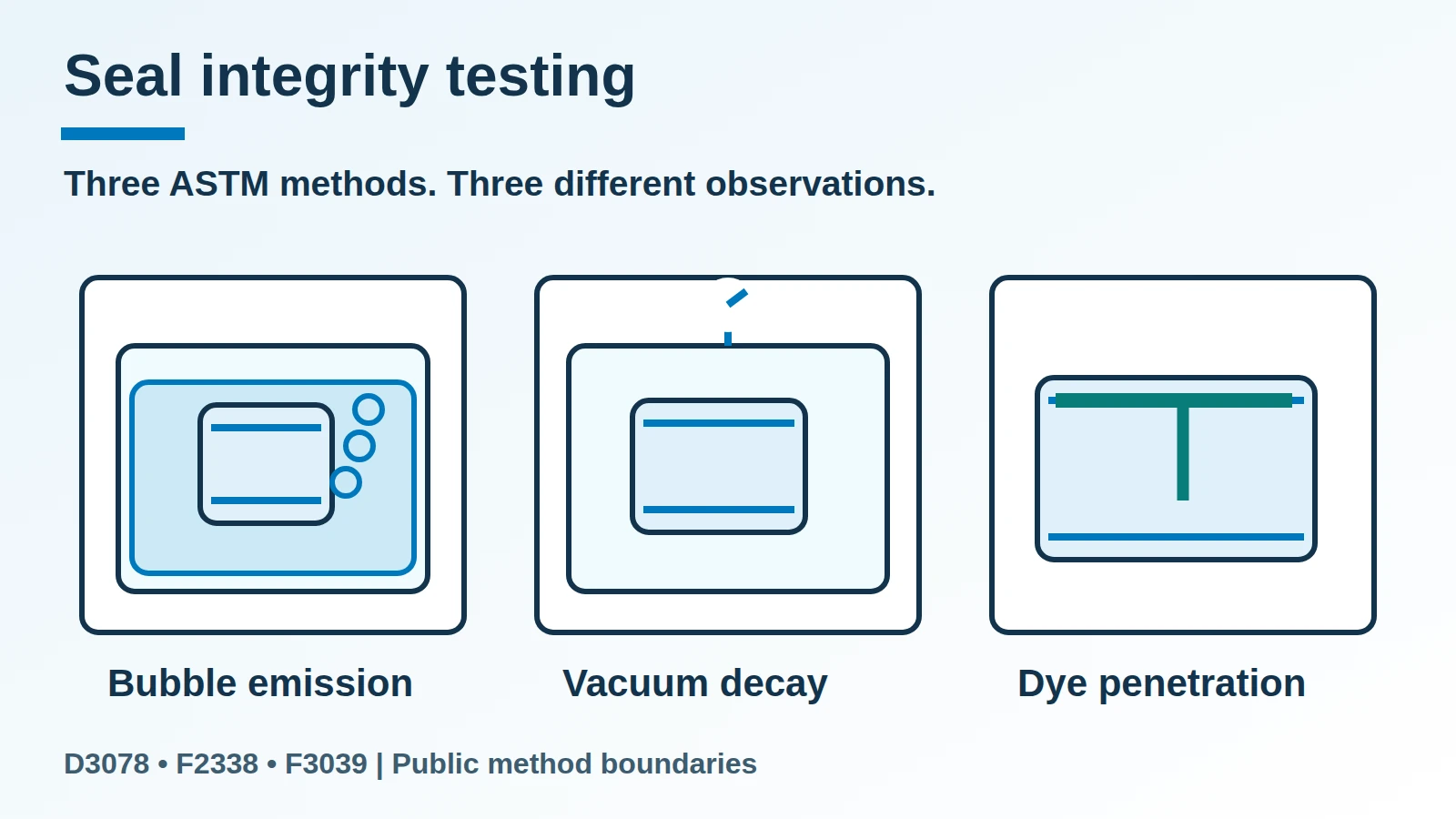
A missed leak leaves the lot decision resting on the wrong observation. Seal integrity testing with ASTM methods starts by matching the package to the test: bubble emission, vacuum decay, and dye penetration answer different questions.
For seal integrity testing, choose the method’s package scope before comparing results. D3078 screens gas-headspace flexible packs for gross leaks; F2338 measures chamber vacuum loss; F3039 locates dye paths in nonporous materials. A clear bubble bath, a pressure response, and a dye stain are different records. None supplies a universal food-pack acceptance number. Keep the package construction, contents, method edition, and result together, then name who holds the affected lot.
Which observation fits the package?
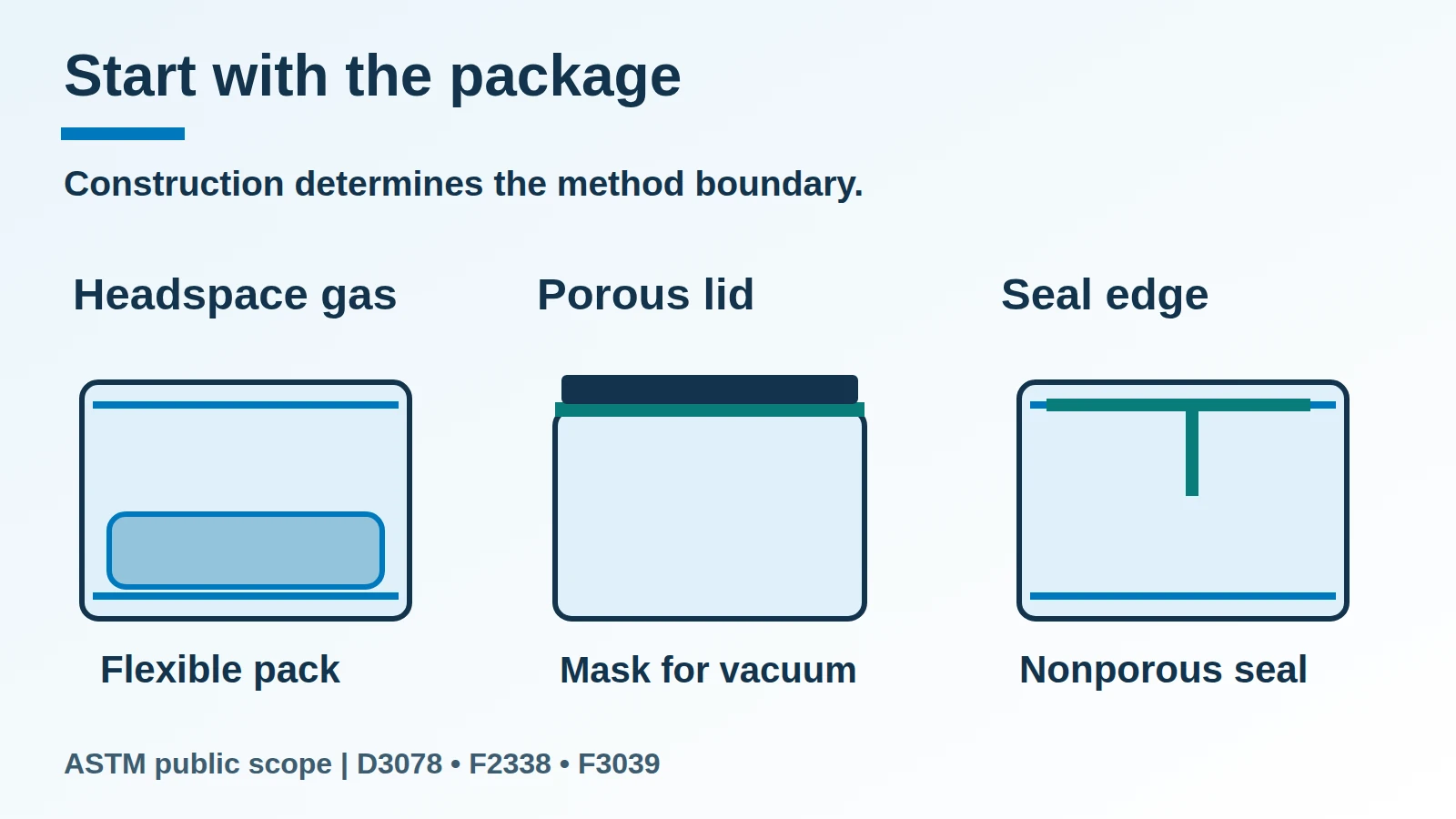
Match the construction and contents to the method before treating a result as evidence. The table uses only the retrieved ASTM public pages; the prevention steps are practical implications of those boundaries.
| ASTM method | Publicly described boundary | What the record can say | Dominant Failure Mode & Prevention |
|---|---|---|---|
| D3078-02(2021)e1, bubble emission | Gross leaks in flexible packs with headspace gas; compatible immersion fluid and room-temperature equilibrium | Whether bubbles were observed under the recorded conditions | Product may plug small openings; record contents and avoid treating no bubbles as proof of no small leaks |
| F2338-24, vacuum decay | Listed rigid, semi-rigid, and flexible package systems; porous barriers need masking | Chamber pressure response against established controls | Gas through an unmasked porous surface obscures the intended measurement; use an appropriate mask and controls |
| F3039-23, dye penetration | Nonporous seals in Method A; nonporous flat sheets in Method B | Location of a dye indication, as a go/no-go result | Poor dye contrast hides indications; check contrast and segregate all dye-exposed samples |
D3078’s public scope makes sensitivity depend on contents, material, and test parameters. Its chamber capability is not a prescribed test setting. Do not turn it into a vacuum setpoint for a filled pouch.
F2338’s public page describes gas or vapor leaving a package into an evacuated chamber. Its acceptance comparison uses non-leaking controls, leaking packs, and simulated leaks. The listed study sensitivities belong to particular product-package systems; they are not a specification for every food pouch.
F3039’s public text treats dye testing as destructive and gives no measured leak size from a stain. Keep a localized indication separate from any claim about leak rate.
What physical boundary changes the choice?
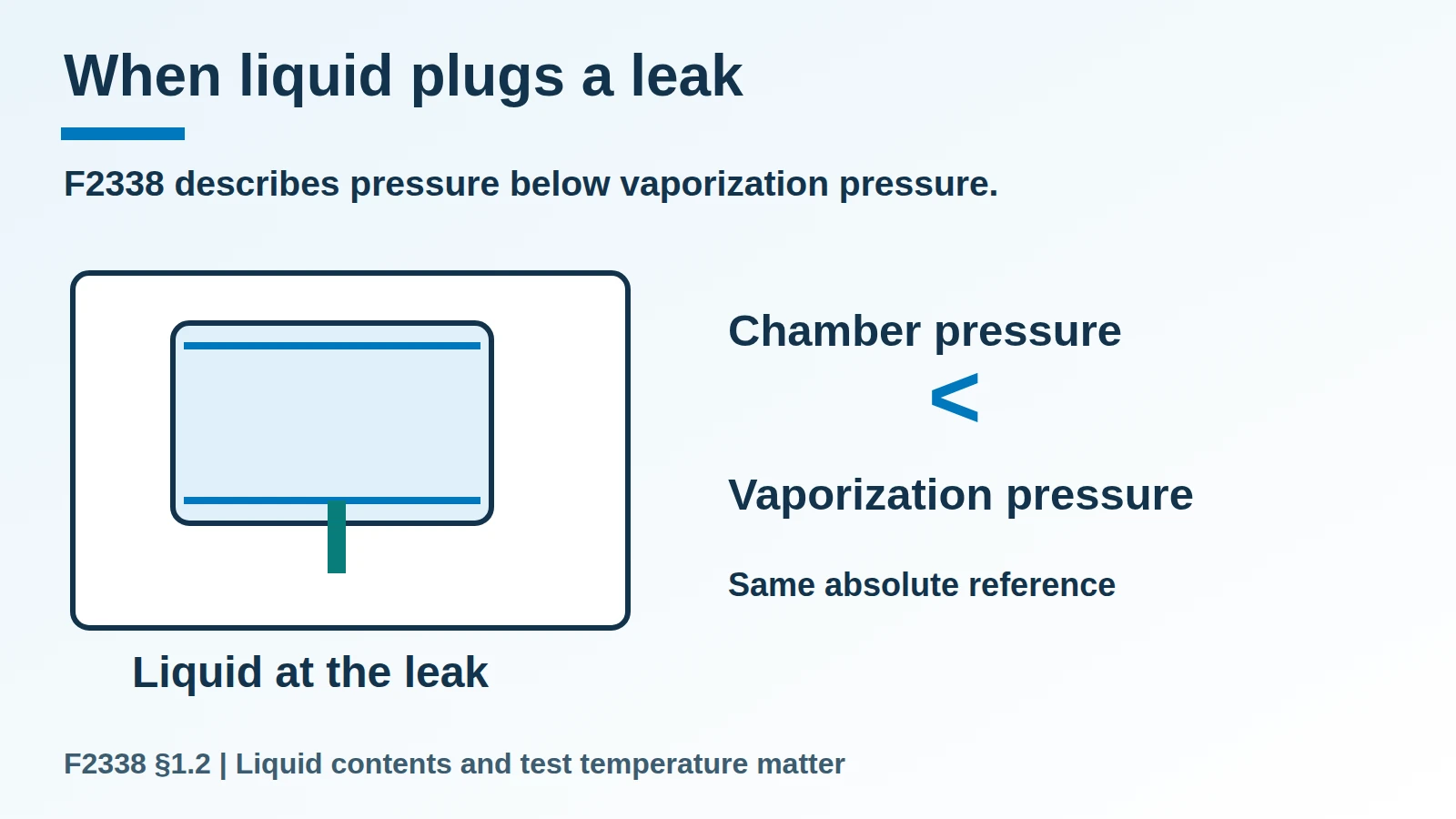
A liquid-plugged leak needs a different vacuum condition from a simple headspace-gas path. F2338 §1.2 states that, for leaks partly or wholly plugged by liquid contents, chamber pressure is taken below that liquid’s vaporization pressure.
Threshold rule: for that liquid-plugged condition, P chamber, absolute < P vaporization of the liquid at the test temperature. Identify the contents and temperature before using the rule. Both pressures must use the same absolute reference. This is a method-selection boundary, not an invented pressure recipe or a food-safety acceptance limit.
F3039 Method A describes an edge-seal channel formed by a 50 µm wire; Method B describes a 10 µm hole in flat sheet. These are different reference defects. Neither number measures the unknown opening behind a dye indication.
What must stay in the sample file?
Keep the object, conditions, observation, and disposition on one record. Start with the parent seal integrity questions, then add the exact method and edition.
For each sample, write the pack construction, contents, lot, sampling time, preparation, recorded test conditions, control identification, and result. Separate the observation from the disposition: “dye indication at this edge” identifies a site; “hold this lot” names an action. Do not replace either with a bare pass mark.
The publicly retrieved portions do not provide a complete operating procedure. The full standards are sold separately. Package-specific acceptance numbers and a validated plant procedure are outside that public text; this guide supplies neither. No peel-strength requirement is inferred from these leak methods.
How much material and time does the check consume?
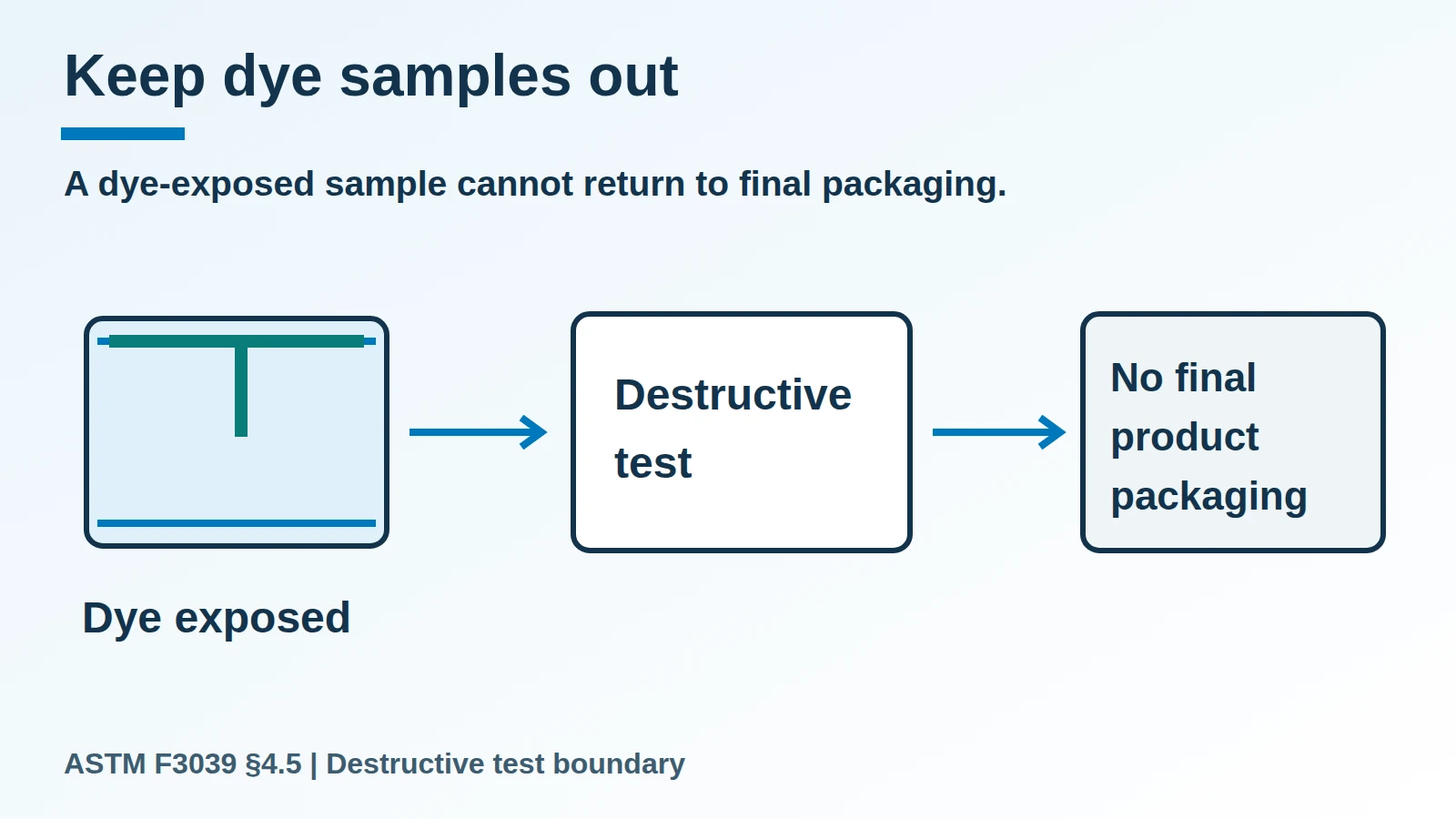
Count consumed samples separately from held stock. Dye-exposed samples cannot return to final product packaging under F3039; nondestructive vacuum-decay testing does not itself authorize release.
Sample mass formula: M consumed = n consumed × m per pack.
Worked example — labeled planning assumptions: 12 dye-exposed packs × 0.25 kg per pack = 3 kg of product in consumed samples. This excludes packaging mass and says nothing about a required sample size, leak prevalence, or lot acceptance.
| Ledger line | Quantity to record | Where the record connects |
|---|---|---|
| Consumed samples | Pack count and product mass; keep dye-exposed material separate | Name the sample in seal integrity questions |
| Setup and test work | Operator minutes, controls, repeat tests, and cleanup | Retain the procedure and evidence in the food-equipment evidence checklist |
| Held stock | Lot, quantity, start and end time, and disposition owner | Preserve the link through coding and lot records |
A sample loss belongs in the mass ledger. An unresolved result belongs in the hold record. Joining those files by lot code through lot number tracking and mass-balance reconciliation prevents the consumed test pack from standing in for the stock awaiting a decision.
Method and source boundary
The comparison uses the public ASTM abstract, scope, and significance text retrieved on 19 October 2026, not the purchased procedures. Diagram labels describe those method boundaries; the mass example uses stated planning assumptions. Latest update: October 2026.