Under § 117.3, a lot means the food produced during a period of time and identified by an establishment’s specific code. Under § 1.1310, a traceability lot is a batch or lot of food that has been initially packed (for raw agricultural commodities other than food obtained from a fishing vessel), received by the first land-based receiver (for food obtained from a fishing vessel), or transformed, and a traceability lot code is a descriptor, often alphanumeric, used to uniquely identify a traceability lot within the records of the traceability lot code source. Review the traceability rules and our coding and lot records guide below to align pack-side lot coding with batch documentation.
Federal Definitions of a Lot, Production Aggregate, and Traceability Lot Code
Under § 113.3(m), a lot means that amount of a product produced during a period of time indicated by a specific code. Under § 113.3(n), low-acid foods are any foods (other than alcoholic beverages) with a finished equilibrium pH greater than 4.6 and a water activity (a w) greater than 0.85, excluding tomatoes and tomato products having a finished equilibrium pH less than 4.7. Under § 114.3(b) and (c), acidified foods have a water activity (a w) greater than 0.85 and a finished equilibrium pH of 4.6 or below, and a lot means the product produced during a period indicated by a specific code.
Under § 106.3 (21 CFR parts 106 and 107), a production aggregate in continuous-process infant formula manufacturing is a specific identified amount produced in a unit of time that is intended to have uniform composition, character, and quality within specified limits and is produced according to a master manufacturing order. Under § 106.3, a production unit is a specific quantity of an infant formula produced during a single cycle of manufacture that has uniform composition, character, and quality within specified limits, and a production unit number or production aggregate number is any distinctive combination of letters, numbers, or symbols from which the complete history of manufacture, processing, packing, holding, and distribution can be determined. Under § 1.1310, transformation is an event in a food’s supply chain that involves manufacturing/processing a food or changing a food (for example, by commingling, repacking, or relabeling) or its packaging or packing, when the output is a food on the Food Traceability List.
Commodity Coding Intervals and Record Retention Rules
- Under § 113.60(c), each hermetically sealed container of low-acid processed food shall be marked with a permanently visible identifying code that identifies in code the establishment where packed, the product contained therein, the year packed, the day packed, and the period during which packed.
- Under § 113.60(c), the packing period code on low-acid canned food containers shall be changed with sufficient frequency to enable ready identification of lots during sale and distribution, and codes may be changed on the basis of intervals of 4 to 5 hours, personnel shift changes, or batches that do not extend over a period of more than one personnel shift.
- Under § 113.100(a) and (b), processing and production information shall be entered on forms that include the product, the code number, the date, the retort or processing system number, the size of container, and the approximate number of containers per coding interval, and must be reviewed by a qualified plant management representative not later than 1 working day after the actual process and before shipment or release for distribution.
- Under § 113.100(f) and (g), initial distribution records shall be maintained to facilitate segregation of specific food lots, and processing and production records shall be retained at the processing plant for not less than 1 year from the date of manufacture and at the processing plant or other reasonably accessible location for an additional 2 years (a 3-year record-retention period).
- Under § 114.80(b), each acidified food container or product shall be marked with an identifying code specifying the establishment where packed, the product contained therein, and the year, day, and period during which it was packed, with the packing period code changed on the basis of intervals of 4 to 5 hours, personnel shift changes, or batches not representing containers processed during more than one personnel shift.
- Under § 106.80, each production aggregate of infant formula shall be coded with a sequential number that identifies the product and the establishment where packed and permits tracing of all stages of manufacture, including the year, the days of the year, the period during those days that the product was packed, and the receipt and handling of raw materials used.
- Under § 56.37, officially identified shell eggs shall be legibly lot numbered on either the individual egg, the carton, or the consumer package, and the lot number shall be the consecutive day of the year on which the eggs were packed (for example, 132), unless another lot numbering system is submitted in writing and approved by the Administrator.
- Under § 381.126(a) and (b), either the immediate container or shipping container of all poultry food products shall be plainly and permanently marked by code or otherwise with the date of packing, and the immediate container for dressed poultry shall be marked with a lot number which shall be the number of the day of the year on which the poultry was slaughtered or a coded number.
- Under § 317.8(b)(32)(i) and (ii), a calendar date shown on meat labeling shall express the month of the year and the day of the month for all products, and also the year for products hermetically sealed in metal or glass containers, dried or frozen products, and must be immediately adjacent to a phrase explaining the meaning of the date in terms of ‘packing’ date, ‘sell by’ date, or ‘use before’ date.
| Product Category | Rule Reference | Required Container Code and Period Change Basis |
|---|---|---|
| Human food (general) | § 117.3 | Food produced during a period of time and identified by an establishment’s specific code |
| Low-acid canned foods | § 113.60(c) | Permanently visible code identifying establishment, product, year packed, day packed, and packing period; changed at intervals of 4 to 5 hours, personnel shift changes, or batches not extending over more than one personnel shift |
| Acidified foods | § 114.80(b) | Code specifying establishment, product, year, day, and packing period; changed at intervals of 4 to 5 hours, personnel shift changes, or batches not representing containers processed during more than one personnel shift |
| Infant formula | § 106.80 | Sequential number on each production aggregate identifying product and establishment and tracing year, days of the year, period packed, and receipt and handling of raw materials used |
| Officially identified shell eggs | § 56.37 | Legibly lot numbered on individual egg, carton, or consumer package using consecutive day of the year packed (e.g., 132), unless another system is approved in writing |
| Poultry food products | § 381.126(a) and (b) | Immediate or shipping container marked with date of packing; dressed poultry immediate container marked with day of the year slaughtered or a coded number |
| Meat labeling calendar dates | § 317.8(b)(32)(i) and (ii) | Calendar date expressing month and day (plus year for hermetically sealed metal or glass containers, dried, or frozen products) immediately adjacent to packing date, sell by date, or use before date |
Decoding Pack-Side Lot Code Formats: Julian Dates, Leap-Year Offsets, and Shift Strings
In the 4-digit YDDD Julian date code format documented by Nehemiah Manufacturing, the first digit (Y) is the last digit of the production year (for example, 5 for 2025) and the following 3 digits (DDD) are the Julian Date Code representing the day of the year from 001 to 365 (or 366 on leap years), optionally extended with production time or production line number as YDDD HH:MM or YDDD ##. In Trust20’s comparison of open dating versus closed dating, closed date codes include Julian codes showing the number of days since the beginning of the calendar year, where a Julian date of 031 means January 31st and 365 means December 31st. Pair the format breakdowns below with our date code rub and placement guide when checking print legibility on pouches, jars, and cartons.
In the Standard Year Julian Dates Calendar, January 1 is day 1, February 1 is day 32, March 1 is day 60, January 31 is day 31, March 31 is day 90, May 31 is day 151, July 31 is day 212, August 31 is day 243, October 31 is day 304, and December 31 is day 365. In the Leap Year Julian Dates Calendar, February has 29 days (February 29 is day 60), March 1 is day 61, March 31 is day 91, May 31 is day 152, July 31 is day 213, August 31 is day 244, October 31 is day 305, and December 31 is day 366.
Multi-Segment Lot Code Examples and Floor Transcription Errors
In Allera’s multi-site lot code example B2 1470 3A, segment B2 identifies Plant B, Line 2; 147 is the Julian date (Day 147 of the year, 27 May in a non-leap year); 0 is the last digit of the year; 3 is the third shift; and A is the first lot produced on that line and shift. Two common floor errors with Julian date codes are digit transposition—where day 147 gets read or entered as 174—and single-digit year ambiguity across decades, where a code ending in 0 could be 2020 or 2030; in a non-leap year, Day 032 is 1 February and Day 200 is 19 July.
In Bentsai’s lot code examples, LOT-2405-A breaks down as 24 for the year (2024), 05 for the day of production (often the 5th day of the cycle), and A for the shift or production line; while PL-07-165-26-A encodes PL as Facility code (Plant A), 07 as Product code, 165 as the 3-digit Julian date (June 14th), 26 as Year (2026), and A as Shift A. In ANSER Coding’s export shipping carton example, a GS1-128 barcode containing GTIN, production/harvest date, and lot number is paired with a human-readable TLC (such as Mar24 5124) and a lot-specific product-and-date code (such as MANGO240324). In Wolf Packing’s packaging line traceability example, when packing line A fills 1,000 jars from ingredient lot X123, each jar receives Traceability Lot Code A-X123-0320 so contamination can be traced upstream to supplier lot X123 and downstream to all A-X123-0320 shipments.
| Code Format or Calendar Type | Segment Structure | Decoded Meaning and Day Values |
|---|---|---|
| 4-digit Julian date code | YDDD, YDDD HH:MM, or YDDD ## | First digit Y is last digit of year (5 for 2025); following 3 digits DDD represent day of the year from 001 to 365 (or 366 on leap years); ## is production line number |
| Standard Year Julian Calendar | 365-day calendar | Jan 1 is day 1; Jan 31 is day 31; Feb 1 is day 32; Mar 1 is day 60; Mar 31 is day 90; May 31 is day 151; Jul 31 is day 212; Aug 31 is day 243; Oct 31 is day 304; Dec 31 is day 365 |
| Leap Year Julian Calendar | 366-day calendar | Feb has 29 days (Feb 29 is day 60); Mar 1 is day 61; Mar 31 is day 91; May 31 is day 152; Jul 31 is day 213; Aug 31 is day 244; Oct 31 is day 305; Dec 31 is day 366 |
| Multi-site line and shift code | B2 1470 3A | B2 is Plant B, Line 2; 147 is Julian date (Day 147 of the year, 27 May in a non-leap year); 0 is last digit of year; 3 is third shift; A is first lot produced on that line and shift |
| Facility and cycle lot codes | LOT-2405-A and PL-07-165-26-A | In LOT-2405-A, 24 is 2024, 05 is day of production (often the 5th day of the cycle), A is shift or line; in PL-07-165-26-A, PL is Plant A, 07 is Product code, 165 is 3-digit Julian date (June 14th), 26 is 2026, A is Shift A |
| Export shipping carton codes | GS1-128 with Mar24 5124 and MANGO240324 | GS1-128 barcode holds GTIN, production/harvest date, and lot number alongside human-readable TLC Mar24 5124 and lot-specific product-and-date code MANGO240324 |
| Ingredient-linked line TLC | A-X123-0320 | Packing line A filling 1,000 jars from ingredient lot X123 applies TLC A-X123-0320 to link supplier lot X123 to all downstream A-X123-0320 shipments |
Machine-Readable Case and Pallet Lot Coding with Application Identifiers
In the GS1 Application Identifiers vocabulary, AI 00 is the Serial Shipping Container Code (SSCC) with formatString N2+N18 (fixedLength: true, length: 18, checkDigit: true), and AI 01 is the Global Trade Item Number (GTIN) with formatString N2+N14 (fixedLength: true, length: 14, checkDigit: true, and gs1DigitalLinkQualifiers 22, 10, 21). In the GS1 Application Identifiers vocabulary, AI 10 is the Batch or lot number (title BATCH/LOT) with formatString N2+X..20, variable length (fixedLength: false) up to 20 characters, separatorRequired: true, and requires AI 01, 02, 03, 8006, or 8026.
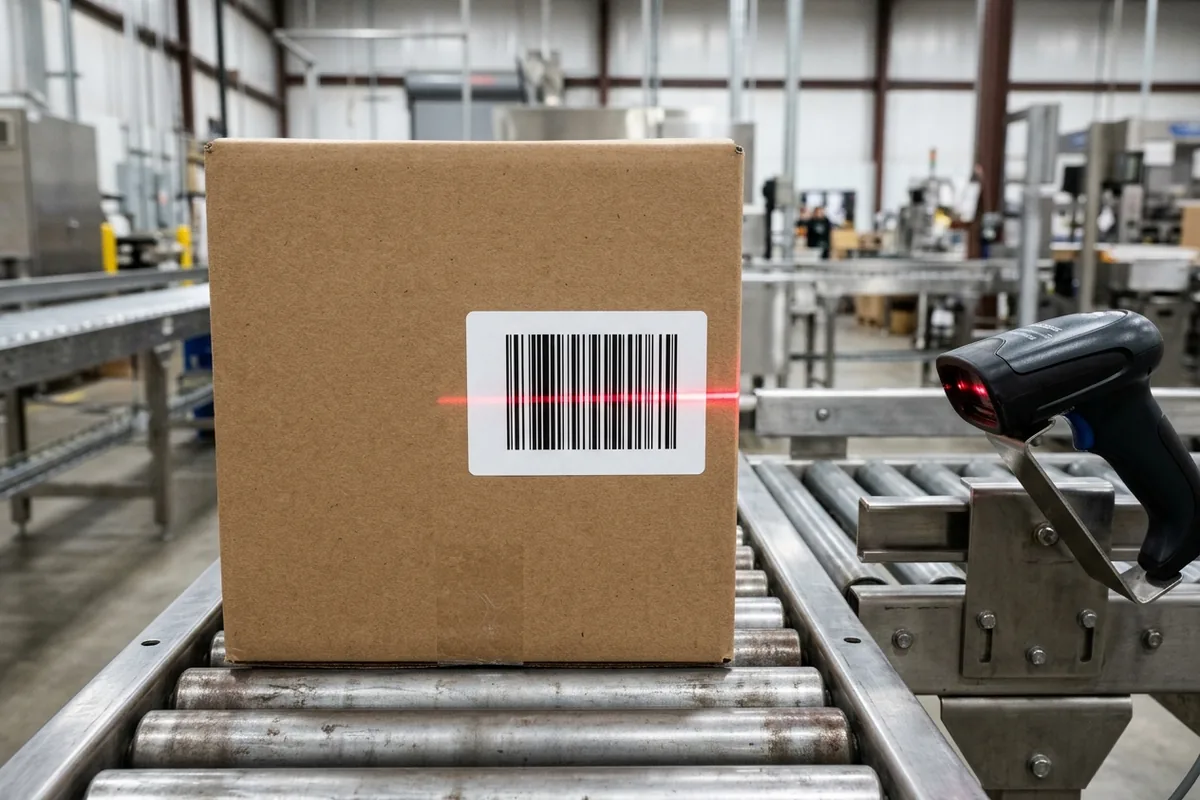
In the GS1 Application Identifiers vocabulary, AI 11 is Production date (PROD DATE) and AI 13 is Packaging date (PACK DATE); both have formatString N2+N6 in YYMMDD (yymmd0) format with fixedLength: true, length: 6, and separatorRequired: false. In the GS1 Application Identifiers vocabulary, AI 15 is Best before date (BEST BEFORE or BEST BY), AI 16 is Sell by date (SELL BY), and AI 17 is Expiration date (USE BY or EXPIRY); all three use formatString N2+N6 in YYMMDD (yymmd0) format with fixedLength: true, length: 6, and separatorRequired: false. In the GS1 Application Identifiers vocabulary, AI 7003 is Expiration date and time (EXPIRY TIME) with formatString N4+N10 in YYMMDDhhmm format (composed of a length 6 yymmdd component and a length 4 hhmm component), separatorRequired: true, and requires AI 01 or 02.
| Identifier Code | Field Title and Format | Length, Separator, and Pairing Rules |
|---|---|---|
| AI 00 and AI 01 | Serial Shipping Container Code (SSCC, N2+N18) and Global Trade Item Number (GTIN, N2+N14) | AI 00 has fixedLength: true, length: 18, checkDigit: true; AI 01 has fixedLength: true, length: 14, checkDigit: true, and gs1DigitalLinkQualifiers 22, 10, 21 |
| AI 10 | Batch or lot number (BATCH/LOT, formatString N2+X..20) | Variable length (fixedLength: false) up to 20 characters; separatorRequired: true; requires AI 01, 02, 03, 8006, or 8026 |
| AI 11 and AI 13 | Production date (PROD DATE) and Packaging date (PACK DATE) in YYMMDD (yymmd0) format (N2+N6) | Both use fixedLength: true, length: 6, and separatorRequired: false |
| AI 15, AI 16, and AI 17 | Best before date (BEST BEFORE or BEST BY), Sell by date (SELL BY), and Expiration date (USE BY or EXPIRY) in YYMMDD (yymmd0) format (N2+N6) | All three use fixedLength: true, length: 6, and separatorRequired: false |
| AI 7003 | Expiration date and time (EXPIRY TIME) in YYMMDDhhmm format (formatString N4+N10) | Composed of a length 6 yymmdd component and a length 4 hhmm component; separatorRequired: true; requires AI 01 or 02 |
Rework Addition, Lot-Splitting Boundaries, and Recall Scope Control
Under § 117.3, rework means clean, unadulterated food that has been removed from processing for reasons other than insanitary conditions or that has been successfully reconditioned by reprocessing and that is suitable for use as food; allergen cross-contact means the unintentional incorporation of a food allergen into a food; and sanitize means to adequately treat cleaned surfaces by a process that is effective in destroying vegetative cells of pathogens, and in substantially reducing numbers of other undesirable microorganisms, but without adversely affecting the product or its safety for the consumer. Under § 117.80(b)(5), (b)(8), and (c)(5), raw materials, other ingredients, and rework must be held in bulk, or in containers designed and constructed so as to protect against allergen cross-contact and against contamination, and material scheduled for rework must be identified as such; raw materials and other ingredients that are food allergens, and rework that contains food allergens, must be identified and held in a manner that prevents allergen cross-contact; and work-in-process and rework must be handled in a manner that protects against allergen cross-contact, contamination, and growth of undesirable microorganisms. Coordinate these lot-splitting boundaries with forward and backward recall lot tracking, packaging line clean-in-place validation, and allergen changeover evidence records.
In Section 4 (Table 4-2) of the FDA Food Processing GMP Study, the expert panel identified ‘incorrect labeling or packaging’ and ‘poor plant and equipment sanitation’ as main problems for baked goods, rated ‘incorrect labeling or packaging’ with the highest allergen risk score across sectors, and identified ‘incorrect labeling or packaging’ (7 responses, 44%) and ‘contamination by reworked product’ (5 responses, 31%) among processor-level food safety problems. In Section 4 (Table 4-14) of the FDA Food Processing GMP Study, the record types most frequently recommended by experts as preventive controls were cleaning and sanitation related records (87 percent), equipment maintenance records (73 percent), supplier audit records (67 percent), and personnel records (60 percent), alongside raw material/ingredient records, labeling and packaging records, and rework allergen controls. Under § 430.4(a) and (b)(3)(ii)(B)–(C) (and 9 CFR 417.5 recordkeeping), ready-to-eat (RTE) product is adulterated if it contains Listeria monocytogenes or comes into direct contact with a food-contact surface contaminated with L. monocytogenes; if an establishment under Alternative 3 producing deli or hotdog products obtains a second positive food-contact surface test for an indicator organism during follow-up testing, it must hold lots of product that may have become contaminated until the problem is corrected and either sample and test the held lots or rework them using a process destructive of L. monocytogenes.
Under § 1.1320(a) and (b), a firm must assign a traceability lot code when it initially packs a raw agricultural commodity (other than a food obtained from a fishing vessel), performs the first land-based receiving of a food obtained from a fishing vessel, or transforms a food, and must not establish a new traceability lot code when conducting other activities such as shipping. Under § 1.1350(a)(1) and (2), for each new traceability lot of food produced through transformation, records must link each input Food Traceability List food’s traceability lot code, product description, and quantity and unit of measure used from that lot to the new output traceability lot code, transformation location description, completion date, product description, quantity and unit of measure (such as 6 cases, 25 reusable plastic containers, 100 tanks, 200 pounds), and reference document type and number. Under § 1.1455(c)(1), (c)(3)(ii), and (d), required traceability records must be made available to an authorized FDA representative within 24 hours after a request—along with any information needed to understand these records, such as internal or external coding systems, glossaries, and abbreviations—provided in an electronic sortable spreadsheet when requested under paragraph (c)(3), and retained for 2 years from the date created or obtained. The original compliance date for the FDA Food Traceability Final Rule (implementing Section 204(d) of FSMA in 21 CFR Part 1 Subpart S) was Tuesday, January 20, 2026; the FDA proposed extending the compliance date by 30 months to July 20, 2028, and the Continuing Appropriations, Agriculture, Legislative Branch, Military Construction and Veterans Affairs, and Extensions Act of 2026 directed FDA not to enforce the rule prior to July 20, 2028.
Lot Boundary Triggers, Mid-Lot Coder Stops, and Recall Volume
In Allera’s lot-sizing comparison for an identical ingredient contamination event, a facility running one lot per production day must recall everything made that day across all lines and shifts (roughly 40,000 units), whereas a facility running one lot per line per shift recalls only one line and one shift (roughly 7,000 units), with lot boundaries triggered by shift change, sanitation or CIP break, raw material lot change, formulation or specification change, or significant process deviation followed by a restart. In Allera’s wrong-code incident response sequence, when a coder is set to the wrong date, a line or shift digit is incorrect, or nothing printed at all, the response sequence is to stop the line and quarantine everything produced since the last verified good check—if the last verification was four hours ago, four hours of production is in scope; if it was fifteen minutes ago, fifteen minutes is in scope.
According to Wolf Packing’s packaging traceability guide, tighter lot control through automated packaging systems reduces recall scope by 60-80% compared to manual date-code tracking; broad date-code recalls withdraw 50,000-500,000 units from a production day while lot-level recalls limit withdrawal to 5,000-50,000 units; and Dot Foods reported that 4-6% of inbound pallets contain mixed lot codes. In SG Systems Global’s traceability KPIs, rework visibility is defined as the percentage of rework routed through defined, traceable paths versus ad-hoc practices (with a target of 100 % defined paths), and label scan failure rate is measured as the number of unreadable or non-compliant GS1-128/SSCC labels per 10,000 scans. In our own coding-and-lot-records guide (referencing the 9 August 2004 FDA study), the four roles connecting a pack mark to a batch record are Mark, Meaning, Match, and Break—where a mid-lot coder stop requires writing the last good unit and the first unit after the restart as two rows so a single code does not hide the break.
| Operational Scenario | Lot Boundary or Handling Rule | Record and Scope Impact |
|---|---|---|
| Rework container staging and allergen holding (§ 117.80(b)(5), (b)(8), and (c)(5)) | Hold raw materials, other ingredients, and rework in bulk or containers protecting against allergen cross-contact and contamination; identify material scheduled for rework as such; handle work-in-process and rework to protect against allergen cross-contact, contamination, and growth of undesirable microorganisms | Raw materials and other ingredients that are food allergens, and rework containing food allergens, must be identified and held in a manner that prevents allergen cross-contact |
| Post-lethality RTE follow-up surface positive (§ 430.4(a) and (b)(3)(ii)(B)–(C)) | Hold lots of deli or hotdog product under Alternative 3 after a second positive indicator test on a food-contact surface | Sample and test held lots or rework them using a process destructive of L. monocytogenes under 9 CFR 417.5 recordkeeping |
| Transformation of Food Traceability List foods (§ 1.1350(a)(1) and (2)) | Assign a new output traceability lot code and link each input FTL lot code, product description, and quantity used | Record output TLC, location, completion date, quantity and unit of measure (e.g., 6 cases, 25 reusable plastic containers, 100 tanks, 200 pounds), and reference document number |
| Regulatory record and code key request (§ 1.1455(c)(1), (c)(3)(ii), and (d)) | Provide required traceability records plus internal or external coding systems, glossaries, and abbreviations within 24 hours | Supply an electronic sortable spreadsheet when requested under paragraph (c)(3) and retain records for 2 years |
| Line-and-shift vs. full-day lot boundary | Split lots at shift change, sanitation or CIP break, raw material lot change, formulation or specification change, or significant process deviation followed by restart | Reduces single-ingredient contamination recall scope from roughly 40,000 units (one lot per day across all lines and shifts) to roughly 7,000 units (one lot per line per shift) |
| Automated lot-level vs. broad date-code tracking | Replace manual full-day date-code tracking with automated batch-level lot control and pallet lot segregation (4-6% of inbound pallets at Dot Foods contain mixed lot codes) | Reduces recall scope by 60-80%, narrowing withdrawals from 50,000-500,000 units per production day to 5,000-50,000 units per batch |
| Wrong-code print or unprinted pack incident (Allera response sequence) | In Allera’s response sequence when the coder has the wrong date, wrong line or shift digit, or no print, stop the line and quarantine everything produced since the last verified good check | Verification four hours ago places four hours of production in quarantine scope; verification fifteen minutes ago limits scope to fifteen minutes |
| Mid-lot coder stop and restart (9 August 2004 study reference) | Connect the pack mark and batch record across Mark, Meaning, Match, and Break | Write the last good unit before the stop and the first unit after the restart as two rows so one code does not hide the break |
Sources
- U.S. Food and Drug Administration — Code of Federal Regulations, Current Good Manufacturing Practice, Hazard Analysis, and Risk-Based Preventive Controls for Human Food
- U.S. Food and Drug Administration — Code of Federal Regulations, Thermally Processed Low-Acid Foods Packaged in Hermetically Sealed Containers
- U.S. Food and Drug Administration — Code of Federal Regulations, Acidified Foods
- U.S. Food and Drug Administration — Code of Federal Regulations, Infant Formula Requirements Pertaining to Current Good Manufacturing Practice, Quality Control Procedures, Quality Factors, Notification Requirements, and Records and Reports
- U.S. Food and Drug Administration — Code of Federal Regulations, Additional Traceability Records for Certain Foods
- U.S. Food and Drug Administration — Food Safety Modernization Act Final Rule on Requirements for Additional Traceability Records for Certain Foods
- U.S. Food and Drug Administration — Good Manufacturing Practices for Food Processing Study, Common Food Safety and Quality Problems
- U.S. Department of Agriculture Agricultural Marketing Service — Code of Federal Regulations, Voluntary Grading of Shell Eggs, Lot Marking of Officially Identified Shell Eggs
- U.S. Department of Agriculture Food Safety and Inspection Service — Code of Federal Regulations, Poultry Products Inspection Regulations, Date of Packing and Date of Processing
- U.S. Department of Agriculture Food Safety and Inspection Service — Code of Federal Regulations, Labeling, Marking Devices, and Containers
- U.S. Department of Agriculture Food Safety and Inspection Service — Code of Federal Regulations, Control of Listeria monocytogenes in Post-Lethality Exposed Ready-to-Eat Products
- Global Traceability Vocabulary — Application Identifiers Specification for Logistics and Batch Identification
- Nehemiah Manufacturing — Julian Date Code Key and Translator
- Allera Technologies — What Is a Lot Code: How to Read, Design, and Verify One
- Bentsai — What Is a Lot Code: A Guide to Formats and Printing
- Trust Twenty — Decoding Date Codes: How Do I Read Julian Codes and Date Marks
- Anser Coding — Understanding Traceability Lot Codes
- Wolf Packing Machine Company — Food Traceability and Packaging Machines
- SG Systems Global — Food Traceability Key Data Elements and Critical Tracking Events Guide
- Food Safety Audit Notes — How a Pack Code and a Lot Record Meet