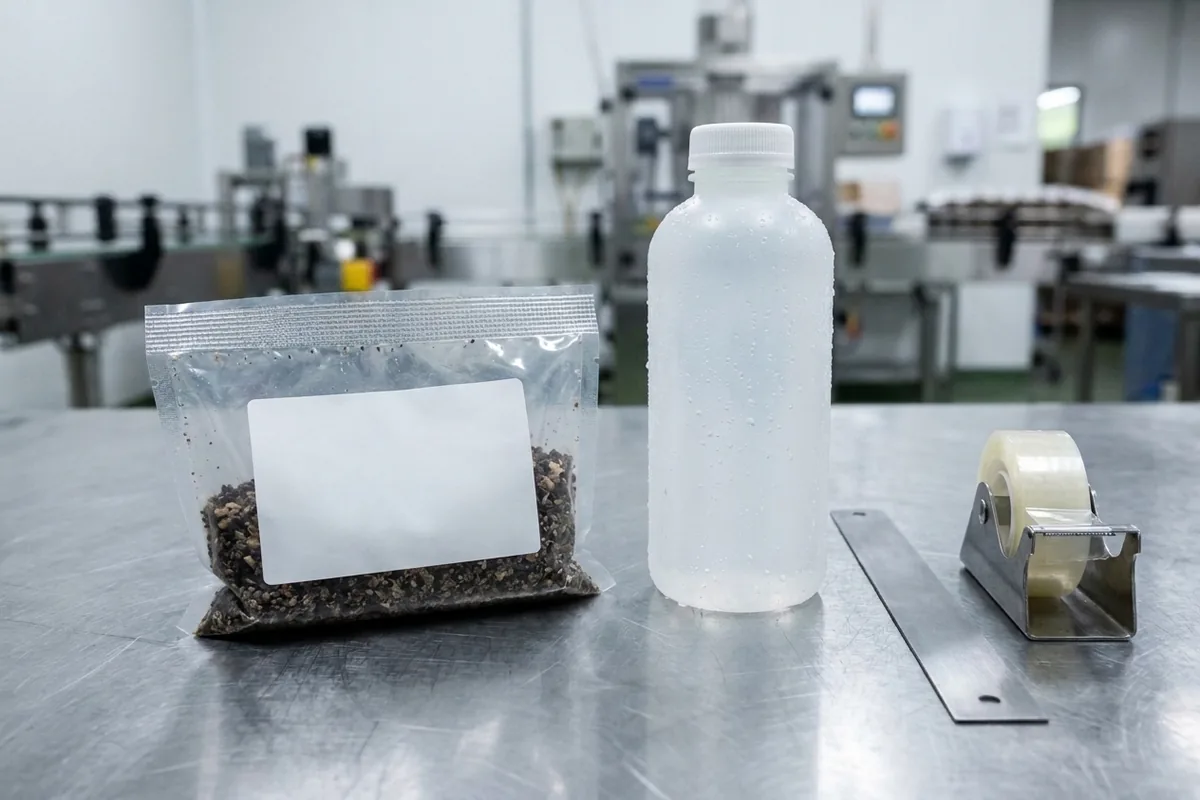
A date code check fails in distribution when quality assurance signs off on a crisp, dark print sample pulled from a dry, stationary film web at shift startup, only for the expiration date code and batch lot mark to smear off against wet conveyor rails, dissolve in filling-head oil mist, or vanish inside the serrated crimp of a vertical form-fill-seal (VFFS) heat-seal jaw. When a printed mark becomes illegible between the packaging line and the retail shelf, automated warehouse scanners reject the case, retailers issue compliance chargebacks, and a targeted batch withdrawal expands into a multi-week recall because neither consumers nor inspectors can read the package identifier.
Within our traceability cluster, our foundational guide on coding and lot records separates the physical mark on the pack (Mark), the batch file that defines it (Meaning), the cross-check between the two (Match), and the two-row split required when a coder stops mid-run (Break). Once that batch linkage is established, our lot number tracking and 4-hour mock recall protocol governs how GS1 application identifiers, multi-roll film splices, and modified atmosphere packaging (MAP) gas lots close to a 100.0% mass balance. This engineering guide owns the physical survival of the mark itself: substrate wetting physics (dynes/cm²), opaque contrast windows and ISO/IEC 15415 / 15416 optical grading, standardized dry, condensation, oil, and 90° tape-pull date code rub test procedures, and pack code placement rules that keep variable codes at least 8 mm (0.3 in) clear of heat-seal seams and container edges.
| Physical Retention Dimension | Governing Standard / OEM Technical Benchmark | Line-Side Control Variable | Mandatory Verification Target | Dominant Failure Mode & Engineering Prevention |
|---|---|---|---|---|
| 1. Ink Wetting & Surface Energy | Videojet Application Note (Inkjet Inks for Plastics) | Solvent ink tension (22–25 dynes/cm²) vs. polymer surface energy (dynes/cm²) |
Substrate surface energy >= ink + 10 dynes/cm² (>= 32–35 dynes/cm²) + 100% dry/clean contact |
Ink drops bead up on low-energy BOPP/HDPE or float on condensation water films; corona/plasma treat web and strip water with air knives |
| 2. Substrate Contrast & Optical Grade | ISO/IEC 15415 (2D) & ISO/IEC 15416 (1D); GS1 US & Videojet Sunrise 2027 specs | Ink/background color pair, clear-film window opacity, PoS 2D X-dimension | Minimum ISO Grade C (>= 1.5 / 4.0); PoS 2D QR X-dim 0.396 to 0.990 mm (0.495 mm target) |
Red ink invisible to red-light scanners; dark food inside clear pouches ruins contrast; print black/dark blue/dark green on solid white window |
| 3. Dry, Condensation & Oil Rub Test | PTS-DF 103/2011 (300 DPI timed wipe), ISO 18935 (1 h DI water soak), Videojet 4-tier scale |
Post-print cure delay (s), pad pressure, stroke count, water/oil film state |
Best (100% unchanged) or Excellent (> 75% unchanged, 100% legible) after wet/oil rub |
Uncalibrated dry finger swipe misses post-pasteurization or oil-smear rub-off; test chilled/wet and oil-smeared packs after timed cure |
| 4. 90° Tape Pull & Carton Scuff | IPC-TM-650 (3M 600 0.5 in), Cross-Hatch (3M 610 1 in), ASTM D5264 (Sutherland 2000 / Hanatek) |
Tape grade, 3 squeegee strokes, dwell (< 1 min or 5 min), 90° pull, 2 lb / 4 lb rub load |
Zero ink drop lift disabling character/module decoding (100% legible post-pull & post-scuff) |
Brittle or under-cured resin lifts onto case tape or scuffs against corrugated dividers; match ink resin chemistry to polymer and lock cure time |
| 5. Seam & Edge Placement | GS1 US Bar Code Symbol Placement (Sec. 2.3, 3.3.3, 4.1, 4.3, 4.5); Domino V230i TTO VFFS notes |
Edge/seam clearance (mm), cylinder tangent angle (θ), VFFS encoder registration |
>= 8 mm (0.3 in) and <= 102 mm (4 in) from edges/seals; ladder orientation when θ > 30° |
Code drifts into VFFS fin/end sealing jaws or wraps tight bottle necks; lock encoder registration and enforce >= 8 mm seam margin |
1. Why dry-film checks fail: surface energy (dynes/cm²), condensation films, and open vs. closed date codes
Key takeaway: A date code survives wet, oily, and high-friction packaging lines only when the plastic substrate’s surface energy exceeds the liquid ink’s surface tension by at least 10 dynes/cm² (>= 32 to 35 dynes/cm² for 22 to 25 dynes/cm² solvent inks) and the print zone is completely free of condensation water or product oil at the instant of drop impact.
Food packages carry two functional categories of date and batch markings that share the same physical ink-retention vulnerabilities on the line:
- Open date codes (consumer-facing expiration date codes): Human-readable calendar dates printed for retail buyers and store rotation, such as Best if Used By, Sell By, Freeze By, or mandatory Use By safety dates (encoded in machine-readable GS1 symbols under Application Identifier
AI (15)for Best-Before Date orAI (17)for Expiration Date inYYMMDDformat). - Closed date codes (manufacturing and traceability lot codes): Alphanumeric plant, line, shift, Julian date, and military-time strings (
AI (10)Batch/Lot Number) used by quality teams to isolate production windows during a 4-hour forward and backward mock recall. As documented in Section 4 of the U.S. Food and Drug Administration 2004 GMP study, incorrect labeling or packaging ranks among the top operational food safety problems; an unreadable date or lot mark breaks the link between the unit in commerce and the batch file.
Drying time vs. ink adhesion: why fast-drying solvent inks still wipe off
A common troubleshooting error on packaging lines is confusing ink drying time with ink adhesion. As detailed in Videojet Technologies’ application note Choosing the Right Inkjet Inks for Plastics, these two properties are governed by separate chemical mechanisms:
- Solvent evaporation controls drying time, not adhesion: In Continuous Inkjet (
CIJ) and Thermal Inkjet (TIJ) formulations, the volatile solvent carrier (such as methyl ethyl ketoneMEK, ethanol, or acetone blends) evaporates rapidly after drop impact so the mark does not transfer onto adjacent idler rollers. However, the solvent type has negligible influence over whether the dried mark adheres to the polymer. - Resin chemistry and contact surface area control adhesion: Once the solvent flashes off, mechanical resistance to rubbing, scuffing, and tape pull depends on the physical and chemical bond between the ink’s binder resin and the plastic substrate (
HDPE,BOPP,PP, orPET). The larger the microscopic contact area between the ink drop and the polymer surface, the stronger the bond. - Surface energy and drop spreading (
22–25 dynes/cm²vs.>= 32–35 dynes/cm²): Liquid ink droplets spread flat across a plastic film only when the solid substrate’s surface energy (γ_substrate) is substantially higher than the liquid ink’s surface tension (γ_ink). Solvent-based inkjet inks typically operate at a surface tension of22 to 25 dynes/cm². To achieve complete drop wetting and wide contact area, Videojet’s engineering guideline requires the substrate surface energy to be at least10 dynes/cm²higher than the ink:
Surface Energy Wetting Margin Equation:
Δγ = γ_substrate - γ_ink >= 10 dynes/cm²
- Worked calculation (representative polyolefin film qualification): Suppose a packaging line runs a solvent-based
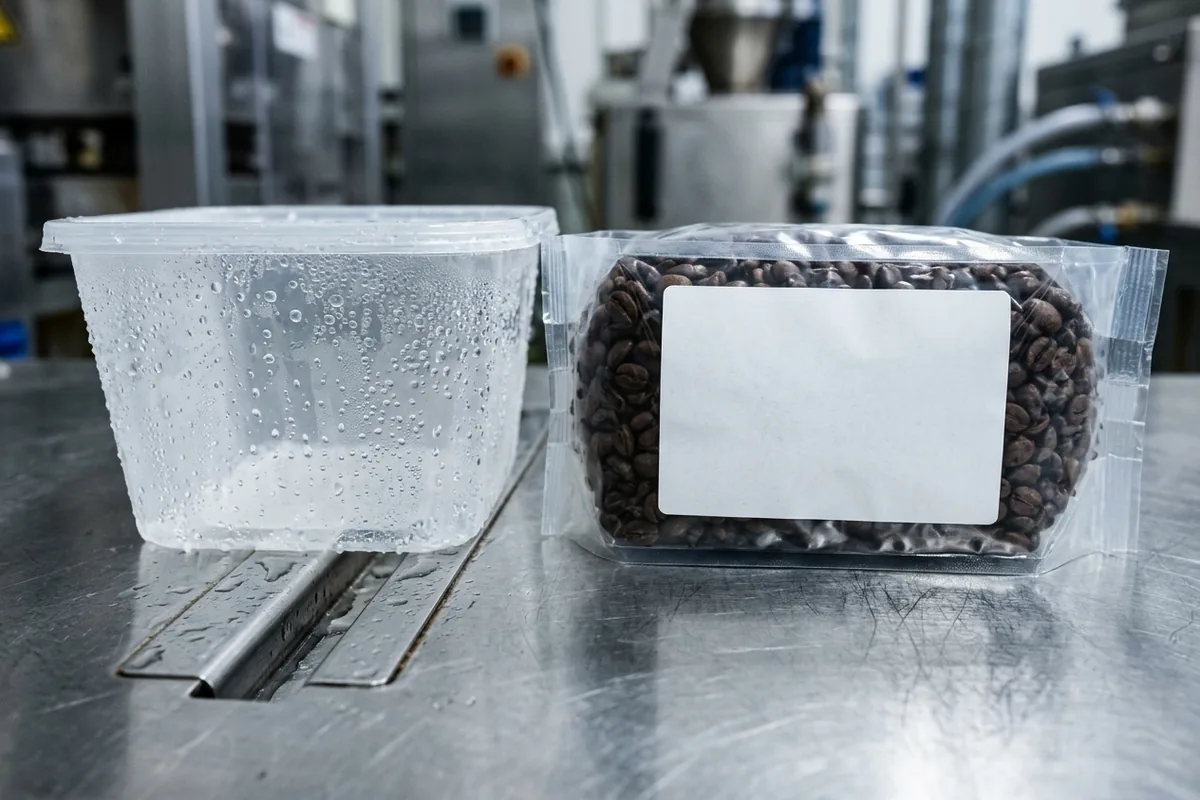
CIJink with a surface tension ofγ_ink = 24 dynes/cm²on untreated biaxially oriented polypropylene (BOPP) or polyethylene (PE) film whose native surface energy isγ_untreated = 29 dynes/cm². The wetting margin isΔγ = 29 - 24 = 5 dynes/cm², which falls below the10 dynes/cm²threshold (5 < 10 dynes/cm²)—causing the ink drops to bead into high-contact-angle spheres with minimal footprint that smear off under light finger or carton friction. Passing the film through an inline corona or plasma treater to raise substrate surface energy toγ_treated = 38 dynes/cm²yieldsΔγ = 38 - 24 = 14 dynes/cm² >= 10 dynes/cm², restoring full drop spreading and resin anchoring. - Why condensation water, oil mist, and dust cause instant adhesion loss: Even on properly corona-treated film (
>= 35 dynes/cm²) or high-energy polyester (PET), trace surface contamination from cold-fill condensation water films, cooking or filling oils, release agents, or food dust physically blocks the ink drop from making100%contact with the polymer (Videojet, Inkjet Inks for Plastics;InkJet, Inc., Methods of Ink Testing). When ink lands on a microscopic film of condensation or oil, the resin cures onto the liquid layer rather than the plastic wall and wipes off completely during pasteurization, cooling-tunnel conveying, or case packing. - Rules-of-Thumb for wet and oily coding zones:
- If containers exit a cold filler, washer, or cooling tunnel below ambient dew point → install high-velocity compressed-air knives immediately upstream of the
CIJorLaserprint station to strip the boundary water layer milliseconds before coding (Videojet, Inkjet Inks for Plastics). - If flexible pouches are formed on a VFFS or HFFS machine → position the Thermal Transfer Overprinter (
TTO) orTIJhead on the dry, flat unwind film web upstream of the forming collar and product filling tube so the expiration date code is printed and cured before the film ever contacts food oils or cold product (Domino Printing, Adjusting Date Code Placement in Continuous-Motion VFFS Packaging).
- If containers exit a cold filler, washer, or cooling tunnel below ambient dew point → install high-velocity compressed-air knives immediately upstream of the
2. Substrate contrast, opaque print windows, and ISO/IEC 15415/15416 optical grading
Key takeaway: Print date codes and 2D traceability symbols using a single solid dark ink (black, dark blue, or dark green) inside an unscreened, solid white opaque window on clear films, never use red or reddish-brown ink for dark marks, and enforce a minimum inline verifier score of 1.5 (ANSI/ISO Grade C) under ISO/IEC 15415 and ISO/IEC 15416.
A date code that survives mechanical rubbing still fails at retail point-of-sale (PoS) or warehouse receiving if optical scanners and human inspectors cannot separate the dark printed characters from the package background. As brands transition toward GS1 Sunrise 2027—where 2D DataMatrix and QR codes powered by GS1 Digital Link carry the 14-digit GTIN (AI 01), expiration date code (AI 17 in YYMMDD), and batch/lot number (AI 10) in a single symbol—optical contrast and element geometry must be controlled simultaneously (Videojet, GS1 Sunrise 2027 and 2D Code Quality on Packaging; GS1 US, Place Barcodes on Products).
Four mandatory color, background, and clear-film rules (GS1 US)
According to GS1 US’s How to Place Barcodes on Products guidelines, packaging artwork and inline coder setups must obey four optical rules:
- Approved dark mark colors (bars, 2D modules, and OCV text): Always print dark elements in black, dark blue, or dark green over a white or light background (spaces and Quiet Zones).
- Absolute prohibition on red and reddish-brown marks: Never print barcode bars, 2D modules, or machine-verified date codes in red or reddish-brown ink. Retail and warehouse laser/LED scanners illuminate packages with red light (
~660 nm). Under red illumination, red and reddish-brown pigments reflect light just like a white background, making red marks optically invisible to the scanner. (Conversely, reddish tones can only function as background colors behind black ink, never as the dark mark itself.) - Single solid ink color (no 4-color process): Print scannable symbols using a single solid ink formulation rather than a four-color (
CMYK) process build, where slight press registration drift blurs bar edges and degrades modulation. - Opaque white print windows on transparent films: When a food product is packed in clear flexible film or transparent thermoformed trays, the food showing through the clear film becomes the optical background (
GS1 US). Dark, mottled, or shifting contents (such as roasted coffee, dark chocolate, sliced meats, or leafy greens) destroy symbol contrast behind black ink. When printing an opaque white window patch onto clear film for the date code, print each ink layer as a 100% solid layer—if a fine screen is used to lay down white ink, verify that zero halftone voids or pinholes remain in the background patch.
ISO/IEC 15415 and 15416 print quality grading and PoS 2D X-dimensions
Both tabletop quality-control verifiers and inline packaging-line vision cameras grade 1D linear barcodes under ISO/IEC 15416 and 2D matrix symbols (GS1 DataMatrix and QR codes) under ISO/IEC 15415 across a 0.0 to 4.0 numeric scale (where 4.0 = Grade A, 3.0 = Grade B, 2.0 = Grade C, 1.0 = Grade D, and 0.0 = Grade F). Verifiers score symbol contrast, modulation, print growth (ink spread/gain), axial non-uniformity, and Quiet Zone violations, assigning the lowest parameter score as the overall symbol grade (Videojet, GS1 Sunrise 2027).
| Optical & Dimensional Parameter | Retail PoS 2D Symbol Requirement (GS1 / Videojet A4) |
Line-Setup Target & Reject Interlock | Common Inline Failure Cause & Corrective Action |
|---|---|---|---|
| Minimum ISO/IEC 15415 / 15416 Grade | >= 1.5 (ANSI/ISO Grade C) on the 0.0 to 4.0 scale |
Target >= 2.5 (Grade B) at startup; PLC line-stop after 3 consecutive < 1.5 reads |
Low contrast on unbacked clear film, clogged TIJ nozzles, or wrinkled TTO ribbon; clean printhead and verify white window opacity |
PoS 2D QR (GS1 Digital Link) X-Dimension |
Min: 0.396 mm (0.016 in)Target: 0.495 mm (0.019 in)Max: 0.990 mm (0.039 in) |
Quality specification 1.5/12/660 (Grade 1.5, 12 mil aperture, 660 nm red light) |
Scaling artwork with image editors instead of regenerating symbol geometry; always recreate barcode art at exact target X-dimension (GS1 US) |
Encoded Traceability Syntax (GS1 AIs) |
AI (01) 14-digit GTIN + AI (17) Expiration Date (YYMMDD) + AI (10) Batch/Lot |
Validate URI / FNC1 syntax in template software (e.g., Videojet Velicity Design) + inline OCV |
Manual operator keypad typos (e.g., 261325 invalid month); lock coder templates to MES batch recipes |
| Quiet Zone & Symbol Height (No Truncation) | Full clear unprinted margin around all 4 sides of 2D code (left/right of 1D bars) | Zero graphics, border lines, or text encroaching into Quiet Zone (GS1 US Sec. 2.3.3) |
Slicing barcode height (truncation, GS1 US Sec. 3.3.4) to fit narrow flaps destroys omnidirectional PoS scanning; keep full height |
3. Date code rub test, 90° tape-pull adhesion, and condensation/oil survival protocols
Key takeaway: Replace uncalibrated dry thumb swipes with a standardized three-part physical retention protocol—combining a timed dry, condensation-wet, and product-oil rub test, a 90° pressure-sensitive tape-pull test (3M 600 or 3M 610), and a carton/mechanical scuff abrasion test (ASTM D5264 Sutherland or Hanatek)—requiring 100% code legibility (Best, Excellent, or Very Good) before releasing the line.
When an operator wipes a thumb casually across a freshly printed pouch without controlling how many seconds have elapsed since printing, how hard they press, or whether the surface is wet or oily, the check cannot predict whether the date code will survive retort sterilization, cold-chain sweating, or 500 miles of corrugated divider vibration (Videojet, Inkjet Inks for Plastics; Kao Collins, How to Do Ink Adhesion and Abrasion Testing; InkJet, Inc., Methods of Ink Testing).
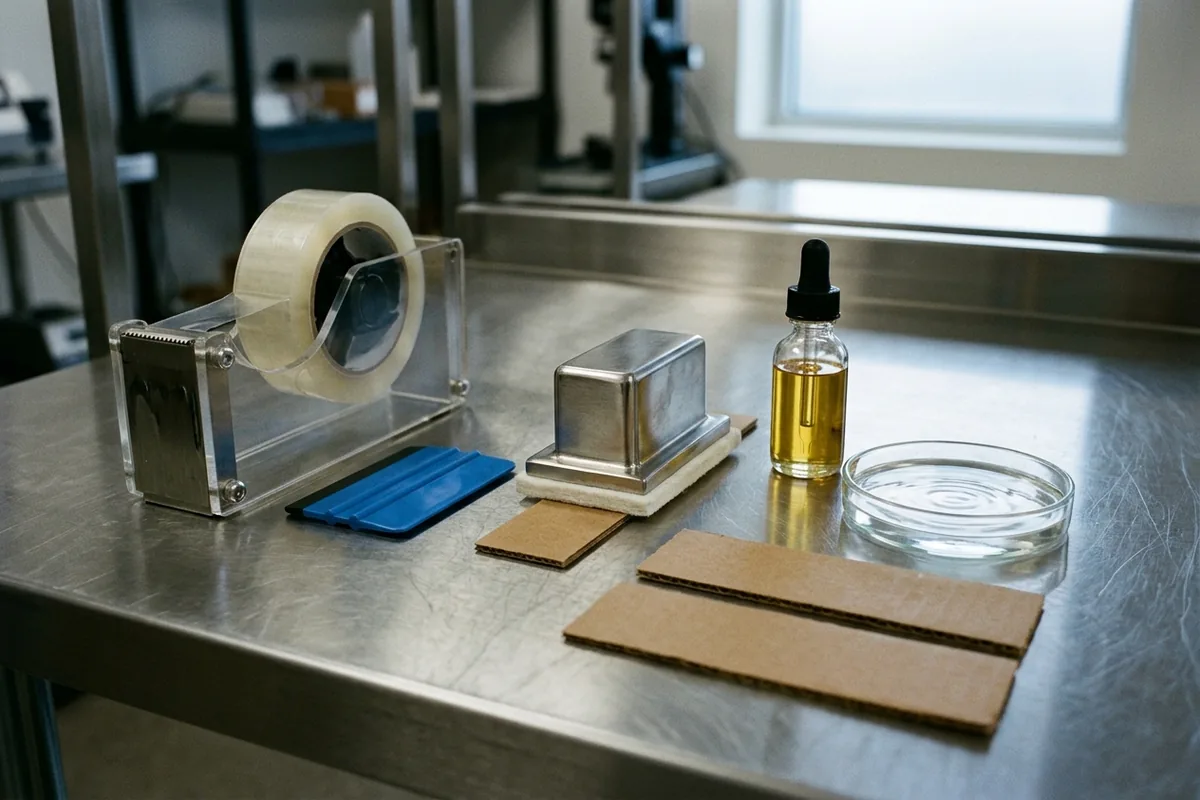
Part A: Controlled thumb rub, timed wipe (PTS-DF 103/2011), and condensation/oil rub tests
Videojet’s Inkjet Inks for Plastics identifies four variables that alter manual rub results: applied pressure, number of rub strokes, moisture or oil on the rubbing surface, and skin/pad texture (calloused skin is significantly more abrasive than smooth skin or a standardized felt pad), alongside post-print cure time. To eliminate operator-to-operator drift, structure the date code rub test across both laboratory qualification and line-side shift checks:
- Automated timed dry-wipe benchmark (
PTS-DF 103/2011principle): Developed by the German Paper Technology Foundation (PTS) and used by industrial ink manufacturers (InkJet, Inc.) to benchmarkTIJandCIJdrying times,PTS-DF 103/2011printsGS1 DataMatrixcodes at300 DPIand uses an automated wipe unit to swipe across the codes at predetermined time intervals (e.g., 1 s, 2 s, 5 s, 10 spost-print) until smudge-free dry time is established. On the shop floor, record and enforce this exact post-print cure delay (s) before the web hits the first turning bar or rub test. - Deionized water immersion & cold-fill condensation rub (
ISO 18935benchmark): UnderISO 18935(InkJet, Inc.),300 DPIGS1 DataMatrixcodes are submerged in deionized water for1 hour, removed, dried on a glass plate, and graded with an optical code reader to prove water resistance. For shift QA checks on chilled, beverage, or retort lines, condition test packs until a visible condensation water film forms (or immerse per plant SOP) and execute10 firm back-and-forth strokeswith a damp microfiber/felt pad under consistent load. - Product-oil and fat contact rub test: On lines packing edible oils, marinated meats, cheese, fried snacks, or oil-roast nuts, apply a thin smear of the actual line filling oil or fat over the cured code, wait
60 seconds, and execute10 firm rub strokeswith a clean felt pad to verify that product oils do not plasticize or dissolve the ink resin.
Part B: Manual 90° pressure-sensitive tape-pull adhesion tests (IPC-TM-650 & Cross-Hatch)
Rub testing checks shear smudge resistance; tape-pull testing measures normal tensile bond strength between the ink resin and the polymer surface (Videojet, Inkjet Inks for Plastics; Kao Collins, How to Do Ink Adhesion and Abrasion Testing). Kao Collins specifies two standardized manual tape protocols borrowed from board and coating verification:
- Method 1 — Straight 90° Rapid Tape Pull (
IPC-TM-650Manual Method for Uncut Codes):- Select a fresh roll of
0.5-inch (12.7 mm)3M 600transparent pressure-sensitive test tape (Kao Collins). - Cut a fresh strip at least
2 inches (5 cm)long and apply it firmly across the cured date code after the specified post-print cure time (Videojetvariable: amount of time after printing), smoothing out all entrapped air bubbles with a plastic squeegee. - Within
1 minuteof application, remove the tape with a rapid pull force at a90°right angle to the packaging surface. - Inspect both the removed tape strip (over a white sheet) and the package code for lifted ink drops or broken character segments, then re-verify the code with a barcode grader.
- Select a fresh roll of
- Method 2 — 6-Blade Cross-Hatch Lattice Tape Pull (For Heavy Coatings & Pre-Printed Patches):
- Using a multi-tooth cross-hatch adhesion cutter (
e.g., Dyne Testing6-blade cutter), make6 parallel cutsacross the printed coating, then repeat at a90°angle to form a25-squarelattice (Kao Collins). - Cut an approximately
3-inch (7.5 cm)strip of1-inch (2.54 cm)wide3M 610test tape, center it over the grid (folding one end into a pull tab), and bond it using3 even, firm strokes with a plastic squeegeeuntil uniform color shows beneath the tape. - Allow a
5-minutedwell time, pull the tape off rapidly, and inspect the grid squares against standard adhesion charts.
- Using a multi-tooth cross-hatch adhesion cutter (
Part C: Carton and mechanical abrasion testing (ASTM D5264 Sutherland & Hanatek)
To verify that printed date codes will not abrade off against corrugated case flaps, cardboard partition dividers, or vibrating accumulation tables during transit:
- Shop-floor corrugated kraft scuff check (
Videojet): Press a clean strip of corrugated kraft paper or carton board against the printed code and rub for a fixed stroke count (e.g., 20 strokesat constant hand or block weight), checking for ink transfer or fading. - Laboratory mechanical rub testing (
Kao Collins): Mount printed film, foil, or carton samples in aSutherland 2000 Rub Tester(ASTM D5264, using standardized2 lb (0.91 kg)or4 lb (1.82 kg)test weights at preset speed and stroke cycles) or aHanatek Rub and Abrasion Tester(configured for printed-to-printed contact or rubbing against referenceMellotexpaper or felt pads; rotary wear can also be evaluated on aTaber Abraser).
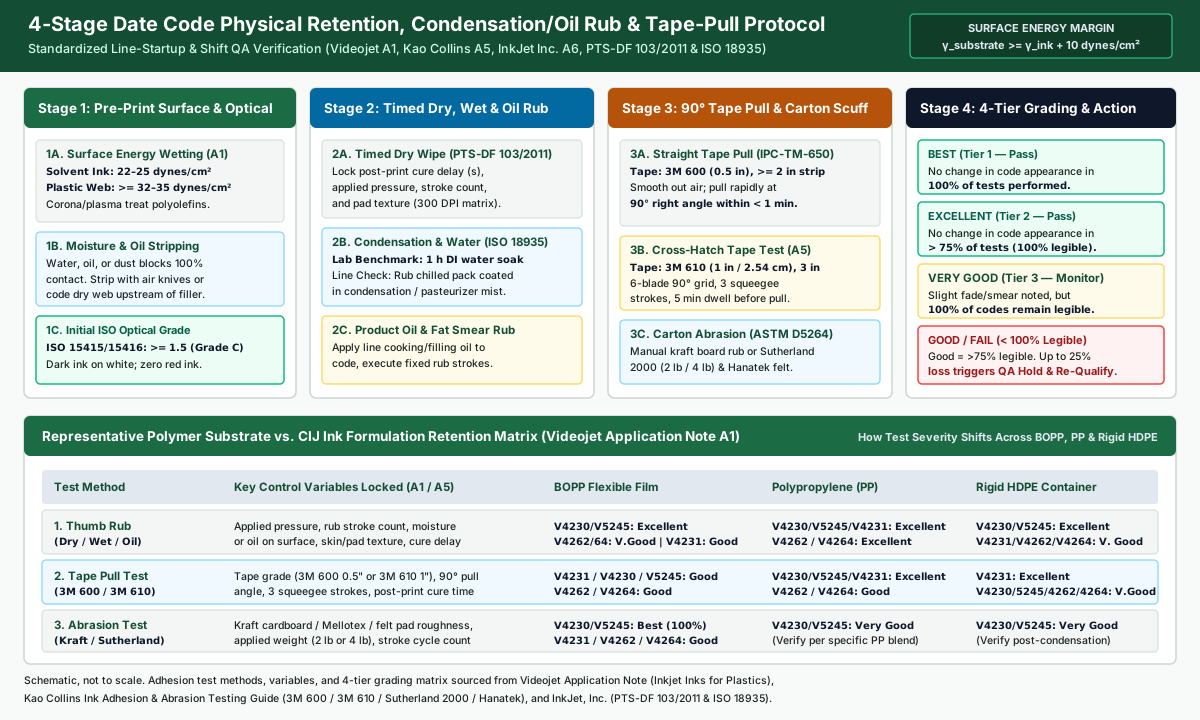
How to grade rub, tape-pull, and abrasion outcomes (Videojet 4-tier scale)
In Choosing the Right Inkjet Inks for Plastics, Videojet defines a four-tier legibility scale across BOPP flexible film, polypropylene (PP), and rigid HDPE (testing ink formulations V4230/V5245, V4231, V4262, and V4264):
Best: No change in code appearance in100%of tests performed.Excellent: No change in code appearance in> 75%of tests performed (100%of codes remain legible).Very Good: Slight fading or smearing noted, but100%of codes remained legible.Good: Codes remained legible in> 75%of tests performed.- Audit disposition rule for food packaging lines: Notice in Figure 3 how a single ink formulation (
e.g., V4262) scoresExcellenton polypropylene thumb rub but drops toGoodonBOPPtape-pull and abrasion tests. Because aGood(> 75%legible) rating allows up to24%of rubbed packages to become unreadable in distribution, food safety QA teams must requireBest,Excellent, orVery Good(100%legible across all tested units) plusISO/IEC 15415/15416 >= 1.5 (Grade C)post-rub. Any ink/substrate combination grading below100%legible requires immediate corona/air-knife adjustment or ink formulation re-qualification (e.g., moving from V4231/V4262 to fast-adhesion V4230/V5245 on BOPP).
4. Pack code placement: heat-seal seam avoidance, the 8 mm edge rule, and 30° curve limits
Key takeaway: Enforce the GS1 Edge Rule by placing every date code, barcode, and Quiet Zone at least 8 mm (0.3 in) and no more than 102 mm (4 in) from any package edge, fold, longitudinal fin seal, or transverse heat-seal crimp, lock continuous-motion VFFS encoder registration so codes never drift into sealing jaws, and switch cylindrical containers to ladder orientation whenever surface curvature exceeds a 30° tangent angle.
Even the most durable ink formulation fails if the pack code placement puts characters or barcode modules over a structural seam, a serrated heat-seal crimp, or a tight container curve. GS1 US’s Quick Reference Guideline for Bar Code Symbol Placement establishes strict geometric boundaries across flexible pouches, blister packs, bottles, jars, boxes, and cans.

Why date codes must never touch heat-seal seams or stay within 5 mm of an edge
Under GS1 US Section 2.3.3 (Avoiding Scanning Obstacles) and Section 3.3.3 (Edge Rule), packaging engineers and line operators must enforce three placement rules:
- Zero overlap with seams, crimps, folds, and perforations (
GS1 USSec. 2.3.3): Never position a date code, linear barcode, 2D symbol, or its surrounding Quiet Zones on perforations, die-cuts, seams (vertical fin seals, lap seals, or horizontal end-seal crimps), ridges, edges, tight curves, folds, flaps, overlaps, or rough textures, and never fold a symbol around a package corner. - Dual failure mode in heat-seal zones (Code Crush + Seal Compromise): When a Thermal Transfer Overprinter (
TTO) or inkjet head drifts so the date code lands inside the horizontal or vertical heat-seal zone on a pouch, two failures occur simultaneously:- Code destruction: Heated serrated crimping jaws (
130 °C to 190 °C) melt, smear, and emboss ridges across the ink or thermal ribbon transfer, dropping symbol contrast and modulation toISO Grade F (0.0). - Seal inspection interference: Dark ink or ribbon wax/resin transferred onto the seal land obscures visual checks for occluded product, channel leaks, or delamination during seal integrity checks.
- Code destruction: Heated serrated crimping jaws (
- Mandatory
>= 8 mm (0.3 in)to<= 102 mm (4 in)Edge Rule (GS1 USSec. 3.3.3): Every scannable symbol and date code block must sit no closer than8 mm (0.3 inches)and no farther than102 mm (4 inches)from any package edge or cut/seal seam. As GS1 US Section 3.3.3 explicitly documents, previous guidelines permitted a5 mm (0.2 inch)minimum, which practical experience proved inadequate because operator and retail cashier thumbs naturally grip the outer5 mmedge of bags and cartons, covering the code and blocking optical scans.
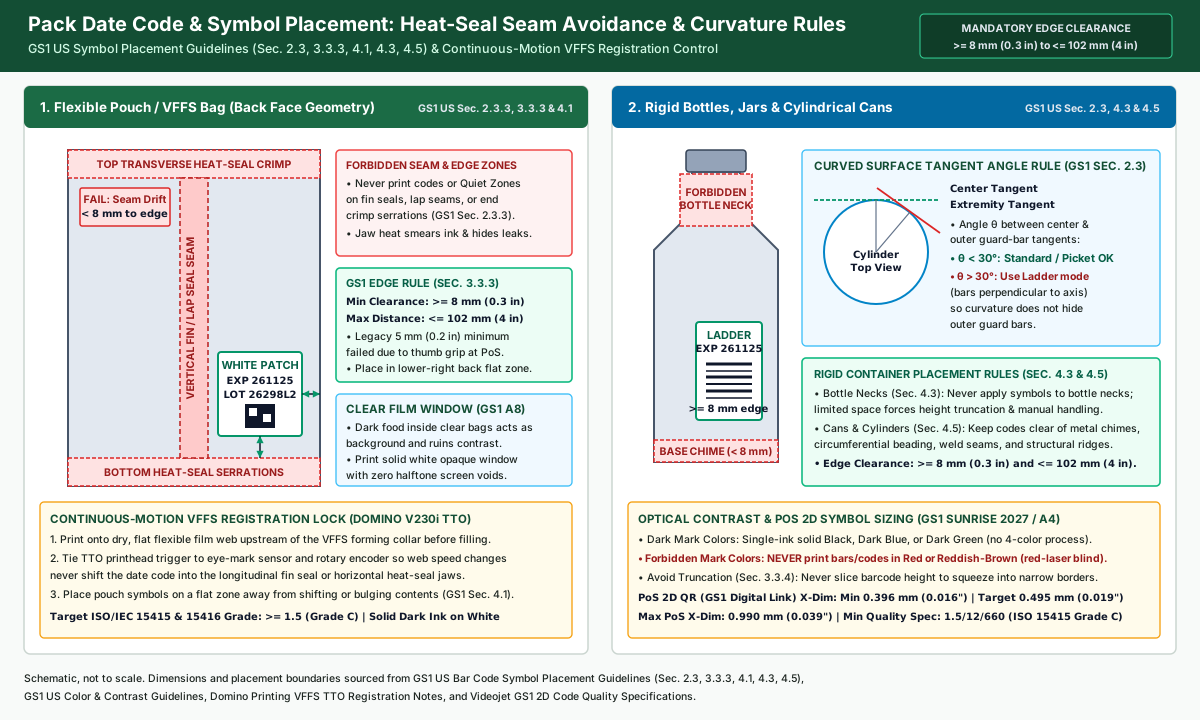
Package-specific placement rules: pouches/VFFS bags, bottles/jars, and cans (GS1 US & Domino)
Package Format (GS1 US Section) |
Preferred Placement Zone | Specific Obstacles to Avoid | Registration & Orientation Control |
|---|---|---|---|
Flexible Bags & Pouches (Sec. 4.1 & Domino A2) |
Lower-right quadrant of the back panel (or front panel if back is obstructed), on a flat area away from shifting/bulging contents, >= 8 mm (0.3 in) from all seal edges |
Longitudinal vertical fin/lap seal, top/bottom fold-sealed or pinch-sealed crimps, gusset folds, and tear notches | Qualify continuous-motion VFFS print registration (e.g., Domino V230i TTO on Ishida Atlas baggers) using eye-mark sensors and rotary encoders so speed ramps never shift the print window into the jaws |
Blister Packs (Sec. 4.2) |
Lower-right quadrant of the flat card backing, >= 8 mm (0.3 in) clear of card edges |
Never place under the formed plastic blister bubble, close to the blister flange edge, or over back-card access perforations | Keep symbol on flat, unperforated backing board with full Quiet Zone margin |
Bottles & Jars (Sec. 4.3 & Sec. 2.3) |
Lower-right quadrant of back spot label on the flattest vertical sidewall, >= 8 mm (0.3 in) from base and label edges |
Application to the neck of a bottle is strictly prohibited (causes height truncation and awkward handling); avoid shoulder tapers and base heels | Check cylinder curvature tangent angle (θ); if θ > 30°, rotate barcode to ladder orientation (bars perpendicular to bottle axis) |
Cans & Cylinders (Sec. 4.5 & Sec. 2.3) |
Lower-right quadrant of back label/wall, >= 8 mm (0.3 in) clear of top and bottom metal chimes |
Circumferential structural beading, welded side seams, and metal ridges (Sec. 4.5) |
Enforce ladder orientation when center-to-edge tangent angle θ > 30°; if coding retort cans on bottom lids via CIJ, use retort-resistant thermochromic or high-adhesion inks inside the recessed lid well |
5. Matching coder technology (TTO, CIJ, TIJ, Laser) to package format and moisture point
Key takeaway: Prevent date code rub-off and seam drift at the equipment selection stage by matching Thermal Transfer Overprinting (TTO) to dry pre-fill flexible film webs, Continuous Inkjet (CIJ) with air knives to high-speed curved rigid containers, Thermal Inkjet (TIJ) to 300 DPI cartons and flat films up to 12.5 mm print height, and Laser Marking where permanent, zero-rub marks are required.
Selecting the wrong coding technology for a wet or flexible packaging station forces maintenance and quality teams into endless ink-swapping and rework loops. Based on Videojet’s GS1 Sunrise 2027 technology guide (A4), Inkjet Inks for Plastics (A1), Domino Printing’s VFFS TTO Qualification (A2), and InkJet, Inc.’s Ink Testing Methods (A6), each coder architecture has distinct physical boundaries:
| Coding Technology | Optimal Packaging Formats & Station Location | Resolution, Print Area & Consumables | Moisture / Rub Resistance & Engineering Trade-Offs |
|---|---|---|---|
Thermal Transfer Overprinting (TTO)(e.g., Domino V230i) |
Flexible barrier films, pouches, and labels on intermittent or continuous-motion VFFS and HFFS wrappers; installed upstream on the dry unwind web before forming/filling |
300 DPI crisp 2D (QR / DataMatrix) and alphanumeric text; larger print area than inkjet (A4); uses wax/resin or full-resin thermal ribbon |
Avoids filler condensation completely because film is coded dry before product fill; requires encoder registration lock (A2) and ribbon tension control to prevent ribbon creases |
Continuous Inkjet (CIJ)(e.g., Videojet V4230 / V5245 / V4231) |
Rigid HDPE/PP bottles, jars, metal cans, thermoformed tubs, and formed pouches at high line speeds; non-contact curved/recessed coding |
Non-contact droplet deflection; fast-drying solvent inks (22–25 dynes/cm² surface tension, A1) |
Requires substrate energy >= 32–35 dynes/cm² (+10 dynes/cm² margin) and upstream air knives if coding post-fill chilled or washed containers (A1); requires routine solvent/nozzle maintenance |
Thermal Inkjet (TIJ) |
Paperboard cartons, unit-dose blisters, secondary cases, and treated flat films (A4, A6) |
High-resolution 300 DPI (PTS-DF 103/2011 / ISO 18935 benchmarked); maximum print height typically 12.5 mm per cartridge (A4) |
Low maintenance (cartridge-based printhead) and high 2D bar-edge sharpness; short throw distance requires flat substrate presentation within 1 to 3 mm of nozzle plate |
| Laser Marking Systems (CO2, Fiber, or UV Laser) |
Glass jars/bottles, coated paperboard cartons, PET bottles, and pre-qualified multilayer barrier films (A4) |
Permanent surface ablation, engraving, or color-change layer reaction; zero ink or ribbon consumables (A4) |
Permanent mark that cannot rub off in condensation, oil, or retort (A4); requires mandatory lab substrate trials before deployment so laser depth never perforates thin oxygen/moisture barrier layers |
Scope and rework drivers when date codes fail rub or placement checks
When an audit or retail receiving check flags illegible or seam-crushed date codes, the operational loss is driven by four physical scope factors that connect directly to the plant’s lot number tracking and mass-balance ledger:
- Quarantine hold window (
N_holdpacks): Without an inline vision camera interlocked to halt the wrapper after3 consecutive Grade D/F (< 1.5) or OCV no-read prints, a depletedTTOribbon, cloggedCIJnozzle, or failed air knife requires quarantining every pallet produced back to the last passed manual QA check (for example,60 minutes × 90 packs/min = 5,400 packsheld for 100% manual inspection). - Re-labeling vs. destructive de-packaging labor: On rigid bottles or cartons, illegible codes can sometimes be recovered using validated opaque over-labels (provided the inner erroneous code is completely obscured per
GS1 USSection 3.1). On heat-sealed flexibleMAPpouches or retort cans, over-labeling is rarely permitted by retail specs—forcing destructive de-packaging, packaging film scrap, and product rework/disposal. - Destructive QA test pack accounting (
M_QA_test): Every pouch or bottle pulled from the line for1-hourISO 18935water immersion, product-oil rub testing,90°3M 600/610tape-pull testing, or destructive seal integrity testing must be logged in the batch Destructive QA Test Bucket so the100.0%discrete pack mass balance reconciles without unexplained shortages.
6. Shift QA verification checklist: contrast, condensation rub test, and placement log
Key takeaway: Execute and sign off this 8-point physical verification checklist at line startup, after every film roll splice or ink/ribbon lot change, and every 60 minutes during production, retaining the dated log alongside the batch record described in coding and lot records.
Use the following copy-ready inspection table on the packaging floor to verify substrate wetting, optical contrast, dry/wet/oil rub resistance, 90° tape-pull adhesion, and >= 8 mm seam avoidance:
| Check ID & Verification Stage | Inspection Parameter & Test Method | Target Engineering Specification (Pass Criteria) |
Measured Line Value (Example Log: TLC-26298-L2) |
Failure Action & Quarantine Boundary |
|---|---|---|---|---|
| CHK-01: Pre-Print Surface Energy & Cleanliness | Dyne test pen/ink check on plastic web (A1) + visual/tactile check of air-knife strip upstream of printhead |
γ_substrate >= γ_ink + 10 dynes/cm² (>= 34–38 dynes/cm² for 24 dynes/cm² CIJ ink); 100% dry, oil-free print zone |
BOPP/PET web = 38 dynes/cm² (Δγ = +14 dynes/cm²); pre-fill dry TTO station (Pass) |
Adjust corona treater output or air-knife pressure/angle; hold packs printed on wet web |
| CHK-02: Color Pairing & Clear-Film Window | Visual & artwork check against GS1 US Contrast Rules (A8) |
Solid black, dark blue, or dark green mark on white background; zero red/brown bars; solid white window with zero screen voids on clear film | Solid black TTO resin ribbon printed inside pre-printed 100% solid white patch (Pass) |
Halt line if red ink is loaded or if dark product shows through clear-film code zone |
| CHK-03: Inline & Tabletop ISO Optical Grade | ISO/IEC 15415 (2D) / ISO/IEC 15416 (1D) verifier + PoS X-dimension check (A4) |
>= 1.5 (ANSI/ISO Grade C) (>= 2.5 Grade B startup target); PoS 2D QR X-dim 0.396–0.990 mm (0.495 mm target); 3-no-read PLC stop active |
ISO 15415 Grade = 3.1 (Grade B); X-dim = 0.495 mm; 3-consecutive-fail reject tested (Pass) |
Clean printhead, replace creased TTO ribbon, and hold stock back to last passed scan |
| CHK-04: Seam, Crimp & Edge Clearance | Steel machinist scale measurement from code/Quiet Zone to all seams & edges (GS1 US Sec. 2.3.3, 3.3.3, 4.1, 4.3) |
>= 8 mm (0.3 in) and <= 102 mm (4 in) from cut edges, fin/lap seals, and transverse crimps; zero neck/corner placement |
14.0 mm from bottom crimp, 18.5 mm from vertical fin seal, 12.0 mm from right edge (Pass) |
Adjust VFFS eye-mark / rotary encoder registration delay (Domino A2); quarantine jaw-crushed packs |
CHK-05: Curved Container Tangent Angle (θ) |
Center-to-extremity tangent angle check on cans, bottles, and jars (GS1 US Sec. 2.3) |
If θ > 30°, symbol must be in ladder orientation (bars perpendicular to cylinder axis); clear of chimes/beading (Sec. 4.5) |
Flat pouch back panel (θ = 0° < 30°); horizontal orientation verified (Pass) |
Rotate artwork/printhead 90° into ladder orientation on narrow bottles/cans where θ > 30° |
| CHK-06: Timed Dry, Condensation & Oil Rub Test | 10 controlled felt-pad strokes after locked cure delay (s) across: (a) Dry pack (PTS-DF 103/2011), (b) Chilled/wet pack (ISO 18935 1 h soak benchmark), (c) Line-oil smeared pack (A1, A6) |
Best (100% unchanged) or Excellent / Very Good (100% legible) + post-rub ISO Grade >= 1.5 (Grade C) |
Cure delay 3.0 s: Dry = Best; Condensation = Best; Oil rub = Excellent (ISO 2.7 Pass) |
If any sample drops to Good (< 100% legible) or smears unreadably, hold lot and re-qualify ink/ribbon |
| CHK-07: 90° Pressure-Sensitive Tape-Pull Test | IPC-TM-650 straight pull with fresh 0.5 in 3M 600 (>= 2 in strip, < 1 min rapid 90° pull) or cross-hatch with 1 in 3M 610 (3 squeegee strokes, 5 min dwell, A1, A5) |
100% code legibility (Best / Excellent / Very Good); zero lifted characters or 2D modules on tape strip |
3M 600 90° rapid pull at 45 s post-print: zero ink transfer to tape; ISO Grade 3.0 (Pass) |
Increase TTO printhead temperature/pressure or switch CIJ ink resin (e.g., to V4230/V5245, A1) |
| CHK-08: Carton Scuff & Mass-Balance Log | 20 strokes with corrugated kraft board (A1) or ASTM D5264 Sutherland 2000 (2 lb / 4 lb weight, A5) + log consumed QA packs |
100% legible post-scuff; all destructive rub/tape/water-soak sample packs logged to batch M_QA_test bucket |
Kraft scuff = Best (100% unchanged); 6 destructive test packs logged to TLC-26298-L2 ledger (Pass) |
Record consumed test packs in the 4-hour mock recall mass-balance ledger before shift sign-off |