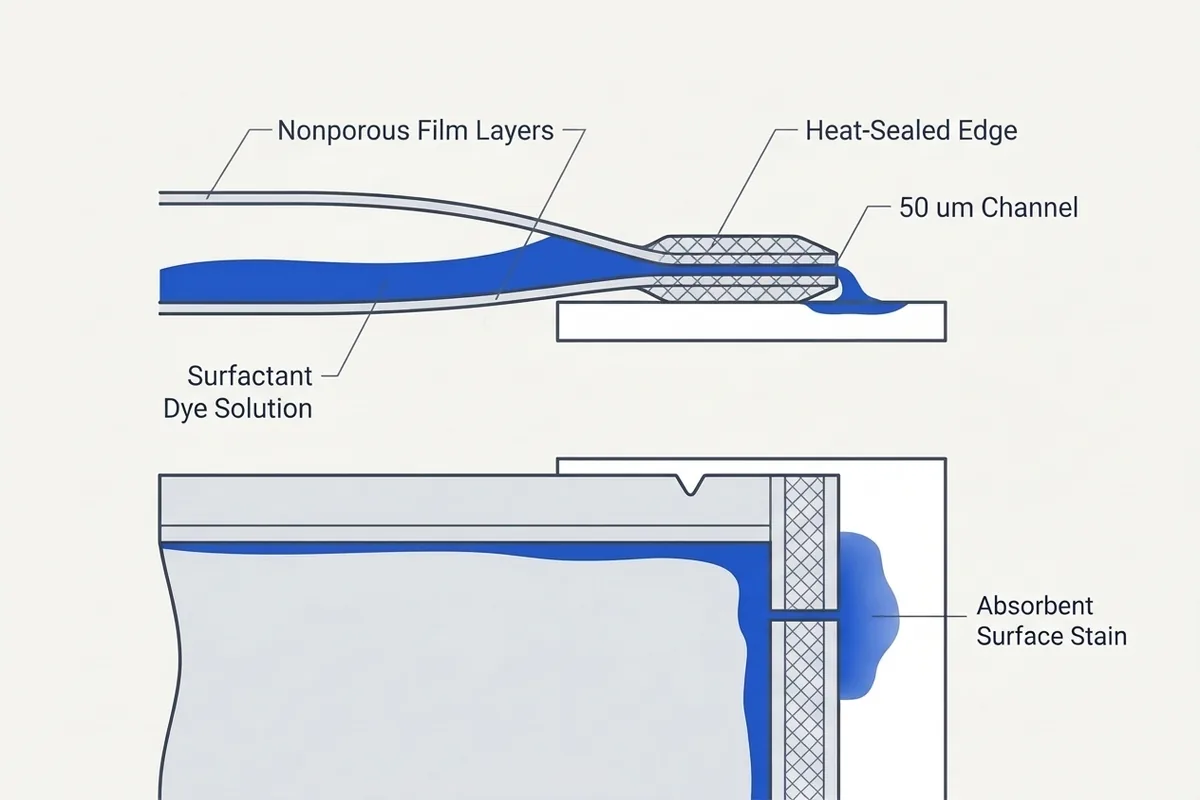
Active standard ASTM F3039-23 defines qualitative, destructive dye penetration leak tests for transparent and opaque nonporous packaging and flexible barrier materials. Method A detects and locates edge-seal channels equal to or greater than a 50 µm (0.002 in.) wire, while Method B detects holes equal to or greater than 10 µm (0.00039 in.) in nonporous flat sheets.
Published in Book of Standards Volume 15.10 by Subcommittee F02.40 (5 pages, DOI 10.1520/F3039-23, ICS Code 55.040, last updated Jun 19, 2023), the standard addresses package seals and barrier webs where liquid does not wick through the substrate itself. Within packaging safety records, pair this method with the object, sample, observation, and reject fields in seal integrity questions. For a broader choice among bubble emission, vacuum decay, and dye penetration, see seal integrity testing with ASTM methods.
What Types of Nonporous Package Leaks Does ASTM F3039 Detect?
ASTM F3039-23 detects and locates through-leaks in both transparent and opaque nonporous packaging components—specifically edge-seal channel defects of 50 µm (0.002 in.) or larger in finished packages and pinhole leaks of 10 µm (0.00039 in.) or larger in flat flexible barrier sheets (Clauses 1.1, 1.2, and 1.3).
Clauses 4.1 and 4.2 identify why those breach sites matter on a packaging line: contaminants may enter the package through leaks, product may be lost through leaks, and gas or moisture ingress or egress through package leaks can degrade sensitive contents. Clause 4.1 notes that leaks are frequently found at seals between package components of the same or dissimilar materials. In a peer-reviewed flexible pouch evaluation, researchers note that ASTM F3039 covers nonporous constructions spanning transparent nylon-nylon pouches and opaque foil-foil packages.
Clause 1.5 sets a strict unit-reporting rule for test records: values stated in SI units and values stated in inch-pound units are regarded separately as standard, may not be exact equivalents, and must be used independently because combining values from the two systems may result in non-conformance.
Which Indicator Dye and Wetting Agent Are Used in Leak Test Solutions?
ASTM F3039-23 Clause 1.4 requires a dye penetrant solution that provides strong visual contrast against the tested packaging material or the absorbent inspection surface, paired with a wetting agent that lowers liquid surface tension so the solution draws into narrow nonporous seal channels.
Wetting chemistry governs whether liquid enters a tight defect at all. As noted in the retortable pouch dye-penetration study, dye penetration depends on controlled physical parameters including dye concentration, temperature, pressure differential, solution viscosity, and surface tension. Depending on solution viscosity, contact angle, and channel diameter, trapped airlocks inside a micro-channel can prevent liquid ingress, and smaller micro-channel diameters require higher gage pressure to break surface tension and produce leakage.
- Legacy aqueous formulation: Prior ASTM F3039 aqueous formulations listed 3% TRITON X-100 wetting agent and 0.05% Toluidine Blue indicator dye in water, compared with 0.5% TRITON X-100 and 0.05% Toluidine Blue in prior porous ASTM F1929 solutions.
- Laboratory alternative surfactant study: In the flexible pouch study, investigators used 1% methylene blue and 0.25% sodium dodecyl sulfate (SDS) in deionized water, adding SDS to reduce surface tension.
- Pressure-assisted vs local injection sensitivity: In that same study, visual inspection after local dye injection detected 4% to 30% of 25 µm and 50 µm micro-channels, whereas vacuum-assisted dye penetration detected 64% at 25 µm and 96% at 50 µm, underscoring how pressure differential and airlocks affect liquid entry.
How Do Method A Edge-Seal Inspection and Method B Roller Transfer Differ?
Method A tests nonporous package edge seals by applying dye penetrant locally for a minimum contact time and inspecting visually or via stain transfer onto an absorbent surface (Clause 1.1). Method B spreads dye across a flat sheet on an absorbent pad with a small roller, then checks the pad (Clause 1.2).
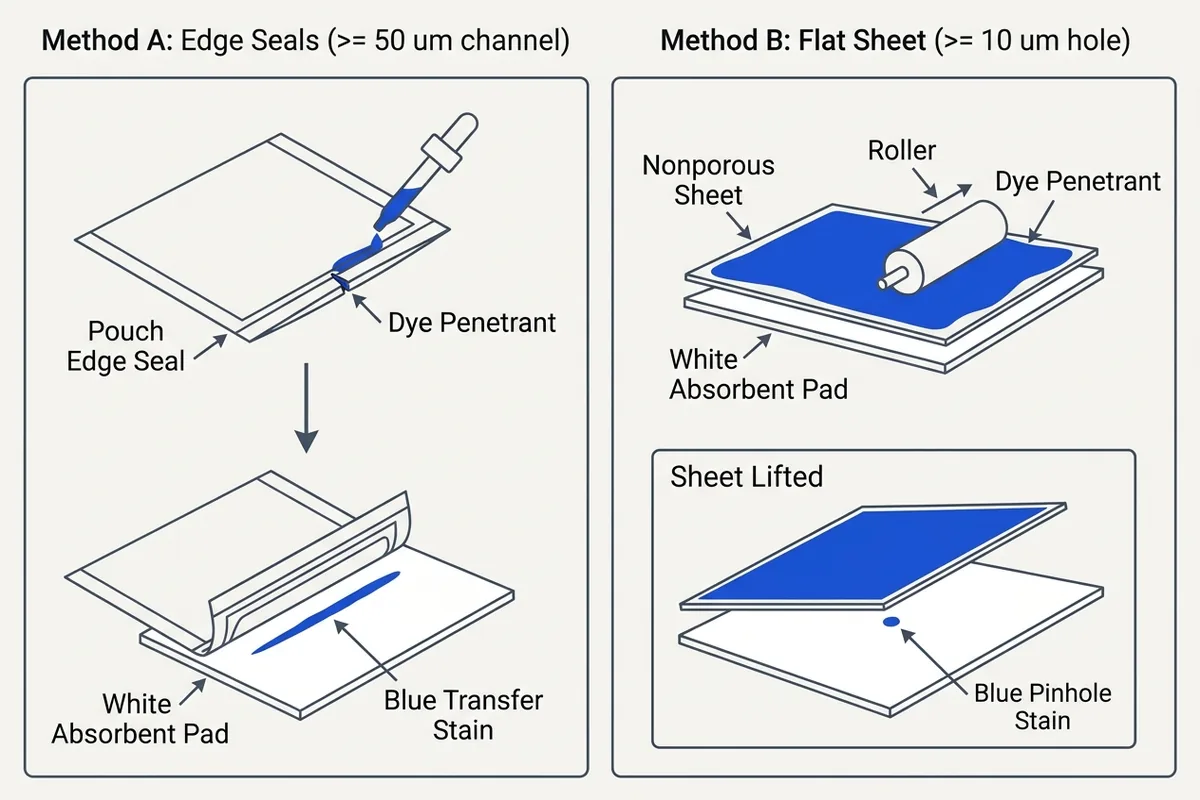
Method A vs. Method B Operational Comparison
| Comparison Parameter | Method A: Nonporous Edge Seals (Clause 1.1) | Method B: Nonporous Flat Sheets (Clause 1.2) |
|---|---|---|
| Reference leak threshold | Channel formed by a 50 µm (0.002 in.) wire or larger | Circular pinhole 10 µm (0.00039 in.) diameter or larger |
| Test specimen geometry | Edge seals of a nonporous package (same or dissimilar materials) | Nonporous flat barrier sheet or film web |
| Dye application step | Apply dye penetrant solution locally to the seal edge and hold for a minimum specified contact time | Place flat sheet on an absorbent surface and spread dye penetrant across the top, preferably with a small roller applying pressure |
| Primary inspection step | Visually inspect the package for dye penetration or, preferably, place the seal edge against an absorbent surface and inspect for staining | Carefully remove the flat sheet and inspect the underlying absorbent surface for dye staining |
| Optical substrate compatibility | Transparent and opaque nonporous surfaces with contrasting dye (Clauses 1.3 and 1.4) | Transparent and opaque nonporous flat sheets with contrasting dye against the absorbent pad (Clauses 1.3 and 1.4) |
| Result interpretation | Qualitative go/no-go leak location; no leak size inferred (Clause 4.4) | Qualitative go/no-go pinhole location; no hole size inferred (Clause 4.4) |
Using the absorbent-surface transfer step in Method A is particularly important for opaque foil laminates, because a stain transferred onto contrasting white absorbent paper confirms through-penetration even when the seal interface cannot be viewed through the film. In Method B, roller pressure maintains intimate contact between the bottom of the nonporous sheet and the absorbent pad so dye passing through a 10 µm opening leaves a distinct dot rather than smearing across an air gap.
Why Are Surfactant Requirements Changing for Dye Penetration Solutions?
Surfactant specifications are shifting away from Triton X-100 because ECHA classified octyl phenol ethoxylates as endocrine-disrupting substances and placed them on Annex XIV of EU REACH, establishing a January 4, 2021 sunset date that restricted production and use in the European Union.
As documented in REACH Annex XIV bioprocessing literature, use of Triton X-100 beyond the January 2021 sunset date requires specific authorization allowing continued use only for a limited time. Because legacy ASTM F1929 and ASTM F3039 formulations explicitly named Triton X-100 as the wetting agent, global testing laboratories required compliant drop-in replacements that preserve capillary wetting into narrow seal channels.
To remove single-brand dependency, ASTM committee revisions to ASTM F3039 Section 5.6 transition from naming one surfactant to defining four performance criteria for any candidate wetting agent:
- Surfactant class: Nonionic surfactant chemistry.
- Surface tension: Between 30 and 33 mN/m.
- Hydrophilic/lipophilic balance: Greater than 10.
- Critical micelle concentration: Less than 2000 ppm.
ASTM committee interlaboratory testing evaluated four nonionic surfactants meeting those requirements: Tergitol 15-s-9, Tergitol 15-s-12, Ecosurf EH-6, and Ecosurf EH-9, with evaluated concentration ranges of 1.0% to 3.0% for nonporous packaging under F3039 compared with 0.2% to 0.3% for porous packaging under F1929. When switching wetting agents in a plant or laboratory procedure, document the exact surfactant identity, concentration, and contrast verification in the lot test record rather than writing a generic dye label.
How Does ASTM F3039 Differ From ASTM F1929 and ASTM E1417?
ASTM F3039-23 tests nonporous flexible packaging seals and flat sheets, ASTM F1929-23 tests transparent-to-porous medical package edge seals that resist dye wicking for at least 5 seconds, and ASTM E1417/E1417M-21e1 is an industrial contract practice for detecting surface-open discontinuities on solid metal and nonmetal components rather than flexible package seals.
| Feature | ASTM F3039-23 | ASTM F1929-23 | ASTM E1417/E1417M-21e1 |
|---|---|---|---|
| Committee and volume | Subcommittee F02.40, Book of Standards Volume 15.10 | Subcommittee F02.40, Book of Standards Volume 15.10 | Committee E07, Book of Standards Volume 03.03 |
| Target materials | Transparent and opaque nonporous packages and flat flexible barrier sheets (Clauses 1.1, 1.2, and 1.3) | Edge seals formed between a transparent material and a porous sheet material | Nonporous metal and nonmetal components in-process, final, or in-service |
| Target defects | Edge-seal channels >= 50 µm (0.002 in.) and flat-sheet leaks >= 10 µm (0.00039 in.) | Edge-seal channels >= 50 µm (0.002 in.) wire equivalent | Surface-open discontinuities: lack of fusion, corrosion, cracks, laps, cold shuts, and porosity |
| Critical material boundary | Nonporous barrier substrates only; requires contrasting dye and absorbent surface transfer | Porous sheet must retain dye without discoloring the seal area for at least 5 seconds; uncoated papers require careful evaluation because dye wicks through porous webs over time | Cautions against elevated temperature on thermoplastics; some cleaners, penetrants, and developers have deleterious effects on plastics |
| Procedural status | Standalone packaging leak test method (go/no-go, destructive) | Standalone porous medical packaging leak test method (go/no-go) | Contract and drawing control practice that must be supplemented by a detailed inspector procedure |
Risks of Misapplying Porous or Industrial Penetrant Standards
Selecting the wrong standard creates immediate false results or material damage. Running ASTM F3039 formulations on a porous paper pouch drives rapid dye wicking across the porous web—an artifact that ASTM F1929-23 specifically guards against through its 5-second retention threshold and porous-side wicking inspection. Conversely, applying industrial penetrants, cleaners, or developers governed by ASTM E1417/E1417M-21e1 to flexible food or medical films risks chemical attack on thermoplastic polymers and uses contract rules written for structural parts rather than pouch heat seals. Likewise, dye penetration locates breach paths and does not measure mechanical separation force; evaluate peel force and failure mode separately in our guide to flexible-barrier seal strength testing.
Why Are Dye-Tested Samples Destructive and Unusable for Product Shipment?
ASTM F3039-23 Clause 4.5 explicitly states that dye penetration tests are destructive and that no package or component test samples exposed to dye penetration testing may be used for final product packaging, regardless of whether a leak stain appeared during inspection.
Two method boundaries work together here. First, Clause 4.3 notes there is no general agreement on what level of leakage is deleterious to a particular package, so components exhibiting any indication of leakage may be rejected. Second, Clause 4.4 confirms that the procedure verifies and locates leakage sites as a qualitative go/no-go test from which no leak size can be inferred. Even a clean, unstained pouch has contacted dye and surfactant solution during testing and has been opened or wetted along its seal margin. In regulated sterile-product stability programs, the FDA container and closure integrity guidance lists dye penetration among physical integrity methods alongside bubble tests, pressure or vacuum decay, trace gas tests, seal force, and electrical conductivity or capacitance tests, and specifies that samples passing an integrity test may be reused in stability testing only when the method is non-destructive and leaves the sample unaltered.
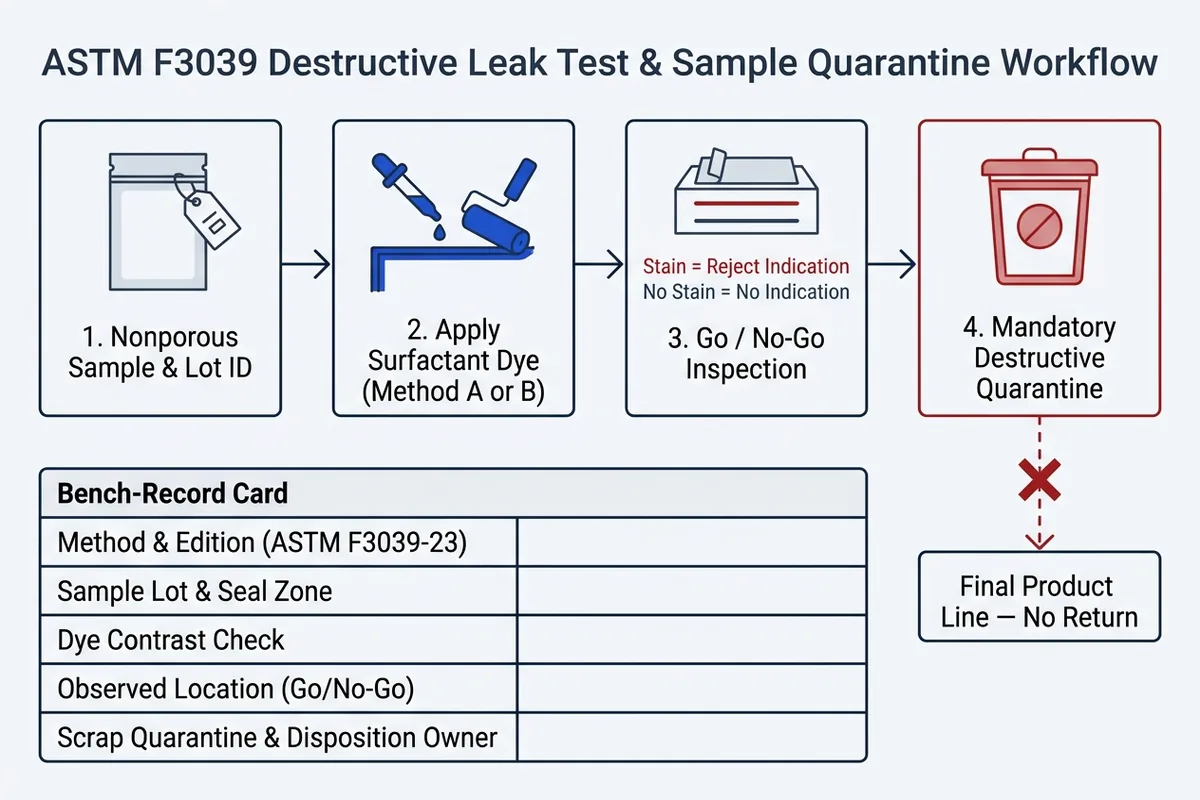
Bench-Record and Quarantine Fields for ASTM F3039
Maintain a single bench record linking the tested lot, dye chemistry, go/no-go observation, and physical scrap disposition:
| Record Field | Required Entry | Operational Safeguard |
|---|---|---|
| Method and edition | ASTM F3039-23 Method A (edge seal) or Method B (flat sheet), with SI or inch-pound unit system kept independent | Prevents mixing Method A (50 µm) and Method B (10 µm) thresholds or combining unit systems (Clauses 1.1, 1.2, and 1.5) |
| Sample object and lot | Pack construction (transparent or opaque nonporous), seal zone or flat-sheet roll, sample count, and lot code | Connects destructive sample loss to lot mass balance in coding and lot records |
| Dye solution and contrast | Indicator dye, surfactant identity and concentration, and confirmation of contrast against substrate or absorbent pad | Verifies wetting-agent compliance and Clause 1.4 visual contrast before scoring |
| Go/no-go observation | Stain present or absent, exact defect location along seal or sheet, and absorbent-pad confirmation | Keeps qualitative site location separate from any unsupported leak-size or leak-rate claim (Clause 4.4) |
| Quarantine and disposition owner | Scrap bin transfer for all dye-exposed units plus named hold owner for affected production lots | Supports Clause 4.5 zero-return handling and closes the reject path defined in seal integrity questions |