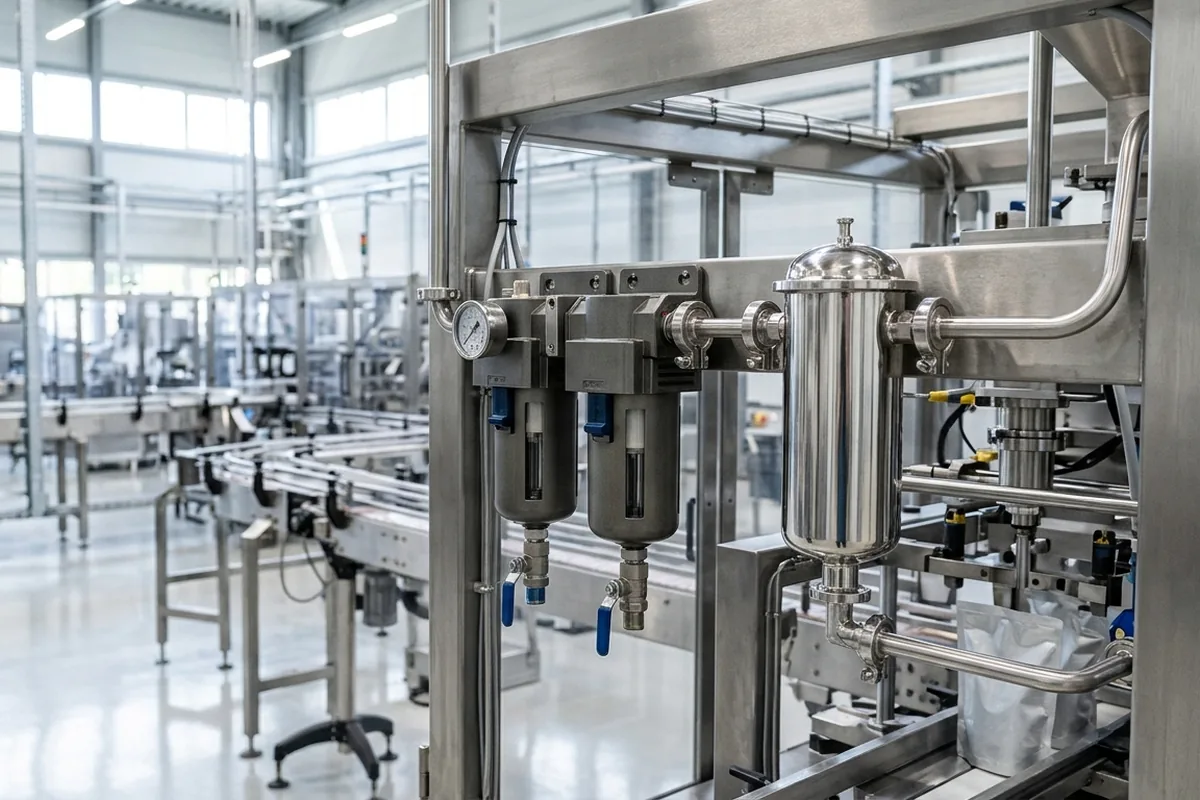
Under 21 CFR 117.40(g), compressed air or other gases mechanically introduced into food or used to clean food-contact surfaces or equipment must be treated so food is not contaminated with unlawful indirect food additives. Under 21 CFR 117.40(d), holding, conveying, and manufacturing systems, including gravimetric, pneumatic, closed, and automated systems, must be designed and constructed so they can be maintained in a clean and sanitary condition. Review the hygienic design rules and line records below when checking food contact compressed air filtration at each packaging drop.
Regulatory Rules and Prerequisite Program Scope for Food-Contact Air
In the US, legacy rule 21 CFR 110.40 (superseded by 21 CFR 117.40) requires that compressed air in direct contact with food or food contact surfaces must be handled in a manner that does not contaminate food. ISO/TS 22002-1:2009 Section 6.5 states that compressed air and gases intended for direct or incidental product contact shall be from a source approved for food contact use and filtered to remove dust, oil, and water. Under FDA Pasteurized Milk Ordinance (PMO) 2015 Revision Appendix H Section II, the coalescing filter and associated traps shall be located in the air pipeline downstream from the compressing equipment and from the air tank.
Food safety codes and sanitary guidelines address point-of-use filter location and performance as follows:
- Module 11.5.5.2 in Edition 8 of the SQF Code (November 2017) specifies that wherever compressed air comes in contact with food, directly or indirectly, filters are to be in place at point-of-use where the air enters the final section of tubing (not in the compressor room).
- Under SQF Code Edition 8 Module 11.5.5.2, the recommended final stage of filtration in food contact areas should have a rating of 0.01 micron with an efficiency of 99.999% (or as determined by appropriate risk analysis).
- SQF Module 11.5.5.2 advises locating point-of-use filtration as close as practically possible to the point where air contacts the food so as not to have long lengths of piping or tubing between the microbial removal filter and the air/food contact point.
- British Compressed Air Society (BCAS) Best Practice Guideline 102 specifies maintaining a -40°F/C dew point in dry air and removing particles greater than 0.1 micron at 99.9999%, and Section 7.3.3 requires oil-in-air concentration less than 0.01 mg/m³.
- 3-A Standard 604-05 (2004) Section D6.6.1 requires at point of use for sterile air removing particles greater than 0.3 micron at 99.9999%; at point of use for non-sterile air, the standard requires removing particles greater than 0.3 micron at 99%.
- Under the FDA Guide to Inspections of Aseptic Processing and Packaging for the Food Industry, filters that are steam sterilized must be designed for steam sterilization and changed out after the manufacturer’s recommended number of steam cycles has been reached.
Packaging Line Branch Separation: Pneumatic Actuators vs. Direct and Indirect Food-Contact Air
In CAGI’s industrial compressed air classifications, Plant Air (satisfied by ISO 8573-1 [-:4-5:-] with a minimum dew point of 45°F) powers pneumatic tools that are often lubricated by a Filter-Regulator-Lubricator (FRL) attached directly prior to the tool, whereas Instrument Air is interpreted as Class [2:<4:3] per ISO 8573-1 to power pneumatic actuators, sensors, and valves. In CAGI’s Process Air classification (where compressed air directly contacts the product), a unified standard does not exist, pressure dew point requirements typically range from -40 to -100°F (ISO class [-:2:-] to [-:1:-]), and a food-contact air knife blowing off excess breadcrumbs on a production line requires an ISO 8573-1 air purity specification of 2-2-1.
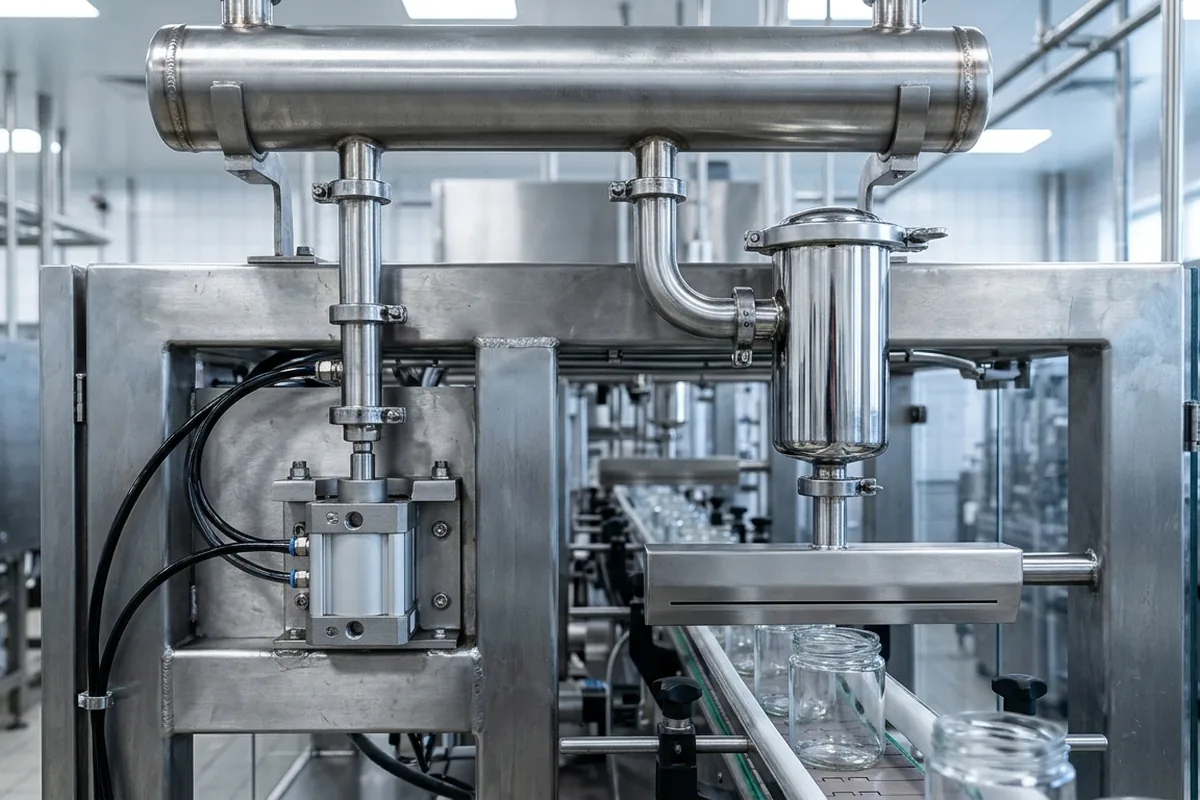
ISO 8573.1 compressed air quality classifications are established at normal plant working pressures of 100 psig (7 barg) and do not apply to vacuum systems; on form-fill-seal machines, compressed air is in contact with packaging material that will then come into contact with food and beverage products. On our packaging line audit checklist, standard industrial FRL (Filter-Regulator-Lubricator) oil-mist bowls must never be installed on air lines feeding packaging zones, and point-of-use compressed air inspection requires verifying the filter housing serial tag, differential pressure log, 6-month element replacement record, and ISO 8573-1 Class 1.2.1 test report.
Purity Classes and Microbiological Scope Limits
Under ISO 8573-1:2010, particle Class 1 allows less than 20,000 particles per m³ with a diameter between 0.1 and 0.5 micron, less than 400 particles between 0.5 and 1.0 micron, and less than 10 particles between 1.0 and 5.0 micron. For moisture, ISO 8573-1 establishes quality classes based on pressure dew point (PDP): Class 4 is 37°F (3°C), Class 3 is -4°F (-20°C), Class 2 is -40°F (-40°C), and Class 1 is -94°F (-70°C). Under ISO 8573-1, Oil Class 1 allows < 0.01 mg/m³ of total oil (liquid, aerosol, and vapor), Oil Class 2 allows < 0.1 mg/m³, Oil Class 3 allows < 1 mg/m³, and Oil Class 4 allows < 5 mg/m³.
| Purity Dimension | Classification Scope | Benchmarks and Limits |
|---|---|---|
| Solid particles | ISO 8573-1:2010 Particle Class 1 | Less than 20,000 particles per m³ with a diameter between 0.1 and 0.5 micron, less than 400 particles between 0.5 and 1.0 micron, and less than 10 particles between 1.0 and 5.0 micron |
| Moisture pressure dew point (PDP) | ISO 8573-1 PDP Classes | Class 4: 37°F (3°C); Class 3: -4°F (-20°C); Class 2: -40°F (-40°C); Class 1: -94°F (-70°C) |
| Total oil (liquid, aerosol, vapor) | ISO 8573-1:2010 Oil Classes | Class 1: < 0.01 mg/m³; Class 2: < 0.1 mg/m³; Class 3: < 1 mg/m³; Class 4: < 5 mg/m³ |
| Plant Air vs. Instrument Air | ISO 8573-1 CAGI Classifications | Plant Air: [-:4-5:-] with a minimum point of 45°F and FRL tool lubrication; Instrument Air: Class [2:<4:3] for pneumatic actuators, sensors, and valves |
| Process Air (product contact) | ISO 8573-1 CAGI Classifications | Typical PDP from -40 to -100°F (ISO class [-:2:-] to [-:1:-]); food-contact air knife requires an ISO 8573-1 air purity specification of 2-2-1 |
ISO 8573-1 does not dictate how to achieve these levels and does not measure or regulate bacteria, mold spores, or other microorganisms, meaning a compressed air system can be fully compliant with ISO 8573-1 Class 1.1.1 and still pose a microbial contamination risk in packaging or filling applications.
Why Compressor-Room Treatment and Oil-Free Nameplates Require Point-of-Use Filtration
Consider how intake air, compressor lubrication, and distribution piping affect air quality upstream of the packaging line:
- Oil vapor concentrations in ambient air range from 0.05 mg/m³ in light industrial settings up to 0.50 mg/m³ in heavy industrial areas, with submicronic aerosols ranging from 0.80 µm to 0.01 µm; since these hydrocarbons are in a vapor phase, they are not captured by the compressor intake air filter.
- An oil-free air compressor operates with lubricant segregated from the compression chamber, but it does not eliminate the possibility of oil contamination and delivers compressed air with an oil content no greater than what is ingested at its intake.
- A lubricated rotary screw air compressor introduces 2.0 to 10.0 ppm/w of oil carryover into the air system, and a 50 horsepower (250 scfm) lubricated air compressor with a 4.0 ppm/w lubricant carryover passes up to 4.8 gallons of oil into the air system over 8000 operating hours.
- Long-term use of lubricated air compressors can saturate the inner surfaces of distribution piping with oil over more than a decade so residual oil bleeds back into clean supply air; in a documented plant case study, upgrading compressor-room filtration failed to meet ISO 8573-1 Class 4.4.4 (5.0 mg/m³ oil limit) for bottles used in product packaging until localized point-of-use coalescing, activated carbon, and particulate filtration was installed on the three critical compressed air lines.
- Inlet air to a compressor typically contains 5–50 bacteria per cfm, meaning that a 75-hp compressor with a capacity of 300 scfm takes in 100,000–1 million bacteria per hour.
- In most cases, at a system pressure of 102 psig (7 barg), airborne bacterial concentration in compressed air is 7 times as severe as in ambient air; adding a 0.2 micron sterile filter elevates compressed air quality to an absolute retention rate of 99.99998% related to 0.2 micron.
- Rust and pipe scale that break free from corroded distribution piping and air receivers form solid particles ranging from 1.0 µm to 40 µm, with 80% approximately 10 µm in size, while wet receiver tanks, drip legs, and drain traps foster microorganism growth.
- When using a decentralized point-of-use approach to upgrade centralized Plant Air (such as nominal ISO 8573-1 class [4:4:5] from the compressor room) for a higher-purity application, additional pre-treatment at the point of use may be required because the air picks up contaminants from the plant air network.
Point-of-Use Multi-Stage Filtration Train and Sanitary Sterile Filter Construction
The following point-of-use filtration stages and replacement intervals apply when configuring a point of use sterile air filter train on a food packaging line. In Parker’s point-of-use filtration SSOP, Stage 1 removes bulk liquid and particulate matter down to 0.01 micron at >= 93% coalescing efficiency with an automatic drain in the filter and a filter element change every 6 to 12 months. In Parker’s point-of-use filtration SSOP, Stage 2A removes oil and water aerosols and smaller particulate matter down to 0.01 micron at >= 99.99% coalescing efficiency with an automatic drain in the filter and a filter element change every 6 to 12 months. In Parker’s point-of-use filtration SSOP, optional Stage 2B uses an activated carbon filter when hydrocarbon vapor carryover from the air compressor is a concern, with the filter element changed every 3 to 6 months. In Parker’s point-of-use filtration SSOP, Stage 3 removes microbial contamination down to 0.01 micron at >= 99.999% particulate removal efficiency (5-log reduction) with a sterile air filter changed every 3 to 6 months, and compressed air should be tested at each food contact point at least annually.
In Parker’s 3-stage point-of-use filtration guide, Stage 1 (0.01 micron at >= 93% coalescing efficiency with automatic drain) achieves ISO 8573-1:2010 Class 2.4.2, Stage 1 + Stage 2 (0.01 micron at >= 99.99% coalescing efficiency) achieves Class 2.2.2, and Stage 1 + Stage 2 + Stage 3 (0.01 micron sterile air filter at >= 99.999% efficiency, 5-log reduction) achieves Class 1.2.2. Filtration efficiency ratings correspond directly to microbiological log reduction (for approximately 0.2 micron and larger particles): 90% is a 1-log reduction, 99% is a 2-log reduction, 99.9% is a 3-log reduction, 99.99% is a 4-log reduction, 99.999% is a 5-log reduction, and 99.9999% is a 6-log reduction.
| Filtration Stage | Target Contaminant Removal | Drain and Testing Protocol | Element Change Interval |
|---|---|---|---|
| Stage 1 (pre-coalescing) | Remove bulk liquid and particulate matter down to 0.01 micron at >= 93% coalescing efficiency | Automatic drain in filter | Change filter element every 6 to 12 months |
| Stage 2A (high-efficiency coalescing) | Remove oil and water aerosols and smaller particulate matter down to 0.01 micron at >= 99.99% coalescing efficiency | Automatic drain in filter | Change filter element every 6 to 12 months |
| Stage 2B (optional activated carbon) | Activated carbon filter when hydrocarbon vapor carryover from the air compressor is a concern | Dry vapor adsorption stage (downstream of coalescers) | Change filter element every 3 to 6 months |
| Stage 3 (sterile air filter) | Remove microbial contamination down to 0.01 micron at >= 99.999% particulate removal efficiency (5-log reduction) | Compressed air tested at each food contact point at least annually | Change filter element every 3 to 6 months |
Sanitary Filter Housings, Media Selection, and Steam Sterilization
Sterile compressed air filter housings are constructed of highly polished 304 or 316L stainless steel, and high-quality sterile filter elements use 100% non-shedding, binder-free thermally welded (sintered) fibers because glues and binders soften during sterilization and offer a feeding ground for bacteria.
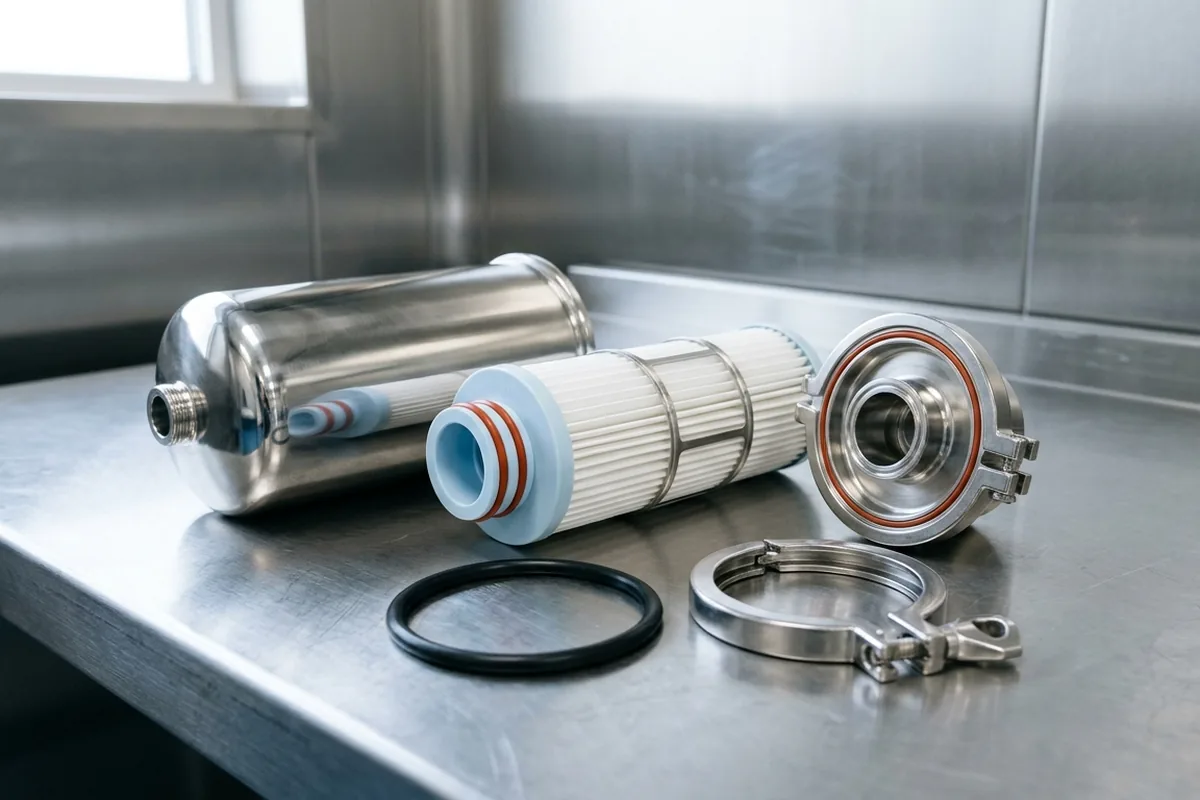
Filter housings, media grades, and steam sterilization cycles are specified as follows:
- Parker Balston 3-stage sterile air filter systems (combining BX + DX + SA filter grades in 1/4 inch to 1 inch pipe sizes, offering 6-log reduction at 99.9999% efficiency at 0.01 micron) are separated into two series by sanitation environment: the Balston 6000 Series for washdown and/or clean-in-place (CIP) applications and the Balston 2000 Series for non-washdown and non-clean-in-place applications.
- nano-purification PF SD-N sterile air depth filters (models PF 0085 SD-N at 85 scfm and 1/2“ NPT through PF 1150 SD-N at 1150 scfm and 3“ NPT) operate at 0 to 232 psig and 35 to 120°F continuous temperature (257°F maximum sterilizing temperature), using 0.01 micron pleated depth polypropylene elements with positive click-lock dual silicone O-rings inside 1.4301 (304) or optional 1.4404 (316L) stainless steel housings passivated and polished to Ra < 1.6 µm with aseptic EPDM seals.
- Pall sterile air filtration evaluates cartridge microbial removal via liquid bacterial challenge, aerosol bacterial challenge, aerosol spore challenge, and bacteriophage challenge rather than pore size ratings alone; PTFE membrane filters are typically preferred for critical sterile air applications (such as Emflon PFRW and PFW at 60°C [140°F] and Emflon HTPFRW at 100°C [212°F] continuous service), while depth filters are used in dry air applications for higher airflow.
- Sterile compressed air filter elements should be sterilized after every production run or at least after 14 days, can be regenerated between 100 and 200 times depending on grade via in-place steam sterilization (SIP) or autoclave at saturated steam ratios of 250°F (121°C) = 30 minutes, 268°F (131°C) = 20 minutes, or 286°F (141°C) = 10 minutes, and require a preventive maintenance plan recording plant floor location, installation and replacement dates, sterilization/replacement frequency, and spare element inventory location.
Compare the filter housing boundary with our clean-in-place system validation guide and the packaging equipment cleanability review.
Condensate Drains, Pressure Dew Point Drops, and the Differential Pressure Gauge Blind Spot
One cubic foot of compressed air at 100 psig begins as 7.8 cubic feet of free air at atmospheric pressure, and an air compressor delivering 100 scfm ingesting 60°F dew point ambient air introduces approximately 14 gallons of water into the air system over a 24-hour period. Downstream packaging drops are exposed to the following moisture and carryover conditions:
- When compressed air flows through a regulator, nozzle, air knife, or blow-off device at the point of use, rapid pressure reduction causes an expansion temperature drop that can cause water vapor in air dried to a 37°F (3°C) refrigerated dryer pressure dew point to condense into liquid droplets upon discharge in a cool production area.
- When compressed air flows from room-temperature piping into refrigerated food packaging zones with temperatures around -22°F to -40°F (-30°C to -40°C), water condenses, pools, and may freeze if the pressure dew point is not lower than the refrigerated area temperature; piping systems should also avoid drip legs where stagnant water can accumulate.
- Water vapor can diffuse into a positively pressurized compressed air stream delivering -40°F (-40°C) PDP air through semi-permeable thermoplastic tubes and hoses driven by vapor concentration differences, and atmospheric humidity can also be drawn in through leaking fittings, deteriorated seals, cracked tubing, or faulty drain valves during pressure fluctuations or shutdown partial vacuums.
- In a milk products plant aiming for Class 0 compressed air, production air quality was compromised when an older lubricated air compressor was routinely brought online when demand exceeded capacity, an improper check valve and fixed purge cycle degraded desiccant dryer stability during light loads, and a failed condensate drain on the receiver allowed liquid water to enter the distribution network.
Clogged, backed-up, or malfunctioning drains are the leading failure point for air-stream moisture; plants are recommended to test compressed air drains daily in all key system equipment (or install drain alarms), check the air-oil separator annually, and replace inline filters every six months to keep oil carryover below the manufacturer’s three parts per million. Of the ten main contaminants found in a compressed air system, filtration treats nine of them and coalescing filters reduce six of the ten; coalescing filter variants typically use a float drain whereas dry particulate filter variants use a manual drain, and isolation valves must always be opened slowly when pressurizing a filter after servicing so pressure spikes do not rupture the element.
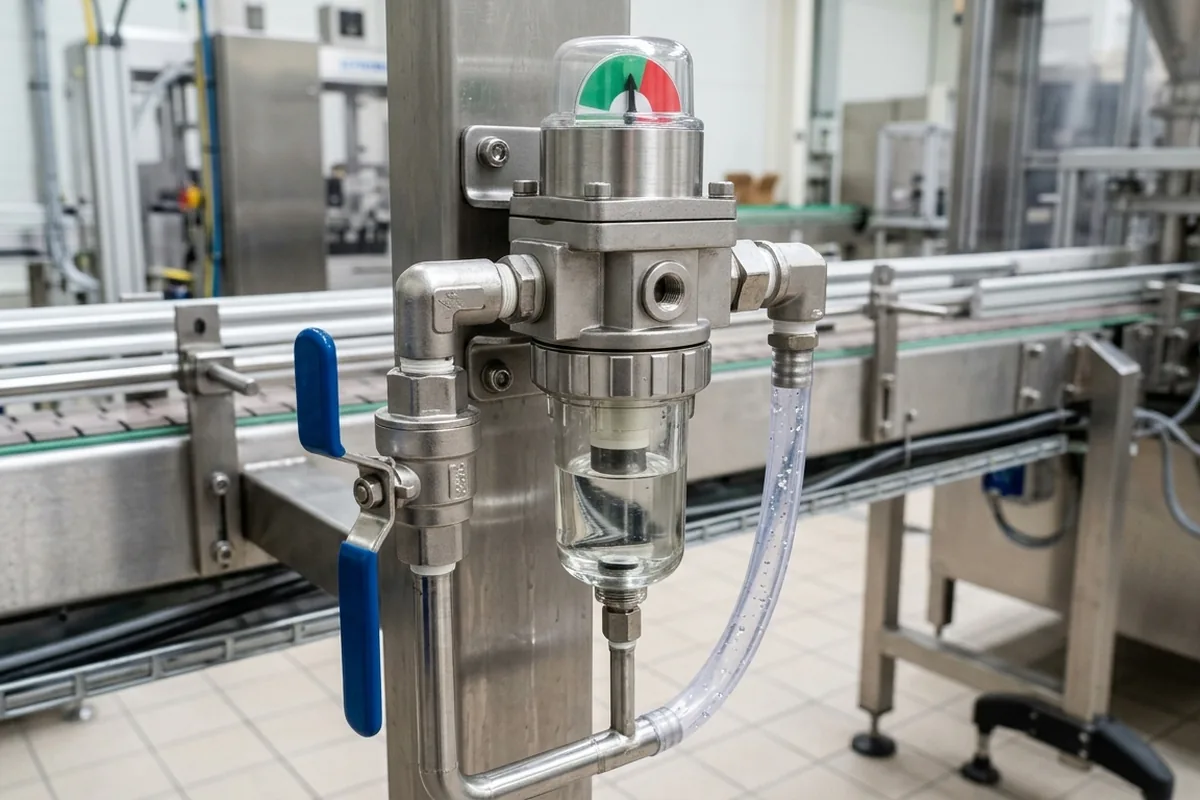
Why a Green Differential Pressure Gauge Does Not Prove Filter Integrity
Differential pressure (dP) monitoring devices fitted to compressed air filter housings are uncalibrated indicators with a typical accuracy of around plus or minus 25% whose true purpose is to indicate premature blockage of a filter element, not to serve as a filter service or air quality indicator; if a filter element tears or ruptures, compressed air takes the path of least resistance so the dP indicator does not move and remains in the green area while contamination passes downstream.
Every 14.5 psi (1 bar) of differential pressure that a positive-displacement air compressor must overcome equals approximately a 7% increase in electrical consumption; furthermore, filter elements cannot be washed with hot soapy water or solvent, cannot be inspected visually because the visible outer layer is the drainage layer and the human eye can only see down to around 40–50 microns, and in-line activated carbon cartridges have a fixed oil-vapor adsorption capacity requiring frequent replacement.
Packaging Blow-Off Air Check and Point-of-Use Audit Evidence Checklist
Use the table below during a packaging blow off air check alongside the packaging line food safety audit checklist and the food equipment evidence checklist.
| Verification Item | Line-Side Physical Check | Documentary Audit Record |
|---|---|---|
| Point-of-use filter placement | Wherever compressed air comes in contact with food, directly or indirectly, filters are in place at point-of-use where the air enters the final section of tubing (not in the compressor room) | SQF Code Edition 8 (November 2017) Module 11.5.5.2 point-of-use verification |
| Packaging zone air line hardware | Pass air through a 0.01 um coalescer, dryer (<= -40 C), and 0.2 um sterile filter without FRL (Filter-Regulator-Lubricator) oil-mist bowls on air lines feeding packaging zones | Filter housing serial tag, differential pressure log, 6-month element replacement record, and ISO 8573-1 Class 1.2.1 test report |
| Sterile element SIP and PM schedule | Sterilize sterile filter elements after every production run or at least after 14 days (regenerated between 100 and 200 times via SIP or autoclave at saturated steam ratios of 250°F [121°C] = 30 minutes, 268°F [131°C] = 20 minutes, or 286°F [141°C] = 10 minutes) | Preventive maintenance plan recording plant floor location, installation and replacement dates, sterilization/replacement frequency, and spare element inventory location |
| Condensate drain and oil carryover PM | Test compressed air drains daily in all key system equipment or install drain alarms to prevent clogged, backed-up, or malfunctioning drains | Annual air-oil separator check and six-month inline filter replacement record to keep oil carryover below the manufacturer’s three parts per million |
| Differential pressure (dP) gauge check | Use uncalibrated dP monitoring devices (typical accuracy around plus or minus 25%) strictly to indicate premature blockage of a filter element | Scheduled element replacement log maintained regardless of a green dP reading because air takes the path of least resistance through a hole, tear, or rupture |
Sources
- U.S. Food and Drug Administration — Current Good Manufacturing Practice, Hazard Analysis, and Risk-Based Preventive Controls for Human Food, Equipment and Utensils
- Donaldson Process Filtration — Food and Beverage Regulatory and Best Practices Overview
- Food Safety Magazine — Point-of-use Compressed Air Filters Help Ensure Product Quality
- Compressed Air and Gas Institute — Compressed Air Purity Guide
- Compressed Air Best Practices — The Importance of Compressed Air Quality in Nitrogen Generation Systems for Food Packaging
- Compressed Air Best Practices — Pressure Dew Point Matters in Food Grade Compressed Air
- Compressed Air Best Practices — Compressed Air and Vacuum System Purity for Food Packaging
- Compressed Air Best Practices — Meeting Compressed Air Quality Specifications
- Compressed Air Best Practices — Sterile Compressed Air Filters Remove Bacteria
- Compressed Air Best Practices — Maintaining Compressed Air Filters and the Purpose of Differential Pressure Monitoring Devices
- Pall Corporation — Sterile Air and Gas Filtration Solutions for Food and Beverage
- Hengst Filtration — Guide to the Quality of Compressed Air for Food Production
- Parker Hannifin / Centro — Food Contact Compressed Air Point-of-Use Filtration Market Application Publication
- Parker Hannifin — Point-of-Use Filtration for Food Processing
- nano-purification solutions — Sterile Air Depth Filters Technical Data Sheet
- Food Safety Audit Notes — Food Safety Audit Checklist for Packaging Lines and Suppliers